Updates, Live

Monday, October 27, 2014

Bert Williams, A Natural Born Gambler (1916)

(The History Blog)
no copyright infringement intended


A Natural Born Gambler from 1916, 22 minutes long, one of the three movies having Bert Williams as director, writer and star. The cinematographer is Billy Bitzer.

A group of black gentlemen, organized in some kind of fraternity or lodge whatever, meets regularly in the back room of a bar to discuss matters of interest, their reunions ending in drinking or gambling or both. However gambling seems to be forbidden those days, so the guys have to be careful not to be discovered by the police. Among them the Honorable Bert Williams, kind of a walking delegate, which means big mouth and vague duties, always in debt and in need of money, always trying to cheat for the pleasure of game, always loosing. On the wall a torn-out image of President Lincoln, like a Deus Otiosus no longer interested in the daily operation of this rapidly decaying world, while seemingly taking pleasure in watching this very movie (he from the wall where's hanging, we from this other side of the screen). Watching this movie is like visiting a nostalgia shop: each scene looks like an incredible memorabilia.

Of course the police discovers the gamblers and brings them in front of the judge. The only one put in jail is (you gotcha) no other than our main hero (only for ten days, it's a comedy, not a drama). While in prison, he plays imaginary poker games, where he keeps on loosing: his pantomime is genial.

The movie comes with all racial stereotypes of the epoch: the rule by then was that the interpret of a black personage had to do minstreling, which meant to shoe-black his face and whiten his lips for the contrast; the intertitles followed another rule, to spell the fractured English supposed to be the blacks' parlance; and many other things like that. No wonder, the movie was made in 1916. It looks now completely anti-PC, but in those days the political correctness was just the opposite.


(Bert Williams)

Labels: ,

Monday, December 03, 2007

New York City Subway


Edward Hopper, Night on the El Train, etching, 1918
(on display at the Hopper Exhibition, Washington National Gallery of Art)

...once upon a time New York Subway was known as the El Train...

(click here for the Romanian version)

My son came to visit me and puzzled a couple of Washingtonians by asking them about the nearest T station. Later that year I went to my son and it was my turn to puzzle a couple of Bostonians: I asked them about the nearest Metro station.

When it comes to naming the underground transit system any given city in America seems to do it in its own way. In Boston it is T. As the train approaches the last station the conductor announces graciously, thank you for riding the T, then he adds, please, don't forget your personal belongings!

In DC the name is Metro. At the last station we are thanked for choosing the Metro and reminded to take all our belongings. Some people listen to this, some don't. So it goes.

In Philadelphia the name is El. As for Chicago, well, the matter seems to be much more complicated: I've just talked to a friend who lives there and he explained me that the El runs in Chicago on the Loop. As simple as that.

John Sloan, Six O'Clock Winter, In New York the subway is called just that: Subway, but in the old times it used to be named the El, too, as it was running on elevated trackage in all Manhattan. John Sloan painted the Six O'Clock Winter in 1912: two parallel worlds, each one with its own dynamics - the people down, the El up. I saw this painting some time ago at an exhibition organized at the Phillips Collection. The two universes living in parallel reminded me of the Fallen Angels of Wong Kar-Wai. There is an image there joining two scenes: the room where the main character is alone, the street in the evening, full of life - each of the two scenes is unaware of the other. A great image: it comes from Chris Doyle, one of the greatest cinematographers of all times.

Another painting, created by John Sloan in 1922, The City from Greenwich Village. So, in 1922 the El was still there, coming from Broadway and crossing the 23rd Street and the Fifth Avenue. The Flatiron Building was on its place since 1902.


London was the first city to have an underground transit system, in 1863. It was followed by Budapest, 1894 (I traveled once on that old line of the Hungarian capital). Then came Paris Metro, in 1900.

As for New York there was an attempt to start a pneumatic subway line in 1869 (the Beach Pneumatic Transit, under Broadway, between Warren and Murray Streets).

It didn't surpass the status of a mere curiosity; some apocryphal stories claim that the abandoned line still exists and mysterious events take place every now and then. Actually it remained only in the New York folklore and in some New York restaurants as a mural image:


The real underground system in New York started operation on October 27, 1904, almost 35 years after the opening of the first elevated line (Wikipedia). The underground line was between City Hall and Grand Central Station.

It was Billy Bitzer who made a short movie in 1905, Interior NY Subway, 14th Street to 42nd Street, for the American Mutoscope and Biograph Company.


The camera platform was on the front of a train following another train on the same track. Lighting was provided by a specially constructed work car on a parallel track. The ride was from the 14th Street (Union Square) up tot the 42nd Street (Grand Central Station) (I followed here the summary as provided by the Library of Congress, where the original is kept).

The stations look today pretty much the same they looked from the very beginning. Only the Grand Central Station is not the same. In 1905 the station was the one built by Cornelius Vanderbuilt in 1869; the station in use today would be inaugurated in 1913. Anyway, New York stations keep their old style (the same as it is on the old subway line in Budapest). Look for instance at this Art Nouveau 14st Street Eagle:


And the legacy is visible even in the way the lines are referred either by numbers or by letters, as it was from the beginning, when several companies were managing separate subway networks.

Coming back to the movie, it seems a banal documentary. It is much more, actually, besides the obvious technical performance. A movie six minutes long, exactly the time the train takes to run from Union Square to the Grand Central. The movie follows a story from start to conclusion, the story and the movie itself are created step by step in front of us (think at De Brug of Joris Ivens, from 1928, or at his Philips-Radio, from 1931; and think at the movies of Vertov).

The train is here the mysterious personage, running from us, trying to escape, disappearing in the darkness, caught again by our sight, disappearing again; there is a silent story, told only by this dialog between darkness and light, evolving to its logical conclusion: the platform on Grand Central, full of greatly dressed passengers. The story is perfectly balanced, one more image would be no more necessary.

The lighting device is not hidden and so we follow in the same time the story of the movie itself: its creation comes in front of our eyes in the dialog between the train from the movie and the platform following with the light on the parallel track. Think again at Chelovek s kino-apparatom of Vertov!

I mentioned earlier the name of Chris Doyle. I think the three greatest cinematographers in movie history could be considered Billy Bitzer (who worked with Griffith), Eduard Tisse (who worked with Eisenstein) and Chris Doyle (who works with Wong Kar-Wai).

(New York, New York)

(Early Movies)

(Hopper)

Labels: ,

Thursday, November 29, 2007

Skyline of Manhattan - The Hoffmannesque City


(click here for the Romanian version)

I remember the first time I saw Manhattan's skyline: I was coming from Boston with the Greyhound. The skyscrapers appeared suddenly: it was like a huge stone forest; it was more than that: the absolute forest. The feeling was brutal: the uniqueness of New York; no possible reference; the city could be defined only by itself. Even to say that it was the total Metropolis would have been inappropriate. It was New York, period.

I was traveling by Amtrak two weeks ago, from DC to Boston. Soon after the train left the Penn Station in New York, we had the view of Manhattan's skyline. The view lasts for about five minutes, as the train is running slowly on the elevated rail trackage, over Brooklyn and Queens. No more brutal feeling, I know now the city, the view of the skyscrapers became familiar to me.

I tried several shots. It was in the afternoon. A storm was approaching, the sky was grey, there was a kind of dark hallo in the air. I knew that my photos would be somehow sullen, but I was very enthusiast and I tried to record also a video. Here is what I got:


Actually I liked the dark hallo of the air, as I was thinking of one of the most amazing short movies that I had seen ever: Panorama from the Tower of Brooklyn Bridge.

It was filmed in one day, April 18, 1899, for the American Mutoscope and Biograph Company; the official birthdate of the movie was much later, September 12, 1903, when the proprietary company released it.

A movie of only 38 seconds: the view was taken from the tower on the Brooklyn side of the bridge. As the film begins, the camera is looking southwest, towards the southern tip of Manhattan (the Battery). The camera pans very rapidly north following Manhattan's East River shoreline, across the bridge span itself and the bridge's New York side tower, following the shoreline further north towards Corlear's Hook, where the film ends. Some visible landmarks include the Fulton Fish Market buildings at Fulton and South Streets (currently the site of the South Street Seaport Museum); north of the bridge tower is the Catherine Slip, where a Catherine Street Ferry is docked (the summary as it was prepared by the researchers from the Library of Congress).

The author was one of the greatest cinematographers of all times, Billy Bitzer. He is famous for what he achieved in The Birth of a Nation and Intolerance, but you should see also his short movies from the first years of the twentieth century. It's a huge treasure of jewels.

Here you can watch the movie (the original version is at the Library of Congress):


The pelicula is a bit decayed, only this is fortunate: the blurred image creates a genuinely Avant-Garde effect. It's a gem.

And I was dreaming to achieve that blur in my photos and videos!

A couple of days after I was traveling back from Boston. It was now late, towards evening. I tried again some shots and a new video. The city was looking again dreadful with endless nuances of darkness among weird clouds playing with the stone forest of skyscrapers: the natural site for fantastic stories imagined by someone like E.T.A. Hoffmann.


(New York, New York)

(Early Movies)

Labels:

Friday, October 26, 2007

Un film esential - Intolerance

Lilian Gish in IntoleranceO tanara mama, alaturi de pruncul aflat in leagan. Imaginea revine de nenumarate ori in Intolerance, filmul lui Griffith, facut in 1916. Scena leaga intre ele episoadele filmului, desfasurate fiecare in spatii geografice extrem de diferite si in perioade istorice extrem de diferite. Sa observam ca imaginea tinerei mame aflata langa pruncul din leagan nu are o localizare in timp sau spatiu: imaginea aceasta este liantul filmului tocmai pentru ca poate fi oriunde si oricand. Este imaginea esentiala a rostului vietii, ne spune Griffith. Viata inseamna dragoste care creaza.
Tanara mama este interpretata de o actrita celebra a acelor ani, Lilian Gish. In maini tine o carte. Este greu, desigur, sa vedem titlul cartii. Diversi comentatori ne asigura ca este un volum de versuri: Leaves of Grass, al lui Walt Whitman. Iar cartea este deschisa la un poem intitulat Out of the Cradle Endlessly Rocking:
Out of the cradle endlessly rocking,
Out of the mocking-bird’s throat, the musical shuttle,
Out of the Ninth-month midnight,
Over the sterile sands, and the fields beyond, where the child, leaving his bed, wander’d alone, bare-headed, barefoot,
Down from the shower’d halo
Asocierea imaginii din film cu versurile avantate ale lui Whitman creaza un contrapunct superb. Pruncul va parasi leaganul ca sa isi traiasca din plin viata, dar aici este inceputul vietii, este esenta din care se va dezvolta totul:
Out from the patches of briers and blackberries,
From the memories of the bird that chanted to me,
From your memories, sad brother—from the fitful risings and fallings I heard,
From under that yellow half-moon, late-risen, and swollen as if with tears,
From those beginning notes of sickness and love, there in the transparent mist
Iar filmul este despre opozitia dintotdeauna intre aceasta imagine esentiala a vietii si raspunsul pe care il da societatea. Intoleranta, oarba la esenta vietii, distrugand viata. Societatea care distruge Evanghelia Iubirii in numele Legii si care distruge Iubirea in numele Evangheliei. Razboaiele dintre cei care cred in Isus si cei care cred in Iisus. Societatea care distruge zeii tai pentru a pune in loc zeii mei. Terorizarea saracilor in numele operelor de binefacere.
----------------------------
Iar imaginea tinerei mame, langa pruncul din leagan, revine, mereu si mereu:

From the thousand responses of my heart, never to cease,
From the myriad thence-arous’d words,
From the word stronger and more delicious than any,
From such, as now they start, the scene revisiting,
As a flock, twittering, rising, or overhead passing,
Borne hither—ere all eludes me, hurriedly,
A man—yet by these tears a little boy again,
Throwing myself on the sand, confronting the waves,
I, chanter of pains and joys, uniter of here and hereafter,
Taking all hints to use them—but swiftly leaping beyond them,
A reminiscence sing.
---------------------------------------------
Daca e sa incerc o ierarhizare, Intoleranta mi se pare mai important decat Potemkin sau Octombrie, pentru ca le premerge.
Sigur, Eisenstein, la zece ani dupa Griffith, e matur, putem vedea filmele lui fara sa zambim ingaduitori - filmele lui nu dau nici un semn de batranete. Si este apoi o alta deosebire: sentimentalismul filmului lui Griffith si patosul filmelor lui Eisenstein.
Intoleranta este plin de naivitatile inceputului, de melodrama - este pe de alta parte extrem de ambitios - ceea ce poate ca il aduce periculos de aproape de ratare (dar ii da si marca geniului) - insa tot mestesugul cu care ma delecteaza filmele lui Eisenstein - ei bine, totul, se afla acolo, in Intoleranta.
Ritmul fantastic - filmul dureaza trei ore, mergand in paralel pe patru naratiuni - in America inceputului de secol, in Iudeea Evangheliilor, in Parisul Noptii Sfantului Bartolomeu, in Babilon - nu te plictistesti, nu te enerveaza toata naivitatile si ingrosarile, nu te enerveaza didacticismul evident - in primul rand pentru ca ritmul viguros al filmului nu iti da o clipa de ragaz. Iar David Wark Griffih trece genial dintr-o poveste in alta, are grija sa le evolueze in acelasi tempo - si are siguranta trecerii de la filmarea de departe la close-up - si are mai ales geniul scenelor de masa - furnicarul de oameni aia care se misca apoi in Potemkin si in Octombrie, se misca magistral mai intai aici, in Babilonul inchipuit de Griffith - si are suflu, nu si-l pierde, exact cum Eisenstein va avea acelasi suflu peste zece ani - respiratia unui atlet, a unei locomotive, vigoare.
Iar scena marii piete publice din Babilon, filmata de sus, cu miscarea oamenilor peste tot, pe scari (scarile din Potemkin sunt deja acolo, in Babilonul lui Griffith), pe marele platou, pe balcoanele palatelor - poate ca este cea mai extraordinara scena de masa din toata istoria filmului. Sigur ca Griffith isi imparte meritele cu cameramanul, Billy Bitzer.
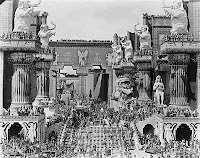

Marea scena de pe platoul BabilonuluiTrei mari regizori care au avut alaturi de ei trei mari cameramani: Griffith cu Billy Bitzer, Eisenstein cu Eduard Tisse, Wong Kar-Wai cu Chris Doyle. Ei au creat acele cateva momente esentiale care marcheaza istoria cinematografului.
Da, Intoleranta este un film esential. Se gaseste pe web, impartit in trei bucati de cate o ora - partea intaia, a doua si a treia.


(Filmele Avangardei)

Labels: