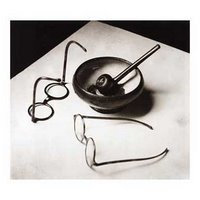
 Through its simple means, pure abstract art can attain the objectivity of ornament, the purity of geometric construction, the spontaneity of the child. But to be art, the subjective must be manifested through the objective, the apparently mathematical must be free, spontaneity must be consciously expressed.
Piet Mondrian, 1929
I was today at the Phillips Collection to see again the two compositions by Piet Mondrian they have there. Geometrical abstractionism? Minimalism? His compositions consist of rectangular forms of red, yellow, blue, or black, separated by thick, black, rectilinear lines. What is there, beyond this extreme simplicity?
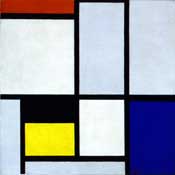 I believe
, said Mondrian,
it is possible that, through horizontal and vertical lines constructed with awareness, but not with calculation, led by high intuition, and brought to harmony and rhythm, these basic forms of beauty, supplemented if necessary by other direct lines or curves, can become a work of art, as strong as it is true.
Mondrian's art is intimately related to his spiritual preoccupations - he was extremely interested in theosophy. Helena Blavatsky (her work had a profound influence over Mondrian) believed that it was possible to attain a knowledge of nature more profound than that provided by empirical means. How?
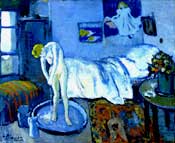
If we look for the reality, then we should free ourselves from the tyranny of objects - and while the literature language is one of words, the language of music is one of sounds - so, the language of paintings should be one of shapes and colors - to see through them the reality beyond the objects - is that the lesson taught by Mondrian?The two compositions by Mondrian are to be found usually in the same room with a couple of works by Paul Klee, and a splendid Blue Room, by Picasso.
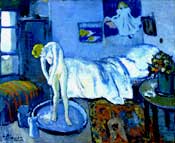
Only today the arrangement was changed. The Blue Room of Picasso was in another place - and the works of Klee were also moved - there was a Paul Klee exhibition, with works gathered from different American museums and collections.
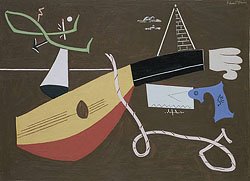
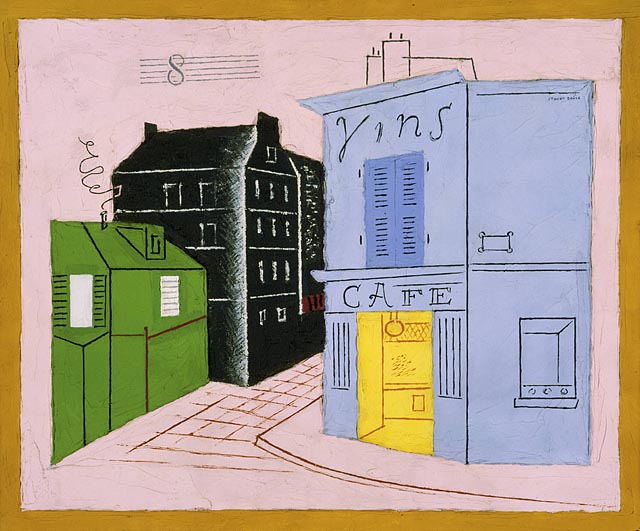
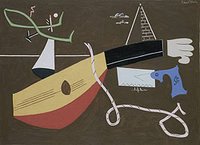 Today I found Mondrian in the company of Stuart Davis (Still Life with Saw). Two other works of Stuart Davis (Blue Cafe and Corner Cafe) were in another place, near a room devoted entirely to Soutine.
Phillips - the collection of masterpieces in downtown DC - Giacometti, de Kooning, Pollock, Gottlieb, Noland, Modigliani, Matisse, Cezanne (Mont Sainte Victoire, reminding me by some curios association the Mount Fuji of Hokusai), Braque, Rouault (with a portrait of Verlaine), Degas, Vuillard, Bonnard, Redon, Van Gogh ...Siskind, Kline ... a Repentant Saint peter by El Greco, and a replica by Goya ...
And I like John Sloan with his Staten Island ferry-boat.
And the Rothko room ... they had in mind the Mark Rothko - Barnett Newman Chapel from Houston, Texas, that I saw only in albums.
At the entrance of the Collection, a bronze by Arp, a Helmeted Head, with strong influence of Brancusi.
As for Paul Klee, let's talk about him in another post ...
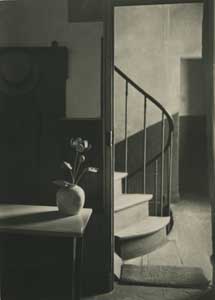
(Phillips Collection)Labels: Kertesz, Mondrian
 Piet Mondrian: Broadway Boogie Woogie, 1942-43