Updates, Live

Tuesday, October 28, 2014

Orhan Pamuk, Ante los Ojos de Occidente

El País - El Boomeran(g)
no copyright infringement intended


A text by Orhan Pamuk about the vision of Istanbul that Western travelers have had for centuries.  He explains his love/hate relationship with Western comments and criticisms. It was published in Carta magazine:


(Pamuk)

(Una Vida Entre Libros)

Labels:

Saturday, February 01, 2014

Hüzün

(http://vaktihuzur.wordpress.com/2010/02/11/huzun-guzeldir/)
no copyright infringement intended

Hüzün güzeldir.
Hüzün biraz isyandır, biraz rıza.
Hüzün zordur.
Hüzün güçlüdür.
Hüzün sızıdır. İnce, keskin, sivri.

Sadness is beautiful
Sadness is a little rebellion, a little pleasure.
Sadness is difficult.
Sadness is strong.
Sadness is yours. Thin, sharp, pointed to none.

Hüzün is a magical word, and when it comes to Istanbul, it suggests the old Bosporus ferries moored to deserted stations in the middle of winter, as Pamuk says in his Istanbul: Memories and the City.

Joshua Hammer had the privilege to walk one evening throughout Istanbul guided by Pamuk, beyond the tourist sights, observing a place of epic history and deep personal associations. It was a marvelous experience and I found its narrative in today's NY Times. It is worth reading, a great description.

What would be, beyond the tourist sight, the most interesting spot in Istanbul? Each Istanbulite should have its own choice, based on her or his deep personal associations. For Orhan Pamuk, it is Sahaflar Çarşisi, the used-book bazaar that has been a magnet for literary types since the Byzantine era (http://www.nytimes.com/2014/02/02/travel/orhan-pamuks-istanbul.html).


leafing through a book at Sahaflar Çarşisi
photo: Ayman Oghanna for NY Times
no copyright infringement intended


(Pamuk)

Labels:

Thursday, March 22, 2012

Ut Pictura Poesis

Sofonisba Anguissola, Selfportrait, 1556
(Selfportrait at the easel, painting a devotional scene)
Łańcut Castle
no copyright infringement intended
(http://en.wikipedia.org/wiki/File:Self-portrait_at_the_Easel_Painting_a_Devotional_Panel_by_Sofonisba_Anguissola.jpg)


Ut pictura poesis; erit quae, si propius stes,
te capiat magis, et quaedam, si longius abstes;
haec amat obscurum, uolet haec sub luce uideri,
iudicis argutum quae non formidat acumen;
haec placuit semel, haec deciens repetita placebit.

I came to the Horatian stanzas while reading a book by Pamuk: The Naive and the Sentimental Novelist. I bought the book last Sunday and I started reading it, leaving aside other books. It puts Horatian stanzas in paradox.

Pamuk used in his book the English rendering of Ars Poetica given by D.A.Russell. I'll give you here the version of A.S.Kline:

Poetry’s like painting: there are pictures that attract
You more nearer to, and others from further away.
This needs the shadows, that to be seen in the light,
Not fearing the critic’s sharp eye: this pleased once,
That, though examined ten thousand times, still pleases.

Is literature a painting made of words? Ut Pictura Poesis: Pamuk follows here Lessing who says in Laocoön that painting is a synchronic art operating with space while poetry is diachronic and operates on time.

W.J.T.Mitchell says it bluntly, we tend to think that to compare poetry with painting is to make a metaphor, while to differentiate poetry from painting is to state a literal truth.

Then what about music? I think we should be very careful, each artwork creates a universe: an illusory world in which time and space are ultimately equivalent, because of the relations, among places in space, among moments in time, that's what matters, and these relations are of the same nature.

Here is a Romanian rendering of the Horatian stanza:

Ca si pictura-i poema; te-atrage vreuna de-aproape,
Alta te-ncanta mai mult daca stai s-o privesti de departe;
Una prefera intuneric; alta voieste lumina,
Ne-nspaimantata deloc de parerea acerbului critic;
Una odata-a placut, insa alta mereu o sa placa.
(trad de Ionel Marinescu, Ed. Univers, Bucuresti, 1970)

(Horace)

(Pamuk)

Labels: ,

Orhan Pamuk


(A Life in Books)

Labels:

Sunday, May 25, 2008

The Oldest Turkish Poem

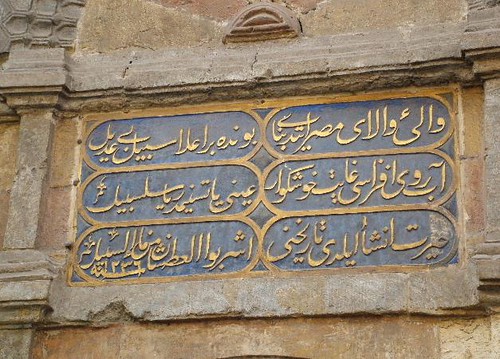
Carved Turkish poem on the wall of Sabeel Mohammad Ali , Cairo


The Divan of the Lover

All the universe, one mighty sign, is shown;
God hath myriads of creative acts unknown:
None hath seen them, of the races jinn and men,
None hath news brought from that realm far off from ken.
Never shall thy mind or reason reach that strand,
Nor can tongue the King's name utter of that land.
Since 'tis his each nothingness with life to vest,
Trouble is there ne'er at all to his behest.
Eighteen thousand worlds, from end to end,
Do not with him one atom's worth transcend.


I am posting this poem as a homage to Pamuk: his unbelievable stories are universes of charms and miracles.

(Pamuk)

Labels:

Thursday, November 08, 2007

Chesapeake Bay, Dreaming Bosphorus

Chesapeake Bay

I'm in the train, reading a novel written by Orhan Pamuk. I'm tired, sometimes closing my eyes, imagining Bosphorus and Istanbul. I've never been there. Day's light is vanishing. The train is just passing on a bridge over some part of Chesapeake Bay. A place where God seems to reveal His Face.

How would sound a book about the Bay, if written by Pamuk?


Chesapeake Bay
Chesapeake Bay
Chesapeake Bay


(Washington, District of Columbia)

(Pamuk)

Labels: