Updates, Live

Monday, October 31, 2016

Singapur: Coches autónomos, niños que juegan con drones y robótica universalizada


(Blogosphere)

Labels:

Friday, September 30, 2011

NY Times: a Column by Siddhartha Deb


Once upon a time some place in India there was a guy who was riding daily his bicycle everywhere he needed to go. Sometimes he was carrying also his wife on the crossbar. Both of them were happy, life was good. As the wife was advancing in age, her tummy was taking proportions and one day she felt from the bicycle. Funny to watch the scene from some distance, but for him: the wife got furious and accused him to be good of nothing.

This was once upon a time, which in India means in the early nineties. Meanwhile the consumer society penetrated there as everywhere, together with cheap credit, malls and automobile culture.

In many ways, the marriage between the Indian middle class and the automobile culture has been disastrous: roads remain awful, drivers continue to be erratic, and traffic in cities like Delhi and Bangalore is worse than ever; and yet the car has become deeply enmeshed with upward mobility, while also complicating this mobility, says Siddhartha Deb (author of The Point of Return and The Beautiful and the Damned: A Portrait of the New India). And he continues, the distinction used to be between those who owned cars and those who didn't, while now distinctions are parsed in terms of the model one owns.
Here is his column in today's NY Times:


(A Life in Books)

Labels:

Saturday, July 30, 2011

Turkey: Top Military Leaders Resign


Turkey’s top commander, Gen. Isik Kosaner, together with the leaders of the navy, army and air force, simultaneously resigned in protest over the sweeping arrests of dozens of generals as suspects in conspiracy. It's a very important moment in the history of modern Turkey, so far characterized by the preeminence of the military as a controlling force over the state.


(Zoon Politikon)

Labels:

Sunday, January 30, 2011

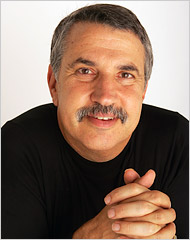
Tom Friedman: Serious in Singapore

Thomas L. FriedmanSingapore probably has the freest market in the world; it doesn’t believe in import tariffs, minimum wages or unemployment insurance. But it believes regulators need to make sure markets work properly — because they can’t on their own — and it subsidizes homeownership and education to give everyone a foundation to become self-reliant. The two isms that perhaps best describe Singapore’s approach are: pragmatism — an emphasis on what works in practice rather than abstract theory; and eclecticism — a willingness to adapt to the local context best practices from around the world. Singapore has a multiethnic population — Chinese, Indian and Malay — with a big working class. It has no natural resources and even has to import sand for building. But today its per capita income is just below U.S. levels, built with high-end manufacturing, services and exports. The country’s economy grew last year at 14.7 percent, led by biomedical exports. Tom Friedman has this op-ed in today's NY Times:


(Zoon Politikon)

Labels: ,

Sunday, January 16, 2011

Nicholas D. Kristof: China's Winning Schools

An international study about student performance in math, science and reading placed in top four countries. Only one of them was non-Confucian: Finland. The other three were China, Hong Kong and Singapore. As for US, 15th in reading, 23rd in science and 31st in math. Well, someone has to be the 15th, isn't it? You cannot have all countries to be the 1st.

Says Nicholas D. Kristof in today's NY Times, Americans think of China’s strategic challenge in terms of the new stealth fighter aircraft, while the real challenge is the rise of China’s education system and the passion for learning that underlies it; we’re not going to become Confucians, but we can elevate education on our list of priorities without relinquishing creativity and independent thought.

Read more in:


(
Zoon Politikon)

Labels: ,

Thursday, November 04, 2010

Tomorrow is Diwali


Diwali, the Festival of Lights: the term is a contraction from the Sanskrit word दीपावली (Dīpāvali) which means row of lamps. It involves the lighting of दीप (divas): small clay lamps filled with oil, to celebrate the triumph of good over evil. It's a rejuvenation, starting life again: celebrants wear new clothes and share sweets with family and friends. It is the awareness of आत्मन् (Ātman), your inner light, beyond your material senses, pure, infinite, and eternal.

It is the most important celebration in India, with significance in all major religions there.

I am happy with all my Indian friends, for them, and with them, I wish them, also I wish for myself, Happy Diwali! Let's enjoy the great celebration of Light!

(Blogosphere)

Labels:

Tuesday, November 02, 2010

Fareed Zakaria: Mr. President, Asia Is Calling

It was easy to welcome the rise of China when it was an abstraction. Now that it is a reality, the geopolitics of Asia will get interesting.

You should read this op-ed of Fareed Zakaria in Washington Post...


(for any comments you should eMail Mr. Zakaria at comments@fareedzakaria.com)


(
Zoon Politikon)

Labels: ,

Monday, November 01, 2010

Brazil Elects First Female President


Dilma Rousseff won with 56% of the votes the runoff on Sunday, which makes her the first female president of Brazil (PBS / The News Hour).

The daughter of a Bulgarian immigrant, she is an economist by profession.

She was in the sixties a guerrilla rebel fighting the military regime. After Brazil came back to a civil government, Dilma Rousseff has activated in the socialist movement. She was the chief of staff of outgoing president Luiz Inácio Lula da Silva.


(
Zoon Politikon)

Labels:

Monday, August 16, 2010

China Surpasses Japan as No. 2 World Economy


W. Post: Japan lost its place to China as the world's No. 2 economy in the second quarter of this year. It happened also before in some quarters, this time the lead seems to become insurmountable.

Read more in W. Post...

Read also this column in NY Times, on the same topic...


(
Zoon Politikon)

Labels:

Tuesday, July 27, 2010

NY Times: China Pushes to End Public Shaming of Suspects

A shame parade of suspected prostitutes in the southern city of Shenzen in 2006
(China Daily via Reuters)


NY Times: The Chinese government has called for an end to the public shaming of criminal suspects, a time-honored cudgel of Chinese law enforcement but one that has increasingly rattled the public. Read more...


(
Zoon Politikon)

Labels:

Monday, July 26, 2010

Two Columns From Today's Washington Post

A Chinese delegation visits the Acu port in Sao Joao da Barra, Brazil. China is on track to become Brazil's No. 1 investor in 2010, with Chinese investment in Brazil topping $20 billion in the first half of this year (Getty)


2009: China was the 29th investor in Brazil. 2010: China is becoming the investor #1 in Brazil. In the past decade China was making a worldwide effort to extract resources to use in its own manufacturing sector. Today China is pushing aggressively toward investing in industries overseas having in mind an economic & political agenda. John Pomfret has this column in Washington Post...

------------------------------------

You should read also this column by Jackson Diehl, who is warning about the lack of vigorous U.S. help for the Mexican administration in its efforts to curb the drug war. Says Mr. Diehl, since the end of the Cold War, neglect of Latin America has become something of a fine art in Washington, practiced by Republican and Democratic administrations alike. But even in that context, the disregard for Mexico over the past couple of years is kind of astonishing. The fact is that U.S. should be aware that it is facing a profound crisis in the immediate vicinity. Read here the whole column...

A policeman runs after a car-bomb attack in Ciudad Juarez, Mexico, this month (AP)


(
Zoon Politikon)

Labels:

Friday, January 01, 2010

First Post in 2010: Swan Lake Performed by the Chinese State Circus

Swan Lake performed by the Chinese State Circus:


(Blogosphere)

Labels:

Tuesday, December 29, 2009

Let's Meet With Bangalore

Some of my best friends live in Bangalore, a great city, striving of modernity, offering also hidden spots of charm and relaxation.


(Blogosphere)

Labels:

Friday, December 18, 2009

Yegor Gaidar Passed Away


Yegor Gaidar passed away at the age of 53. Death was due to pulmonary edema caused by his heart disease.

During the nineties Mr. Gaidar was the main architect of the shock therapy in Russia. Many of his compatriots associate him with the miseries of that decade. Maybe some day Russian society will realize that Yegor Gaidar did what should have been done, and did it with courage, determination and wit. Says Washington Post, he freed prices, knowing that some people's meager savings would be wiped out, because there was no other way to get goods to market; he favored rapid privatization, knowing that the only people with capital to invest were, by Soviet definition, criminals, because he had faith that property-holders would begin to understand the importance of the rule of law; he always defended his program with logic and honesty against enemies who bothered with neither; his program brought less success than similar policies applied in Poland and other central and eastern European countries; he made mistakes, of course; but he also faced ferocious opposition from unrepentant communists and inconstant support from Mr. Yeltsin; having spent a generation longer under communism, Russia had a deeper hole to dig out from; and while outposts of the Soviet empire could blame Russia for their unhappiness during the difficult transition to capitalism, Russians, having no such ready scapegoat, found it convenient to blame Mr. Gaidar. Says Andrei Ostalski from BBC, there were only two solutions - either introducing martial law and severe rationing, or radically liberalizing the economy; the first option meant going all the way back to the Stalinist system of mass repression; the second meant a colossal change, a journey - or, rather, a race - through uncharted waters with an unpredictable outcome.

What happened in Russia after the nineties? Vladimir Putin (favored by soaring oil prices) spurned Gaidar's views and embraced nationalism and authoritarian governance. Still, says Washington Post, it would be wrong to label Mr. Gaidar a failure. The middle class he dreamed of has indeed emerged in Russia, and it enjoys a kind of personal freedom unknown in previous Russian history.

(Zoon Politikon)

Labels:

Monday, December 14, 2009

Brazil's Headaches

Sebastian Mallaby in Washington Post:

The country of the moment is Brazil, that melting pot of almost 200 million people. A thriving democracy, it has a hugely popular president and rapidly falling poverty. It recently won contests to host soccer's World Cup and the 2016 Olympics. It is opening diplomatic missions all over the world. Its economy was one of the last into the financial crisis and one of the first to escape. And yet Brazil's achievements are vulnerable. To keep its marvelous success on track, Brazil may have to do something that horrifies its diplomats: Confront China.

Brazil's vulnerability comes from its currency, the real, which has jumped by a third against the dollar in the past year. A further rise could undermine exporters and make it impossible for domestic producers to compete with cheap imports, puncturing the vitality on which the Brazilian miracle is predicated. And a further rise seems all too possible. The forces driving up the real are not about to reverse themselves.

The first driver is the fragility of the U.S. economy, which causes the Fed to hold down interest rates, inducing capital to seek higher returns elsewhere. Brazil is a favorite destination: Its interest rates are high and financial conditions inspire confidence. Most forecasters expect the U.S. recovery to remain sluggish for the foreseeable future. So the logic of low U.S. interest rates probably won't change, and the upward pressure on the real is likely to continue.

The second force driving up the real is China. If economic logic prevailed, the real would fall against the Chinese yuan: China has a vast current account surplus, while Brazil has a deficit. But last year China re-pegged its currency to the dollar, so the yuan has followed the dollar down, hammering Brazil's ability to compete against Chinese producers. Meanwhile, the illogically weak yuan hurts producers in other countries, encouraging central banks to keep interest rates low and driving yet more capital into Brazil. This pressure from China is likely to grow along with China's economy.

What can Brazil do about its rearing currency? It could cut interest rates to deter money from coming in, but Brazil's economy is hot and lower rates would risk inflation. It could fight capital inflows with taxes -- it has already experimented with this option -- but such restrictions tend to leak like umbrellas made of icing. It could intervene in the foreign-exchange market, selling reals and buying dollars, but then scarce Brazilian savings would get tied up in the depreciating greenback. Or Brazil could protect its industry with tariffs. But protectionism could spark a cycle of retaliation.

The grim truth is that Brazil's domestic tools aren't powerful enough to stop its currency from threatening its success. So what about diplomacy? Asking the United States to raise its interest rates and take pressure off the real is a non-starter. With U.S. unemployment around 10 percent and an additional 7 percent of the U.S. workforce obliged to get by on part-time jobs, there is no way the Fed can raise interest rates to rescue Brazil from its predicament.

That leaves the option of talking to China. Unlike the Fed, China's central bank has good reasons to raise interest rates and abandon its peg to the declining dollar. The peg is distorting the Chinese economy and causing the nation to amass dollar reserves that are destined to lose value. Admittedly, China's political leaders have overruled the technocrats who would like to modify the exchange-rate peg, and they have ignored appeals from the United States and Europe. But the Chinese leadership might be more open to arguments from a successful emerging economy such as Brazil, especially if the Brazilians rounded up support from other middle-income members of the Group of 20.

Unfortunately, Brazil has no stomach for arguments with China. Its diplomats prize solidarity among the emerging "BRIC" nations (Brazil, Russia, India and China), even when that solidarity could threaten the growth on which Brazil's BRIC status is premised. And for the moment, Brazil's currency squeeze is not quite severe enough to scream for attention. The economy is expected to grow by a respectable 3.5 percent or so next year, and Brazil has done so well of late that it seemingly has no time to worry about problems.

On a recent Sunday in Sao Paulo, when Brazilians were reveling in the final day of the soccer season, a gang tunneled into the building of an armored-car company and blew open a safe, making off with nearly $6 million. Security guards heard the explosion but did nothing, assuming the noise came from soccer fans celebrating a goal with particularly tremendous fireworks. Perhaps there is a lesson here. Moments of rejoicing can be moments of trouble.

(Zoon Politikon)

Labels:

Sunday, November 29, 2009

Pankaj Mishra: India's Eternal Crisis


Pankaj Mishra is an Indian essayist and novelist born in 1969 in Uttar Pradesh. His book Butter Chicken in Ludhiana is a sociological study of small-town India. Mr. Mishra is known for his literary and political essays published in NY Times, W Post, The Guardian, New Statesman, among others. A recent book of his is Temptations of the West: How To Be Modern in India, Pakistan, Tibet and Beyond.

Here is an essay by him, published in today's NY Times:

On the evening of Sept. 11, 2001, I hurried through a dark apple orchard to the nearest television in this Himalayan village. My landlord opened his door reluctantly, and then appeared unmoved by the news I had just received by phone. I struggled to explain the enormity of what was happening, the significance of New York, the iconic status of the World Trade Center — to no avail. It was time for his evening prayers; the television could not be turned on.

I did not witness the horrific sights of 9/11 until three days later. Since then, cable television and even broadband Internet have arrived in Mashobra and in my own home. Now the world’s manifold atrocities are always available for brisk inspection on India’s many 24-hour news channels. Indeed, the brutal terrorist assault on Mumbai that killed 163 people a year ago was immediately proclaimed as India’s own 9/11 by the country’s young TV anchors, who seem to model themselves on Sean Hannity and Bill O’Reilly. Yet, on the first anniversary of “26/11,” it seems as remote as 9/11 to the inhabitants of this village.

There is no great mystery behind this indifference, which is distinct from callousness. India, where most people still depend on agriculture for a living, has just suffered one of its most serious droughts in decades. The outlook for winter crops is bleak; many farmers have committed suicide in recent months, adding to the epidemic of rural suicides over the last few years.

Politically, too, India has lurched from one crisis to another in the last year. Prudent financial regulation saved India from the worst effects of the worldwide economic recession. But the rage of people who feel themselves not only left behind but victimized by corporate-driven and urban-oriented economic growth has erupted into violence; the Indian government has called for an all-out war against the Maoist insurgent groups that now administer large parts of central India. Anti-India insurgencies in Kashmir and the northeast continue to simmer, exacting a little-reported but high daily toll.

Geopolitically, India’s room to maneuver has shrunk since the Mumbai attacks. Last November, middle-class nationalist fury, though initially directed at inept Indian authorities, settled on Pakistan, where the attacks were partly planned and financed. The writer Shashi Tharoor described “India’s leaders and strategic thinkers” as watching Israel’s assault on Gaza last winter with “empathy,” and wondering “why can’t we do the same?” One hopes Mr. Tharoor, who has since become India’s junior foreign minister, is today more aware of why India can’t do a Gaza or Lebanon on its nuclear-armed neighbor.

As Western anxiety about nuclear-armed Pakistan’s stability deepens, India can barely afford aggressive rhetoric, let alone military retaliation, against its longtime foe. Pakistan remains vital to Western campaigns against Al Qaeda and the Taliban. Aware of its strategic importance, Pakistan has been in no hurry to accede to India’s demands to prosecute those it holds responsible for the Mumbai massacre. (One hopes the charges filed against seven radicals on Wednesday mark a real change.) Islamabad has also upped the rhetorical ante by accusing India of backing the violent secessionist movement in Baluchistan, in western Pakistan.

India’s seeming impotence enrages those in the new right-wing news media who are eager to commemorate 26/11, and to make that ersatz shorthand signify India’s unavenged humiliation and shame. Prabhu Chawla, the editor of India Today, the country’s leading newsmagazine, expressed the frustration of many middle-class nationalists: “India, divided by politics, doesn’t know what to do with its enemy or with its much-mauled nationalist soul. We are as clueless as we were on that dreadful November night one year ago.”

That may be true, but in a country where 400 million live without electricity, it isn’t easy to manufacture, or sustain, a national consensus. In any case, things are not as bad as the pundits make out. The lone surviving Mumbai killer is already on trial; his accomplices are being gradually apprehended. There have been no major retaliatory attacks against Muslims. There are stirrings of a civic, even political, consciousness among rich Indians who, until the Mumbai massacre, were largely unaffected by our frequent terrorist bombings.

India may have been passive after the Mumbai attacks. But India has not launched wars against either abstract nouns or actual countries that it has no hope of winning or even disengaging from. Another major terrorist assault on our large and chaotic cities is very probable, but it is unlikely to have the sort of effect that 9/11 had on America.

This is largely because many Indians still live with a sense of permanent crisis, of a world out of joint, where violence can be contained but never fully prevented, and where human action quickly reveals its tragic limits. The fatalism I sense in my village may be the consolation of the weak, of those powerless to shape the world to their ends. But it also provides a built-in check against the arrogance of power — and the hubris that has made America’s response to 9/11 so disastrously counterproductive.

(Zoon Politikon)

Labels:

Tuesday, November 24, 2009

Is India the Forgotten Partner?

Nicholas Burns in today's Boston Globe:

President Obama faces a classic diplomatic challenge in South Asia - how to balance a short-term need for progress in Afghanistan and Pakistan without losing sight of our equally important long-term ambitions with India.

The Obama administration is right to focus on fixing a faltering war in Afghanistan and shoring up a weak and unstable Pakistan. But it has been less attentive to one of the most important bipartisan achievements of the Clinton and Bush years - the creation of a long-term US friendship and partnership with India. Few issues will be more important for Americans in the next half century as the global balance of power shifts toward Asia.


With Prime Minister Manmohan Singh in Washington this week, US-India relations have stalled on some critical issues. Influential Indians complain the Obama administration is diminishing America’s prior strategic priority on India to avoid antagonizing regional rivals Pakistan and China. They worry the Obama team does not embrace the core conviction that India’s dramatic rise to global power is clearly in the US interest.

Some of this criticism may be misguided, if not premature. Obama cannot avoid making the Afghan war a priority. Indians should also not view every American initiative through a zero-sum lens. After all, Obama’s decision to make Singh the first state visitor of his administration is a positive symbolic gesture.

Still, relations between the two countries are strained by important differences on terrorism, climate change, trade, and, potentially, future sanctions against Iran. To be fair, India is a difficult and irresolute partner on some of these issues, particularly climate. But, Obama can act more vigorously to restore the energy on India left to him by his predecessors.

The president has an opportunity during Singh’s visit to present his vision of what Secretary of State Hillary Clinton has called US-India 3.0 - the third phase in constructing a US-India partnership. What should he propose?

First, India is focused on making a dramatic reduction in poverty among India’s 700 million poor. Singh has long called for a Second Green Revolution in India and believes the United States is uniquely capable of helping. Obama could offer assistance from America’s Midwestern land-grant institutions that were pivotal in achieving historic breakthroughs in Indian food production four decades ago.

Second, the president could build on common US-India strengths in education and science by proposing more significant cooperation in space research and environmental technologies that would play to the comparative advantage of our private sectors and the 100,000 Indian students in the United States.

Third, Obama should push for stronger military and strategic ties between the two countries. India is a natural military partner of the United States given our common interest in resisting terrorism in South Asia and beyond. Our navies and air forces, in particular, have trained and worked effectively together in recent years. Our defense ties will be transformed should India decide to purchase advanced American military technology to replace its aging and outdated Russian equipment.

Fourth, the United States should work more actively behind the scenes to urge India and Pakistan to restore their Composite Dialogue, reduce bilateral tensions, and commit to progress on the Kashmir issue. India must be more sensitive to Pakistani concerns over its involvement in Afghanistan while Islamabad should finally prosecute the terrorists responsible for last November’s reprehensible Mumbai attacks. As the United States is now the key power broker in the region, Obama is uniquely positioned to help nuclear-armed India and Pakistan avoid the nightmare fear of war that has bedeviled their relations since Partition in 1947.

Finally, as America looks to a future where China’s growing power will be a central challenge, building this new US-India partnership is fundamental to all we seek to accomplish in Asia. Stronger Indian political and military bonds with the United States, Japan, and Australia are the best way to ensure these democratic powers can balance and limit the potentially dangerous aspects of China’s rise in the decades ahead. And, in a larger sense, India can be our most effective international partner in tackling the daunting array of transnational challenges - climate change, terrorism, nuclear proliferation, human rights, and pandemics, to name some - that are now at the heart of America’s global agenda.

Juggling short-term crisis and long-term opportunity is difficult in a complex and combustible South Asia region. But that is what Obama must now do more effectively as he welcomes Singh to Washington and puts his stamp on this pivotal relationship. He should embrace this moment to restore direction to our partnership with India that has been among the most positive bipartisan foreign policy successes of the last two administrations.

(Ambassador Nicholas Burns is professor in the practice of diplomacy and international politics at Harvard Kennedy School’s Belfer Center for Science and International Affairs. He was undersecretary of state for political affairs)


(
Zoon Politikon)

Labels:

Monday, June 01, 2009

The New World: China, India, Indonesia, Brazil

Fareed Zakaria in W. Post:

Increasingly, the story of the global economy is a tale of two worlds. In one, there is only gloom and doom; in the other, there is light and hope. In the traditional bastions of wealth and power -- America, Europe and Japan -- it is difficult to find much good news. But there is a new world -- China, India, Indonesia, Brazil -- in which economic growth continues to power ahead, governments are not buried under debt and citizens remain remarkably optimistic about their future. This divergence between the once rich and the once poor might mark a turn in history.

Over the past six months, much conventional economic wisdom has been discredited. The experts who spoke confidently about unending global growth -- the boomsters -- have been debunked. But the new pundits of pessimism -- the doomsters -- have demonstrated a similar hubris, ignoring evidence that might complicate their story. Six months ago, stock markets worldwide swooned in unison as the U.S. financial system seemed on the verge of collapse. This led many to conclude that the emerging economies of Asia and Latin America had been growing only because of their exports to the United States and Europe; that they had no independent strengths of their own and probably would collapse faster and more furiously than the sophisticated economies of the West. After all, these were Third World countries.

But a funny thing happened on the way to a global depression. Once the panic that seized global markets abated, there began a fascinating and disparate recovery. The S&P 500 is roughly where it started the year, as is the London FTSE. Japanese stocks have fared better, up nearly 7 percent.

Around the globe, though, markets are humming. China's Shanghai index is up 45 percent, India's Sensex is up 44 percent, Brazil's Bovespa is up 38 percent and the Indonesia index is up 32 percent. Stock markets don't tell the whole story, but many are rising because the underlying economies of most of these countries are still registering significant growth.

Consider: In April, India's car sales were up 4.2 percent from a year earlier. Retail sales in China rose 15 percent in the first quarter of 2009. China is likely to grow at 7 or 8 percent this year, India at 6 percent, and Indonesia at 4 percent. These numbers are not just robust but astonishing next to those of the developed world. The U.S. economy contracted at an annual rate of 6.1 percent last quarter, Europe by 9.6 percent and Japan by 15 percent, something that truly begins to rival the 1930s.

Compare the two worlds. On the one side is the West (plus Japan), with banks that are overleveraged and thus dysfunctional, governments groaning under debt, and consumers who are rebuilding their broken balance sheets. The United States is having trouble selling its IOUs at attractive prices (the past three Treasury auctions have gone badly); its largest state, California, is veering toward fiscal collapse; and the U.S. budget deficit is going to surpass 13 percent of GDP -- a level last seen during World War II. With all these burdens, the United States might not return to fast-paced growth for a while. And its economy is probably more dynamic than Europe or Japan's.

Meanwhile, emerging-market banks are largely healthy and profitable. (All major Indian banks, government-owned and private, posted profits in the fourth quarter of 2008.) The governments are in good fiscal shape. China's strengths are well known -- $2trillion in reserves, a budget deficit below 3 percent of GDP. Brazil is posting a current account surplus. Indonesia has reduced its debt from 100 percent of GDP nine years ago to 30 percent today. Unlike in the West, where governments have run out of ammunition and are praying that their medicine will work, these countries have options. Only a year ago, their chief concern was an overheated economy and inflation. Brazil has cut its interest rate substantially -- but only to 10.25 percent, and it can drop it further if things deteriorate more.

The mood in many of these countries is upbeat. Their currencies are appreciating against the dollar because the markets see them as having more fiscal discipline and better long-term growth prospects than the United States. Their bonds are rising. This combination of positive indicators is unprecedented.

The United States remains the world's richest and most powerful country. Its military spans the globe. But since the Spanish empire of the 16th century, the fortunes of great global powers have begun to turn when they get overburdened with debt and stuck on a path of slow growth. These are early warnings. Unless the United States gets its act together fast, the ground will continue to shift beneath its feet.

(
Zoon Politikon)

Labels: ,

Wednesday, February 25, 2009

Sudip Mazumdar: Man Bites Slumdog


I found this in Newsweek: Sudip Mazumdar tells his own story. A street kid who escaped the horrible universe of slums through his passion for books. It reminds me of Buscapé, the personage who was telling his story of escaping the world of Cidade de Deus. And of course, of Jamal, the hero of Slumdog Millionaire. We should know: a few of them succeed, for the most escaping from the slum remains a fairy tale.

Here is the story:

On the way to see Slumdog Millionaire in Kolkata, I had my cabdriver pass through the slum district of Tangra. I lived there more than 35 years ago, when I was in my late teens, but the place has barely changed. The cab threaded a maze of narrow lanes between shacks built from black plastic and corrugated metal. Scrawny men sat outside, chewing tobacco and spitting into the dirt. Naked children defecated in the open, and women lined up at the public taps to fetch water in battered plastic jerry cans. Everything smelled of garbage and human waste. I noticed only one difference from the 1960s: a few huts had color TVs.

I still ask myself how I finally broke out. Jamal, the slumdog in Danny Boyle's award-winning movie, did it the traditional cinematic way, via true love, guts and good luck. People keep praising the film's realistic depiction of slum life in India. But it's no such thing. Slum life is a cage. It robs you of confidence in the face of the rich and the advantaged. It steals your pride, deadens your ambition, limits your imagination and psychologically cripples you whenever you step outside the comfort zone of your own neighborhood. Most people in the slums never achieve a fairy-tale ending.

I was luckier than Jamal in this way: I was no orphan. My parents came from relatively prosperous families in East Bengal (now Bangladesh), but the newlywed couple lost practically everything in the sectarian riots that led up to India's independence. They fled to Patna, the capital of northeastern India's Bihar state, where I was born a few years later. The first of my five sisters was born there in a rat-infested hut one rainy night when I was 3. My father was out of town, working as a construction laborer 100 miles away. My mother sent me with my 6-year-old brother to fetch the midwife, an opium-smoking illiterate. The baby was born before we got back, so the midwife just cut the umbilical cord with a razor blade and left. My mother spent the rest of the night trying to find a spot where the roof wouldn't leak on the newborn.

My parents got us out of the slums three years later. My father landed a job as a petty clerk with a construction firm that was building a dam, and we found a home. It was only a single rented room, but it was better than anything we had in Patna. I went to school nearby. Sometimes a teacher dozed off in class, and a few of us would sneak out the window to steal ripe guavas from a nearby orchard. If we got caught we could count on being caned in front of our classmates. Sometimes it would peel the skin off our backs. By my early teens I was running with a local gang. Membership was my source of confidence, security and excitement. We stole from shopkeepers and farmers, extorted money from truckers and fought against rivals for turf. Many of my pals came from broken families with drunken fathers or abusive stepmothers. Their big dream was to get a job—any job—with the dam-building firm.

Those days ended abruptly when we challenged a rival gang whose members had teased some girls on our turf. Both sides suffered serious injuries before police arrived to break it up. My parents didn't try to stop me from fleeing town. I made my way to Ranchi, a small city then in southern Bihar. I took on a new name and holed up in a squalid neighborhood. A local tough guy befriended me. He and his partners liked to waylay travelers at night. He always kept me away from his holdups, but he fed me when I had no other food. I also fell in with a group of radical leftists. I didn't care much about ideology, but they offered the sense of belonging I used to get from my old street gang. I spent the next five years moving from one slum to another, always a step ahead of the police. For money I took odd jobs like peddling newspapers and washing cars.

I might have spent the rest of my life in the slums or in prison if not for books. By the time I was 6, my parents had taught me to read and write Bengali. Literature gave me a special refuge. With Jack London (in translation) I could be a brave adventurer, and with Jules Verne I could tour the world. I worked my way up to Balzac, Hemingway and Dostoevsky. I finally began teaching myself English with the help of borrowed children's books and a stolen Oxford dictionary. For pronunciation I listened to Voice of America broadcasts and the BBC World Service on a stolen transistor radio. I would get so frustrated I sometimes broke into sobs.

I started hanging around the offices of an English weekly newspaper in Ranchi. Its publisher and editor, an idealistic lawyer-cum-journalist named N. N. Sengupta, hired me as a copy boy and proofreader for the equivalent of about $4 a month. It was there that I met Dilip Ganguly, a dogged and ambitious reporter who was visiting from New Delhi. He came to know that I was living in a slum, suffering from duodenal ulcers. One night he dropped by the office after work and found me visibly ill. He invited me to New Delhi. I said goodbye to my slum friends the next day and headed for the city with him.

In New Delhi I practiced my English on anyone who would listen. I eventually landed an unpaid internship at a small English-language daily. I was delirious with joy. I spent all my waking hours at the paper, and after six months I got a paying job. I moved up from there to bigger newspapers and better assignments. While touring America on a fellowship, I dropped in at Newsweek and soon was hired. That was 25 years ago.

My home now is a modest rented apartment in a gated community in New Delhi. I try to keep in touch with friends from the past. Some are dead; others are alcoholics, and a few have even made good lives for themselves. I've met former slum dwellers who broke out of the cage against odds that were far worse than I faced. Still, most slum dwellers never escape. Neither do their kids. No one wants to watch a movie about that. Slumdog was a hit because it throbs with excitement, hope and positive energy. But remember an ugly fact: slums exist, in large part, because they're allowed to exist. Slumdogs aren't the only ones whose minds need to be opened up.


(A Life in Books)

Labels: ,