Updates, Live

Saturday, May 27, 2017

The Political Landscape Has a New Architecture

the four plus or minus two or three American narratives
(source: blog of Yastreblyansky)
no copyright infringement intended


Two articles deserving a discussion: The Four American Narratives (David Brooks in NY Times) and The New Class War (Michael Lind in American Affairs). Let me add to this that some time ago Aaron Astor made on his Facebook page a subtle distinction between left versus right globalism and left versus right populism. If I find it I will put it here. I should come back to all this.


(Zoon Politikon)

Labels: ,

Tuesday, October 05, 2010

Who Are You, Mr. Emanuel?


Is Rahm Emanuel the definition of profanity brought to perfection in political life? The guy to be approached only if you are wearing asbestos underwear? The pit bull who after terrorizing Congress and then the White House is now running into the wild as a mayoral candidate in Chicago?

It may be true, though David Brooks brings some nuances to the picture: rather than a furious savage, Rahm Emanuel is (whatever that means) an urban cowboy with a compassionate heart.

Read this in today's NY Times...

(Zoon Politikon)

Labels:

Tuesday, July 27, 2010

The Magic Jacket of David Brooks


BoBos in Paradise: BoBos stands for Bourgeois Bohemians. It's the upper class of the current generation of 50 - 60 old, the guys who were the hippies and yuppies of the sixties and seventies.

The author of the book is David Brooks. Is he also a BoBo? As a teenager he was an ardent Democrat, his life since then has been an evolution to the right of the center. What did remain from his yuppie stands?

Well, as he confessed in NY Times today, Mr. Brooks owns a magic green jacket and he enjoys to wear it, now and then. With the magic jacket on, Mr. Brooks is worried for the bad prospects of the Democrats in November and devises strategies of rescue, that he would like to suggest to the president. But, as soon as Mr. Brooks takes his magic jacket off, he gets worried for the bad prospects of Republicans: what if president Obama already has these strategies in mind?

You can read here the full extent of the story with the magic jacket...


(
Zoon Politikon)


(A Life in Books)

Labels:

Friday, March 12, 2010

Getting Obama Right

In the age of Avatar - 3D both liberals and conservatives keep on building avatars for Obama. That's the trend, nothing to do about it. Of course the avatar built by conservatives shows a dangerous socialist, a Big-Government guy, while the avatar built by liberals offers a disappointing centrist, overcareful to Wall Street.

Better is to get Obama right. That's what David Brooks is trying to achieve in his op-ed in today's NY Times:

If you ask a conservative Republican, you are likely to hear that Obama is a skilled politician who campaigned as a centrist but is governing as a big-government liberal. He plays by ruthless, Chicago politics rules. He is arrogant toward foes, condescending toward allies and runs a partisan political machine.

If you ask a liberal Democrat, you are likely to hear that Obama is an inspiring but overly intellectual leader who has trouble making up his mind and fighting for his positions. He has not defined a clear mission. He has allowed the Republicans to dominate debate. He is too quick to compromise and too cerebral to push things through.

You’ll notice first that these two viewpoints are diametrically opposed. You’ll, observe, second, that they are entirely predictable. Political partisans always imagine the other side is ruthlessly effective and that the public would be with them if only their side had better messaging. And finally, you’ll notice that both views distort reality. They tell you more about the information cocoons that partisans live in these days than about Obama himself.

The fact is, Obama is as he always has been, a center-left pragmatic reformer. Every time he tries to articulate a grand philosophy — from his book The Audacity of Hope to his joint-session health care speech last September — he always describes a moderately activist government restrained by a sense of trade-offs. He always uses the same on-the-one-hand-on-the-other sentence structure. Government should address problems without interfering with the dynamism of the market.

He has tried to find this balance in a town without an organized center — in a town in which liberals chair the main committees and small-government conservatives lead the opposition. He has tried to do it in a context maximally inhospitable to his aims.

But he has done it with tremendous tenacity. Readers of this column know that I’ve been critical on health care and other matters. Obama is four clicks to my left on most issues. He is inadequate on the greatest moral challenge of our day: the $9.7 trillion in new debt being created this decade. He has misread the country, imagining a hunger for federal activism that doesn’t exist. But he is still the most realistic and reasonable major player in Washington.

Liberals are wrong to call him weak and indecisive. He’s just not always pursuing their aims. Conservatives are wrong to call him a big-government liberal. That’s just not a fair reading of his agenda.

Take health care. He has pushed a program that expands coverage, creates exchanges and moderately tinkers with the status quo — too moderately to restrain costs. To call this an orthodox liberal plan is an absurdity. It more closely resembles the center-left deals cut by Tom Daschle and Bob Dole, or Ted Kennedy and Mitt Romney. Obama has pushed this program with a tenacity unmatched in modern political history; with more tenacity than Bill Clinton pushed his health care plan or George W. Bush pushed Social Security reform.

Take education. Obama has taken on a Democratic constituency, the teachers’ unions, with a courage not seen since George W. Bush took on the anti-immigration forces in his own party. In a remarkable speech on March 1, he went straight at the guardians of the status quo by calling for the removal of failing teachers in failing schools. Obama has been the most determined education reformer in the modern presidency.

Take foreign policy. To the consternation of many on the left, Obama has continued about 80 percent of the policies of the second Bush term. Obama conducted a long review of the Afghan policy and was genuinely moved by the evidence. He has emerged as a liberal hawk, pursuing victory in Iraq and adopting an Afghan surge that has already utterly transformed the momentum in that war. The Taliban is now in retreat and its leaders are being assassinated or captured at a steady rate.

Take finance. Obama and Tim Geithner are vilified on the left as craven to Wall Street and on the right as clueless bureaucrats who know nothing about how markets function. But they have tried with halting success to find a center-left set of restraints to provide some stability to market operations.

In a sensible country, people would see Obama as a president trying to define a modern brand of moderate progressivism. In a sensible country, Obama would be able to clearly define this project without fear of offending the people he needs to get legislation passed. But we don’t live in that country. We live in a country in which many people live in information cocoons in which they only talk to members of their own party and read blogs of their own sect. They come away with perceptions fundamentally at odds with reality, fundamentally misunderstanding the man in the Oval Office.

(
Zoon Politikon)

Labels: ,

Tuesday, November 11, 2008

GOP's Future: Traditionalists versus Reformers

GOP suffered a big defeat. Republicans have to analyze the causes and find a strategy for their future. Should Republicans stick to their guns and keep the purity of their traditions? Or rather should they accept that we live in a new epoch where old doctrines and mentalities are to be reconsidered? Is America (and the world) the same as in the times of Reagan?

Here is an op-ed of David Brooks in today's NY Times:

It’s only been a week since the defeat, but the battle lines have already been drawn in the fight over the future of conservatism.

In one camp, there are the Traditionalists, the people who believe that conservatives have lost elections because they have strayed from the true creed. George W. Bush was a big-government type who betrayed conservatism. John McCain was a Republican moderate, and his defeat discredits the moderate wing.

To regain power, the Traditionalists argue, the G.O.P. should return to its core ideas: Cut government, cut taxes, restrict immigration. Rally behind Sarah Palin.

Rush Limbaugh and Sean Hannity are the most prominent voices in the Traditionalist camp, but there is also the alliance of Old Guard institutions. For example, a group of Traditionalists met in Virginia last weekend to plot strategy, including Grover Norquist of Americans for Tax Reform, Leonard Leo of the Federalist Society and Tony Perkins of the Family Research Council. According to reports, the attendees were pleased that the election wiped out some of the party’s remaining moderates. There’s a sense that the Republicans on Capitol Hill are freer of wobbly-kneed Republicans than they were before the election, the writer R. Emmett Tyrrell told a reporter.

The other camp, the Reformers, argue that the old G.O.P. priorities were fine for the 1970s but need to be modernized for new conditions. The reformers tend to believe that American voters will not support a party whose main idea is slashing government. The Reformers propose new policies to address inequality and middle-class economic anxiety. They tend to take global warming seriously. They tend to be intrigued by the way David Cameron has modernized the British Conservative Party.

Moreover, the Reformers say, conservatives need to pay attention to the way the country has changed. Conservatives have to appeal more to Hispanics, independents and younger voters. They cannot continue to insult the sensibilities of the educated class and the entire East and West Coasts.

The Reformist view is articulated most fully by books, such as Comeback by David Frum and Grand New Party by Ross Douthat and Reihan Salam, as well as the various writings of people like Ramesh Ponnuru, Yuval Levin, Jim Manzi, Rod Dreher, Peggy Noonan and, at the moderate edge, me.

The debate between the camps is heating up. Only one thing is for sure: In the near term, the Traditionalists are going to win the fight for supremacy in the G.O.P.

They are going to win, first, because Congressional Republicans are predominantly Traditionalists. Republicans from the coasts and the upper Midwest are largely gone. Among the remaining members, the popular view is that Republicans have been losing because they haven’t been conservative enough.

Second, Traditionalists have the institutions. Over the past 40 years, the Conservative Old Guard has built up a movement of activist groups, donor networks, think tanks and publicity arms. The reformists, on the other hand, have no institutions.

There is not yet an effective Republican Leadership Council to nurture modernizing conservative ideas. There is no moderate Club for Growth, supporting centrist Republicans. The Public Interest, which used to publish an array of public policy ideas, has closed. Reformist Republican donors don’t seem to exist. Any publication or think tank that headed in an explicitly reformist direction would be pummeled by its financial backers. National candidates who begin with reformist records — Giuliani, Romney or McCain — immediately tack right to be acceptable to the power base.

Finally, Traditionalists own the conservative mythology. Members of the conservative Old Guard see themselves as members of a small, heroic movement marching bravely from the Heartland into belly of the liberal elite. In this narrative, anybody who deviates toward the center, who departs from established doctrine, is a coward, and a sellout.

This narrative happens to be mostly bogus at this point. Most professional conservatives are lifelong Washingtonians who live comfortably as organization heads, lobbyists and publicists. Their supposed heroism consists of living inside the large conservative cocoon and telling each other things they already agree with. But this embattled-movement mythology provides a rational for crushing dissent, purging deviationists and enforcing doctrinal purity. It has allowed the old leaders to define who is a true conservative and who is not. It has enabled them to maintain control of (an ever more rigid) movement.

In short, the Republican Party will probably veer right in the years ahead, and suffer more defeats. Then, finally, some new Reformist donors and organizers will emerge. They will build new institutions, new structures and new ideas, and the cycle of conservative ascendance will begin again.

Well, Governor Sarah Palin seems to be the star of the Traditionalists for the next period. Will Bobby Jindal, the Governor of Louisiana, assume the Reformers' leadership? We'll wait and see.


(
Zoon Politikon)

Labels:

Tuesday, September 30, 2008

An Article by David Brooks

Here is an op-ed by David Brooks in today's NY Times. The title is Revolt of the Nihilists.

In 1933, Franklin Roosevelt inherited an economic crisis. He understood that his first job was to restore confidence, to give people a sense that somebody was in charge, that something was going to be done.

This generation of political leaders is confronting a similar situation, and, so far, they have failed utterly and catastrophically to project any sense of authority, to give the world any reason to believe that this country is being governed. Instead, by rejecting the rescue package on Monday, they have made the psychological climate much worse.

George W. Bush is completely out of juice, having squandered his influence with Republicans as well as Democrats. Treasury Secretary Henry Paulson is a smart moneyman, but an inept legislator. He was told time and time again that House Republicans would not support his bill, and his response was to get down on bended knee before House Speaker Nancy Pelosi.

House leaders of both parties got wrapped up in their own negotiations, but did it occur to any of them that it might be hard to pass a bill fairly described as a bailout to Wall Street? Was the media darling Barney Frank too busy to notice the 95 Democrats who opposed his bill? Pelosi’s fiery speech at the crucial moment didn’t actually kill this bill, but did she have to act like a Democratic fund-raiser at the most important moment of her career?

And let us recognize above all the 228 who voted no — the authors of this revolt of the nihilists. They showed the world how much they detest their own leaders and the collected expertise of the Treasury and Fed. They did the momentarily popular thing, and if the country slides into a deep recession, they will have the time and leisure to watch public opinion shift against them.

House Republicans led the way and will get most of the blame. It has been interesting to watch them on their single-minded mission to destroy the Republican Party. Not long ago, they led an anti-immigration crusade that drove away Hispanic support. Then, too, they listened to the loudest and angriest voices in their party, oblivious to the complicated anxieties that lurk in most American minds.

Now they have once again confused talk radio with reality. If this economy slides, they will go down in history as the Smoot-Hawleys of the 21st century. With this vote, they’ve taken responsibility for this economy, and they will be held accountable. The short-term blows will fall on John McCain, the long-term stress on the existence of the G.O.P. as we know it.

I’ve spoken with several House Republicans over the past few days and most admirably believe in free-market principles. What’s sad is that they still think it’s 1984. They still think the biggest threat comes from socialism and Walter Mondale liberalism. They seem not to have noticed how global capital flows have transformed our political economy.

We’re living in an age when a vast excess of capital sloshes around the world fueling cycles of bubble and bust. When the capital floods into a sector or economy, it washes away sober business practices, and habits of discipline and self-denial. Then the money managers panic and it sloshes out, punishing the just and unjust alike.

What we need in this situation is authority. Not heavy-handed government regulation, but the steady and powerful hand of some public institutions that can guard against the corrupting influences of sloppy money and then prevent destructive contagions when the credit dries up.

The Congressional plan was nobody’s darling, but it was an effort to assert some authority. It was an effort to alter the psychology of the markets. People don’t trust the banks; the bankers don’t trust each other. It was an effort to address the crisis of authority in Washington. At least it might have stabilized the situation so fundamental reforms of the world’s financial architecture could be undertaken later.

But the 228 House members who voted no have exacerbated the global psychological free fall, and now we have a crisis of political authority on top of the crisis of financial authority.

The only thing now is to try again — to rescue the rescue. There’s no time to find a brand-new package, so the Congressional plan should go up for another vote on Thursday, this time with additions that would change its political prospects. Leaders need to add provisions that would shore up housing prices and directly help mortgage holders. Martin Feldstein and Lawrence Lindsey both have good proposals of the sort that could lead to a plausible majority coalition. Loosening deposit insurance rules would also be nice.

If that doesn’t happen, the world could be in for some tough economic times (the Europeans, apparently, have not even begun to acknowledge their toxic debt) — but also tough political times.

The American century was created by American leadership, which is scarcer than credit just about now.


(
Zoon Politikon)

Labels:

Tuesday, October 02, 2007

On the Road of Kerouac is 50 years old

Jack Kerouac
The only people for me are the mad ones, the ones who are mad to live, mad to talk, mad to be saved, desirous of everything at the same time, the ones who never yawn.
(Jack Kerouac, On the Road)

The Beat Generation: it is Jack Kerouac who coined the term. The generation of the fifties, the Rebels Without a Cause: James Dean, and Stan Brakhage, and James Tenney, and Allen Ginsberg, and Jack Kerouac. In England they were known as the Angry Young Men: John Osborne, and Harold Pinter, and Tony Richardson, and Richard Burton. In Poland it was the generation of Andrzej Wajda and Zbigniew Cybulski. And their characters, a Sal Paradise, a Maciek, a Jim Stark, a Jimmy Porter.

There were of course important differences between them, different countries, different social and political issues, however they were sharing the same feeling of suffocation within the existing milieu, the same anarchic disgust for the established values, the same confused search for something else, perhaps the same confused feeling that radical changes would come soon.

Some of them died far too young. Jack Kerouac was only forty-seven when he passed away, in 1969. His influence in what followed in the American culture was huge: think at Bob Dylan, at Jim Morrison, or at all New Journalists. And many others. He was the catalyst for the counterculture of the sixties.

His most famous book, On the Road, is now fifty years old. How is it now perceived? Here are some thoughts of David Brooks on this topic (it appeared in today's NY Times):

A few decades ago, before TV commercials became obsessively concerned with prostate problems, Jack Kerouac wrote a book called “On the Road.” It was greeted rapturously by many as a burst of rollicking, joyous American energy. People quoted the famous lines: “The only people for me are the mad ones, the ones who are mad to live, mad to talk, mad to be saved, desirous of everything at the same time, the ones who never yawn.”

In the Times review that launched the book, Gilbert Millstein raved that “On the Road” was a frenzied search for affirmation, a book that rejected the ennui, pessimism and cynicism of the Lost Generation. The heroes of the book savored everything, enjoyed everything, took pleasure in everything.

But, of course, all this was before the great geriatric pall settled over the world, before it became illegal to be cheerful.

“On the Road” turned 50 last month, and over the past few weeks a line of critics have taken another look at the book, and this time their descriptions of it, whether they like it or not, are very different.

“Above all else, the story is about loss,” George Mouratidis, one of the editors of a new edition, told The Age in Melbourne.

“It’s a book about death and the search for something meaningful to hold on to — the famous search for ‘IT,’ a truth larger than the self, which, of course, is never found,” wrote Meghan O’Rourke in Slate.

“Kerouac was this deep, lonely, melancholy man,” Hilary Holladay of the University of Massachusetts told The Philadelphia Inquirer. ”And if you read the book closely, you see that sense of loss and sorrow swelling on every page.”

“In truth, ‘On the Road’ is a book of broken dreams and failed plans,” wrote Ted Gioia in The Weekly Standard.

In Book Forum, David Ulin noted that “even the most frantic of Kerouac’s writings were really the sagas of a solitary seeker: poor, sad Jack, adrift in a world without mercy when he’d rather be ‘safe in Heaven dead.’ ”

According to these and other essays, “On the Road” is the book you want to read if you find Sylvia Plath too upbeat.

And of course they’re not wrong. There was a traditionalist, darker side to Kerouac, as John Leland emphasizes in his book “Why Kerouac Matters: The Lessons of On the Road (They’re Not What You Think).”

But reading through the anniversary commemorations, you feel the gravitational pull of the great Boomer Narcissus. All cultural artifacts have to be interpreted through whatever experiences the Baby Boomer generation is going through at that moment.

So a book formerly known for its youthful exuberance now becomes a book of gloomy middle-aged disillusion. (In 20 years, “The Cat in the Hat” will be read as a commentary on unreliable home health care workers.)

And there’s something else going on, something to do with the great taming professionalism of American culture. “On the Road” has been semi-incorporated into modern culture, but only parts have survived.

Students are taught “On the Road” in class, then must write tightly organized, double-spaced term papers on it, and if they don’t get an A, it hurts their admissions prospects. The book is still talked about, but often by professional intellectuals in panel discussions and career-building journal articles.

The effect is that some of the book comes through fine — the longing, the nostalgia for home, the darker pessimism.

But the real secret of the book was its discharge of youthful energy, the stupid, reckless energy that saves “On the Road” from being a dreadful novel. The delightful, moronic, unreflective fizz appears whenever the characters are happiest, when they are chasing girls or urinating from a swerving flatbed truck while going 70 miles an hour.

Those parts haven’t survived. They run afoul of the new gentility, the rules laid down by the health experts, childcare experts, guidance counselors, safety advisers, admissions officers, virtuecrats and employers to regulate the lives of the young. They seem dangerous, childish and embarrassing in the world of professionalized adolescence and professionalized intellect.

If Sal Paradise were alive today, he’d be a product of the new rules. He’d be a grad student with an interest in power yoga, on the road to the M.L.A. convention with a documentary about a politically engaged Manitoban dance troop that he hopes will win a MacArthur grant. He’d be driving a Prius, going a conscientious 55, wearing a seat belt and calling Mom from the Comfort Inns.

The only thing we know for sure is that this ethos won’t last. Someday some hypermanic kid will produce a moronically maxed-out adventure odyssey that will spark the overdue rebellion among all the over-pressured SAT grinds, and us grumpy midlife critics will get to witness a new Kerouac, and the greatest pent-up young-life crisis in the history of the world.


(By Brakhage)

Labels:

Tuesday, June 05, 2007

From today's NY Times - Brooks and Segev

Tom Segev
Two op-eds from today's NY Times, signed by David Brooks (A Million Little Pieces) and Tom Segev (What if Israel Had Turned Back?).
What will happen in Iraq? David Brooks thinks that some smaller US troops will hang around to deal with Al-Qaeda and to make sure the government remains in place. Meanwhile Iraq will actually have a partition, based on the militias' facts on the ground. Says Mr. Brooks, it(the partition) will be done de facto, through the back door, and in the bloodiest way possible....Instead of a sort of managed soft partition that at least has a shot of transferring power to the best local people, we’re now getting machine-gun partition that transfers power to the most violent people. For Iraqis, the thug who rules your local gas station rules your life.
As for Tom Segev (journalist at Haaretz and one of the Israel's controversial New Historians), he imagines kind of alternate history for the events that took place forty years ago: what if Israel hadn’t taken East Jerusalem and the West Bank in the Six-Day War?
Here are the two articles. Firstly the op-ed of David Brooks:
Over a year ago, Joe Biden, Les Gelb and others proposed a federal solution for Iraq. The basic argument was that Iraq is a ruptured society and there is no way to reconstitute it from the center.
There is no social trust between Sunnis and Shiites, the federalists observed. There is a winner-take-all mentality, which is not conducive to compromise. There is no tradition of impartial rule or impersonal justice, making it hard to establish big national institutions that won’t favor one tribe or sect.
Biden, Gelb and the federalists suggested a devolution of power to the regions, as envisioned by the Iraqi constitution.
Everybody out of power sympathized with their diagnosis, but everybody in power rejected it. Some of their objections were reasonable but not insurmountable. The Sunni and Shiite populations are too intermingled for a federal solution, senior administration officials would say when I would press them. There is no governing capacity in Iraq’s regions, so it’s crazy to talk about devolving power there, others pointed out.
Republicans, Democrats and others went ahead as if a solution could come from the center. The Republicans supported the surge, dependent on the performance of a nonsectarian national military. Democrats imagined that if they came up with the right array of benchmarks, timetables and incentives, they could induce Iraqi leaders to cut deals and make peace. A collection of smart, bipartisan people wrote the Baker-Hamilton report, based on the supposition that regional governments could work with the Iraqi center to create stability from the top down.
Now it’s a year later, and where are we? National reconciliation looks farther away than ever. There’s no petroleum law. There’s no de-Baathification law. There are no regional elections. There’s been no drop in violence.
Iraqi society has continued to fracture and is so incoherent that it can’t even have a proper civil war any more. As Gareth Stansfield wrote in a Chatham House report last month, what’s happening in Iraq is not one civil war or one insurgency. Instead, Iraq is home to many little civil wars and many little insurgencies that are fighting for local power. Even groups like the Mahdi Army are splitting.
After three and a half years of covering the conflict, Edward Wong, a Baghdad correspondent for The New York Times, wrote that the hunger for a final crushing victory overshadows any spirit of sectarian compromise. “Looking back on all I have seen of this war,” Wong wrote in last Sunday’s paper, “it now seems that the Iraqis have been driving all along for the decisive victory, the act of sahel, the day the bodies will be dragged through the streets.”
Meanwhile, American political capital has been exhausted. White House officials are looking for some modest, sustainable policy to implement after the surge. Gen. David Petraeus, on the other hand, is apparently looking to up the counterinsurgency. But Republican patience is gone. The Democrats are veering leftward and may not accept any residual U.S. force in Iraq.
The most likely outcome is that we’ll see a gradual withdrawal to the bases. Some smaller number of U.S. troops will hang around to fight Al Qaeda and to make sure nobody topples the figurehead national government. But the Iraqi people will increasingly be on their own, to find security where they can.
And the irony is that what they will get is partition. It’s just that it will be done de facto, through the back door, and in the bloodiest way possible.
For while the center remains paralyzed, local armed bands are grasping for power and creating their own facts on the ground. Wong and Damien Cave described on May 22 in The Times how this is happening. In the Baghdad neighborhood of Kadhimiya, Shiite militias are gradually consolidating control. They are expelling the Sunnis. They have created a system of street justice, complete with underground Islamic courts. They’ve battled rival militias. They fund their activities through extortion and bribery. But amid the mafia behavior and ethnic cleansing, they’ve created relative calm. Two thousand Shiite families have moved in.
This is now a success story: an ethnically cleansed safe place. Instead of a sort of managed soft partition that at least has a shot of transferring power to the best local people, we’re now getting machine-gun partition that transfers power to the most violent people. For Iraqis, the thug who rules your local gas station rules your life.
The continuing U.S. mistake is an unwillingness to see Iraqi reality sociologically, from the ground up.
And the column of Tom Segev:
Forty years ago today, on the morning of June 5, 1967, Jordan launched an artillery attack on the Israeli part of Jerusalem. In reaction Israel conquered the Arab sections of the city as well as the West Bank.
History is full of “what ifs,” and responsible historians should not indulge in such speculation. But journalists may. What if Israel hadn’t taken East Jerusalem and the West Bank in the Six-Day War? Would the Palestinian situation have found some solution and Israel be living at least in relative peace with its neighbors? Would Islamic fundamentalism and terrorism have been avoided?
Perhaps. But the alternate history is not as outrageous or inconceivable as one might think. Leading Israeli policy planners had determined six months before the Six-Day War that capturing the West Bank would be bad for the country. Recently declassified Israeli government documents show that according to these policy planners, taking over the West Bank would weaken the relative strength of Israel’s Jewish majority, encourage Palestinian nationalism and ultimately lead to violent resistance.
These comprehensive political and strategic discussions began in November 1966 and concluded in January 1967. The participants were representatives of the Mossad, the Israel Defense Forces’ intelligence branch and the Foreign Ministry. The documents they prepared were approved by Prime Minister Levi Eshkol and the army’s chief of staff, Yitzhak Rabin, and therefore reflect Israel’s strategic thinking six months before the war.
There was general agreement that it would be to Israel’s advantage for King Hussein of Jordan, whose country controlled the West Bank, to remain in power: he had, in effect, accepted Israel’s existence, so Israel naturally had an interest in strengthening his regime.
Hussein was also endeavoring to unify the West Bank with the East Bank and was encouraging West Bank Palestinians to migrate to the east. Over the preceding 15 years, the number of Palestinians who had left the West Bank for the east had reached 200,000. Moreover, approximately 100,000 Palestinians had left Jordan altogether. Hussein’s effort to integrate Palestinians was “a positive phenomenon from Israel’s point of view,” concluded the final position paper that emerged from that winter’s discussions. Hussein was acting to eradicate the Palestinian question, and this was an excellent reason not to take the West Bank away from him.
But when Jordan attacked the Israeli part of Jerusalem on the first day of the conflict, all reason was forgotten. Jordan’s attack obviously called for some kind of retaliation — but striking back at the Jordanian Army did not require the conquest of the West Bank or East Jerusalem.
Records of the Israeli cabinet meeting where the scope of the retaliation was determined are now available. Amazingly they show that not one of the cabinet ministers ever asked why it was in the interest of Israel to control the Arab parts of Jerusalem. Israel was about to take over some of the holiest places in the Christian and the Muslim world, but no analysts were called in to offer the cabinet alternative ideas. No experts on international law were asked to brief the ministers on the legal implications of their pending decision.
The ministers obviously felt there was no need to raise these questions: the answer was as clear as only fantasy can be. Acting under the influence of the age-old dream of return to Zion as well as Israel’s spectacular victory over Egypt’s forces a few hours previously, the ministers decided with their hearts, not their heads, to take East Jerusalem.
Their emotions propelled the Israelis to act against their national interest. It may have been a series of threatening moves taken by Egypt, or it may have been the intoxication of victory, but in view of the results of the war there was indeed no justification for the panic that had preceded it, nor for the euphoria that took hold after it, which is what makes the story of Israel in 1967 so difficult to comprehend.
And of course once taken, East Jerusalem could not be given back. To the present day it remains the major obstacle for a settlement.
I belong to a generation of Israelis who slowly but surely came to believe in peace. We needed to believe in it. The years since the 1967 conflict led us from war to war, and from one mistake to another. When new hopes emerged, they were overcome by disappointments, and then forgotten. Still, we regarded the conquests of 1967 as temporary and were encouraged by the 1979 peace agreement between Israel and Egypt, under which Israel withdrew from Egyptian territory captured in 1967. We believed that peace with the Palestinians would follow.
But peace with the Palestinians has not come one inch closer. As a result more and more Israelis realize today that Israel gained absolutely nothing from the conquest of the Palestinian territories. Speculating again in hindsight — Israel may have been better off giving up the West Bank and East Jerusalem without peace than signing the 1994 peace agreement with Jordan while keeping these territories. Forty years of oppression and Palestinian terrorism, both extremely cruel, have undermined Israel’s Jewish and democratic foundations. With about 400,000 Israelis living in East Jerusalem and the West Bank and with extreme Islamism as a driving force among the Palestinians, the conflict has become infinitely more difficult to solve.
Hence young Israelis have good reason to look at my generation and say, “You blew it.” I suppose we did. In contrast to my generation, these young people no longer presume to know what should be done to solve the conflict; indeed they often no longer believe in peace. Many resort to cynical skepticism and fatalistic pessimism.
And yet — less idealistic and more pragmatic than people of my generation — young Israelis may also be more realistic than us. Their immediate challenge is conflict management, rather than futile efforts to formulate grand schemes of ultimate solutions to the conflict. With fewer hopes and lower expectations they just may be able to make life at least somewhat more livable for both Israelis and Palestinians. Given the present circumstances, that would be no small accomplishment.

Labels:

Friday, May 18, 2007

Global Guerrillas

David BrooksSetbacks in the war on terror don’t only flow from the mistakes of individual leaders and generals. They’re structural. It’s pointless to decapitate the head of the insurgency or disrupt its command structure, because the insurgency doesn’t have these things. Instead, it is a swarm of disparate companies that share information, learn from each other’s experiments and respond quickly to environmental signals. Democratic nations need to build their own decentralized counterinsurgency networks.

Look on the Global Guerrillas blog of John Robb. And read this op-ed of David Brooks in today's NYT:

May 18, 2007
Op-Ed Columnist
The Insurgent Advantage
By
DAVID BROOKS
The war on terror has shredded the reputation of the Bush administration. It’s destroyed the reputation of Tony Blair’s government in Britain, Ehud Olmert’s government in Israel and Nuri al-Maliki’s government in Iraq. And here’s a prediction: It will destroy future American administrations, and future Israeli, European and world governments as well.
That’s because setbacks in the war on terror don’t only flow from the mistakes of individual leaders and generals. They’re structural. Thanks to a series of organizational technological innovations, guerrilla insurgencies are increasingly able to take on and defeat nation-states.
Over the past few years, John Robb has been dissecting the behavior of these groups on his blog, Global Guerrillas. Robb is a graduate of the Air Force Academy and Yale University, and he has worked both as a special ops counterterrorism officer and as a successful software executive.
In other words, he’s had personal experience both with modern warfare and the sort of information management that is the key to winning it. He’s collected his thoughts in a fast, thought-sparking book, “Brave New War” that, astonishingly, has received only one print review — distributed by U.P.I. — in the month since it’s been published.
Robb observes that today’s extremist organizations are not like the P.L.O. under Yasir Arafat. They’re not liberation armies. Instead, modern terror groups are open-source, decentralized conglomerations of small, quasi-independent groups.
There are between 70 and 100 groups that make up the Iraqi insurgency, and they are organized, Robb says, like a bazaar. It’s pointless to decapitate the head of the insurgency or disrupt its command structure, because the insurgency doesn’t have these things. Instead, it is a swarm of disparate companies that share information, learn from each other’s experiments and respond quickly to environmental signals.
For example, the U.S. has spent billions trying to disrupt attacks from improvised explosive devices, but the I.E.D. manufacturing stream has transmogrified and now includes sophisticated metallurgy, outsourcing and fast innovation cycles. The number of I.E.D. attacks has remained pretty constant throughout the war.
Superempowered global guerrillas — whether it’s Al Qaeda, Iraqi insurgents, Nigerian oil fighters or the Brazilian gang P.C.C. — specialize in what Robb calls systems disruption. They attack the networks that support modern life. In one case, Iraqi insurgents spent roughly $2,000 to blow up an oil pipeline in Southeast Iraq. It cost the Iraqi government $500 million in lost revenue. For the insurgents, that was a return on investment of 25 million percent.
The 9/11 attacks, the Madrid bombings, the Niger Delta oil well attacks and even the Samarra mosque bombing were all attempts to disrupt the economic and social systems of target nations.
But, Robb continues, these new groups are not seeking to take over their countries the way 20th-century guerrillas did. They have a prenational, feudal mind-set to go along with their postnational Silicon Valley-style organizational methods. They merely seek to weaken states, so they can prosper in the lawless space created by collapse of law and order. That way the groups don’t have to construct anything or assume responsibility for anything.
In fact they’ve learned, as Lawrence of Arabia learned decades ago, that it’s better to weaken target governments, but not actually destroy them. When nations don’t feel existentially threatened, they don’t mobilize all their resources to defeat their foes. They try to fight wars on the cheap, and end up in a feckless semibelligerent state somewhere between real war and nonwar.
Robb is pessimistic (excessively so) that top-heavy, pork-driven institutions like the Defense Department or the Department of Homeland Security can ever keep up with open-source insurgencies. Since 9/11, he believes, big government institutions have engaged in a process of hindsight re-engineering designed to reduce future risk, when in fact, the very nature of the threat is that it’s random and cannot be anticipated.
He thinks democratic nations need to build their own decentralized counterinsurgency networks, though he goes over the top in imagining local squads of grass-roots terror fighters.
But time and again, he hints at the core issue, which is that nation-states are inefficient learning organizations, at least compared to their feudal and postnational foes. If the Iraqi insurgents defeat the U.S. then every bad guy on earth will study and learn their techniques. The people now running for president will find themselves in bigger heaps of trouble than the current one now is — trouble that this presidential campaign hasn’t even dealt with.

Labels:

Tuesday, May 08, 2007

David Brooks about Britain

Queen Elisabeth II
We lost the American colonies because we lacked the statesmanship to know the right time and the manner of yielding what is impossible to keep.
The Queen is now visiting us. David Brooks has an op-ed in today's NY Times - it's about the British way to be. A smart conservative view on a smart conservative society.
Britain is a nation with the soul of a historian, says Mr. Brooks.
And with a few obvious exceptions, British historians have not seen history as the march toward some culminating Idea. Instead they’ve seen history as a hodgepodge of activity — as one damn thing after another.
This skepticism, continues David Brooks, permeates national life, for while the British can be socially deferential, they are rarely intellectually deferential. The French and the Germans might defer to their intellectuals, and the Arabs might defer to their clerics, but the British public is incapable. That’s why the British trade unions could take on the upper classes in their day, and why the Brits had an open debate about European unification. The British elites exerted enormous pressure in favor of union, but the tabloid readers didn’t care.
Well, what is better to be, an American or a Brit? If you ask Mr. Brooks, here's his answer: Before I slip totally into sceptred isle fanaticism, I should point out that it’s better to be an American Anglophile than to be British. As an American, you don’t actually have to put up with the snobbery, the cynicism and the insularity. You can choose the slice of Britain you want to admire.
Here's a copy of the whole article:. Enjoy the reading.
May 8, 2007
Op-Ed Columnist
Where History Reigns
By DAVID BROOKS
Although as a child I had turtles named Disraeli and Gladstone, I was never invited to sip Champagne with the queen until yesterday. Although I’ve been an Anglophile all my life, I was never able to participate in a fawning orgy of Albion worship until the British ambassador’s party for the monarch yesterday afternoon.
It was wonderful.
I got to enjoy many of the features I love about Britain: repressed emotions, overarticulate conversationalists and crustless sandwiches. It reminded me why over the decades so many of my Jewish brethren have gone in for the “Think Yiddish, Act British” lifestyle — shopping at Ralph Lauren and giving their sons names that seem quintessentially English: Irving, Sidney, Norman and Milton. More deeply, it reminded me why Britain is such a successful country.
Britain is a nation with the soul of a historian. Its society is studded with institutions that keep the past alive, of which the monarchy is only the most famous. Its press is filled with commemorations, anniversaries and famously eloquent obituaries. Britain has always produced politically engaged celebrity historians, from Gibbon, Macaulay and Trevelyan down to Simon Schama, John Keegan, Andrew Roberts and Niall Ferguson today.
In short, Brits live with the constant presence of their ancestors. When Isaiah Berlin compared F.D.R. and Churchill, he observed that while Roosevelt had an untroubled faith in the future, Churchill’s “strongest sense is the sense of the past.”
History, in the British public culture, takes precedence over philosophy, psychology, sociology and economics. And with a few obvious exceptions, British historians have not seen history as the unfolding of abstract processes. They have not seen the human story as the march toward some culminating Idea.
Instead they’ve seen history as a hodgepodge of activity — as one damn thing after another. As a result, George Orwell generalized, the English “have a horror of abstract thought, they feel no need for any philosophy or systematic ‘worldview.’ ” This isn’t because they are practical — that’s a national myth, Orwell wrote — it’s just that given the stuttering realities of history, they find systems absurd.
Even philosophers in Britain tend to be skeptics, and emphasize how little we know or can know. Edmund Burke distrusted each individual’s stock of reason and put his faith in the accumulated wisdom of tradition. Adam Smith put his faith in the collective judgment of the market. Michael Oakeshott ridiculed rationalism. Berlin celebrated pluralism, arguing there is no single body of truth.
This skepticism permeates national life, for while the British can be socially deferential, they are rarely intellectually deferential. The French and the Germans might defer to their intellectuals, and the Arabs might defer to their clerics, but the British public is incapable. That’s why the British trade unions could take on the upper classes in their day, and why the Brits had an open debate about European unification. The British elites exerted enormous pressure in favor of union, but the tabloid readers didn’t care.
The Brits’ historical consciousness means that in moments of crisis they can all swing together and act as one. But in normal times, as Orwell also noted, “the gentleness of the English civilization is perhaps its most marked characteristic.” Americans talk of “happiness,” but Brits talk, less transcendentally, of “enjoyment.”
American journalists, for example, are spiritually descended from Walter Lippmann. We are always earnestly striving toward some future elevated state. British journalists are spiritually descended from Samuel Johnson. They are conversationalists enjoying the inevitable conflicts that, as W. C. Sellar and R. J. Yeatman put it, pit the wrong but romantic against the right but repugnant.
Before I slip totally into sceptred isle fanaticism, I should point out that it’s better to be an American Anglophile than to be British. As an American, you don’t actually have to put up with the snobbery, the cynicism and the insularity. You can choose the slice of Britain you want to admire.
The slice I was enjoying yesterday on the ambassador’s lawn, as hundreds of Washington power broker types directed their rapturous attention toward Her Majesty, is the Britain that doesn’t often fall for ludicrous ideas. It’s the Britain that has revitalized its economy even while France struggles, and has mostly preserved the pillars, like the monarchy, of its distinct national identity. It’s the Britain still too well bred to mention, as a few expats and Yanks did yesterday, that the Queen looks a bit shorter than Helen Mirren
.

Labels:

Thursday, July 13, 2006

Is David Brooks right?

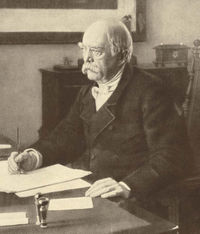
BismarckThe G-8 Summit will start in Sankt Petersburg, and many warn about the support that Putin will get this way for his authoritarian approach.
David Brooks thinks the conservative restoration in post-Soviet Russia was unavoidable. He compares the situation with the post-1848 period in Europe - the Revolutions were crushed, the authoritarian regimes were re-established, but they did gradually the reforms claimed by revolutionaries (constitutions, suffrage, welfare). And that because, they knew they had to keep up with the times.

We’re coming into a period of, at best, a gradualist conservative reform. It’s time to come up with a strategy for helping today’s unimaginative autocrats to become new and improved Bismarcks.

Is David Brooks right? Or by the contrary (and to rephrase him), did post-Soviet years prove to be the turning point when Russia failed to turn?

Labels:

Thursday, June 15, 2006

Nationalists versus Globalists

David Brooks
In his editorial of today's NY Times David Brooks analyzes the change of a paradigm. Left-Write confrontation belongs to the past, today it is about nationalists and globalists. Each orientation is represented in both major political parties of America. Mark Warner, John McCain, Mitt Romney, Hillary Clinton, Rudy Giulianni are progressive globalists, while Jim Webb or Pat Buchanan, Kevin Phillips and Lou Dobbs are populist nationalists, that's what Brooks says. Topics of the new confrontation: immigrants, relations with China/India, Dubai and the NY harbor, American presence in the Middle East.

Bedfelowships across the two major parties. Populist nationalists are liberal on economics, conservative on values and realist on foreign policy. Progressive globalists are market-oriented on economics, liberal on values and multilateral interventionists in foreign affairs.

Says David Brooks, Of course these alignments won't come about instantaneously. Our political institutions and habits have staying power, and the politics of globalization is lagging far behind the reality of it. But the issues that realigned politics in the 1960's are fading, and issues like immigration, trade and interdependence are rising to the fore. Politics is becoming less about left versus right and more about open versus closed. Or, to put it in starker terms, the populists are getting more populist while the elitists are getting more elitist.

Labels: