Updates, Live

Monday, June 07, 2010

Philadelphia Museum of Art: Duchamp influenced by Muybridge

Marcel Duchamp - Nude Descending a Staircase, No. 2 (1912)
Oil on canvas


It is at Philadelphia Museum of Art, and it's a great example of what Dynamic Decomposition means within the Cubist style.

Actually Dynamic Decomposition is tending to leave the Cubist room while opening the eyes on Futurist motivations.

Says Gilles Néret, Cubism sought to bring to light the essence of the picture; Futurism saw in the picture an ideal locus for expressing the contradictions and the tensions of the modern world.

If we look at the work of Marcel Duchamp, we can realize that it is a transgression from both styles. The Nude Descending a Staircase is Cubist in form, while Futuristic in content (if I am allowed to paraphrase here a famous, or rather infamous, expression).

Well, this painting of Duchamp was a replica to Eadweard Muybridge's Woman Walking Downstairs.


Following Muybridge, Marcel Duchamp is trying to split the second: to render in his work both the whole and the moment.

(Philadelphia)

Labels: ,

Thursday, June 03, 2010

The Man Who Split the Second

There is at Corcoran these days an exhibition devoted to a person whose name is probably known only for few people.

If you ask somebody today who invented the cinema, people would think at Edison, or at Lumière brothers. You can rightly call them the Founding Fathers; you should know however that there was also a Grandfather: a British photographer who lived most of his life in America, born as Edward Muggeridge, who changed his Edward in Eadweard (an ancient spelling of the name) and his Muggeridge in Muygridge firstly and then in Muybridge.

Rebecca Solnit (who wrote his biography) called Eadweard Muybridge the man who split the second, suggesting that his role in the history of art was as crucial as it was the split of the atom in the history of science.

I met firstly with the works of Muybridge at Phillips Collection: a great exhibition dedicated to early movies and their links to American painters at the end of the nineteenths century and the start of the twentieth. I was there with a friend of mine who was visiting DC; he told me what he knew about Muybridge and the question of galloping horse.

I wrote about Muybridge some time ago here on the blog. His experiments were seminal for cinematography, and not only. After all, his research to find the answer to the galloping question (can be a galloping horse with all four legs in the air in the same moment) means: can visual art catch movement as a whole while also in a distinct moment? Which means: can life be understood as a whole while also in a distinct moment? No wonder that great modern artists (like Marcel Duchamp and Francis Bacon) were so obsessed with the works of Muybridge. And I think the way to get the meaning of Francis Bacon's paintings is to go a bit in the past, at Muybridge.

Well, Eadweard Muybridge had many other artistic preoccupations in his long life: as an explorer of the Yosemite Valley his photographs foresaw the environmental photo-reportage (and maybe there, trying to capture the grandeur of the landscape, the whole and each bit of beauty, Muybridge firstly thought at the question which would later lead him to his experiments).


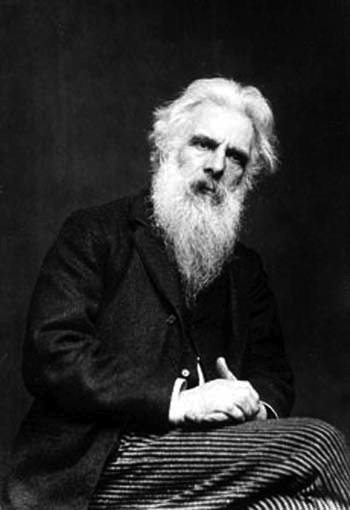
Another photo of Muybridge
(Corcoran Gallery of Art)

But let's come back to the exhibition at Corcoran: it is exhaustive (as all Corcoran's exhibitions have been). And it follows an interesting idea: Muybridge was a man of his epoch; his preoccupations were the ones of his times, of great scientific discoveries, of great industrial beginnings, the times of steam and electricity, of daring expeditions in terra incognita, the epoch of political and industrial revolutions, the world of Livingstone and Stanley, of Darwin, of Lincoln.

Plate 640. Jumping a hurdle; saddle; bay horse Daisy, 1887
(Corcoran Gallery of Art)

(Corcoran)

(Early Movies)

Labels:

Monday, May 11, 2009

Early Movies : A Horse in Motion, authored by Muybridge


Was this the first movie? Maybe: A Horse in Motion, 1878. Author: Eadweard Muybridge, the great pioneer of cinematography, who photographed a horse named Occident in fast motion using a series of 12 stereoscopic cameras. The first successful experience took place on June 11 at a farm in Palo Alto, California. The cameras were arranged along a track parallel to the horse's, and each of the camera shutters was controlled by a trip wire which was triggered by the horse's hooves (I took this info from PastFinder).


And so, the movie history began with finding the answer to the galloping question: is there a moment during a gallop when all four of a horse's hooves leave the ground at the same time?


(Filmofilia)

Labels: