Updates, Live

Friday, June 08, 2012

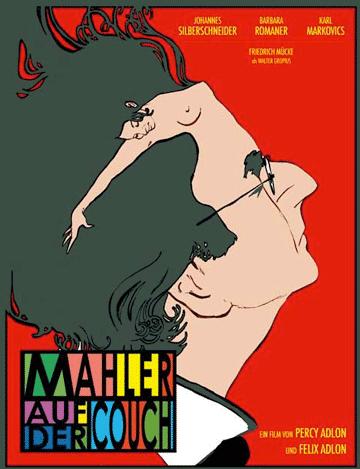
Mahler auf der Couch

Mahler auf der Couch (Germany, 2010)
(http://jewishfilm.org/Catalogue/films/mahleronthecouch.htm)
no copyright infringement intended

When famed composer Gustav Mahler (Johannes Silberschneider) uncovers his wife Alma's (Barbara Romaner) sexual infidelities with up-and-coming architect Walter Gropius (Friedrich Mücke), he settles into Sigmund Freud's (Karl Markovics) couch and pours his heart out on a variety of topics. Percy Adlon and his son, Felix, wrote and direct this quirky take on music, madness and art, propelled by the compositions of Mahler himself.


I heard about this movie some five minutes ago. I called Jack Goelman, as I'm doing now and then, and he was about to leave home to go see Mahler on the Couch. I understood that it's the NY premiere. Jack is very knowledgeable in the movie stuff, and I watched some great documentaries recommended by him, so I am curious to see his impressions on this one, maybe I'd call him again one of these days (the trailer below is not very promising, frankly - and it's hard to avoid the ridicule with a dialog the kind of Dr. Freud? My name is Mahler. Okay, here's the couch. Should I take off my shoes or not? Whichever comes first). At least the poster is a good peice.


On the other hand, speaking about what's new in NY, Jack told me that there is currently a lot of free Shakespeare: small companies playing the bard and offering a quota of free tickets. Otherwise, artists are moving to Brooklyn, in search of cheaper rent, and so Bedford Avenue is the new Mecca for the hipsters. But if we arrived at Bedford Avenue it's time for me to remember an old promise: to talk here about The Wild Party. Promettre c'est noble!


(Jack Goelman)

Labels:

Tuesday, December 07, 2010

Grass: A Nation's Battle for Life (1925)


(click here for the Romanian version)

Grass: A Nation's Battle for Life, released in 1925, one of the earliest ethnographic documentaries in the cinema history. It's a great movie, in the same time the story of its making is amazing.

It all started with two guys having the ambition to create a movie as successful as Flaherty's Nanook of the North. One of the two guys was Merian Caldwell Cooper: a passionate promoter in both aviation and movie industry, a bomber pilot in WWI, twice shot down in fight. The other was Ernest Beaumont_Schoedsack: during the WWI a cameraman on the front, recording infantry actions under shell fire. The two had met for the first time in Poland, during the war with Soviet Russia: Merian Cooper was in the Kościuszko Squadron, while Ernest Schoedsack was there with the Red Cross Photographic Development. They would meet again in the early 20's and start collaborating in making movies. Meanwhile Merian Cooper had been made prisoner by the Red Army and managed to escape.


So, Cooper and Schoedsack decided to make a documentary to be a success as big as Nanook. Flaherty had gone to the Eskimo, their target was Kurdistan. The expedition started in October 1923 in Angora (today's Ankara). There was a fellow-traveler with them: journalist Marguerite Elton Harrison. She too had the taste for danger in her DNA: risky missions in Germany, Russia, Japan, China, imprisoned for a period in Soviet Russia.

It was during the expedition that they decided to go further, to reach a nomadic community of Bakhtiari, some place in central Persia, and to follow them in their seasonal migration in search of grass for their herds.

Twice a year the Bakhtiari have to migrate with their animals, once Eastward, then Westward, between their summer quarters (in Chahārmahāl-o-Bakhtiyārī) and their winter quarters (in Khūzestān). That means crossing the Kārun river (some identify it with Pishon, one of the four rivers of Eden, as mentioned in Genesis) and escalating Zard-Kuh, the highest peak of the Zagros Mountains.

By the times the three Americans were with the Bakhtiari, there were no bridges over the river, and all people were barefoot. They had to pass this way over the heavy snowed mountain. As for crossing the river, the animals had to swim, of course many of them were drowning.

There were about 50,000 people and half a million animals. The huge group was led by Haidar Khan, a man of great authority, exceptionally fit for his huge responsibilities.

The decision of Cooper, Schoedsack and Harrison to join the community of Bakhtiari proved fortunate: by filming their journey they created a masterpiece.


The movie has two distinct parts. Firstly it chronicles the trip from Angora towards Kurdistan, with a picturesque description of a caravanserai, and some other interesting moments, like the sudden meeting with a troupe of desert police, occasion for the filmmakers to shot a surreal scene with the policemen executing a complicate ballet while on their horses!

But it is the second part of the movie that is a masterpiece: simply filming the journey of barefoot people with their animals across the river and over the mountain transmits a great epic sense. It is there the whole drama of this ethnicity struggling for life, rendered with simplicity and greatness.


The journey ended in the spring of 1924 (a certificate issued in Tehran on June 24 that year, cosigned by Haidar Khan and Prince Amir Jang, certified that the three Americans were the first foreigners to have made the forty-eight days migration with the tribe).

Many critics have compared Grass with Nanook, giving to the work of Flaherty a better mark, and obviously the merit of having been the first. I found an interesting remark in an essay by Richard Griffith (who was a curator at MoMA Film Library between 1951 - 1965): Flaherty was an explorer filming a population he knew, while Cooper and Schoedsack were adventurers attracted by the unknown.

The images in "Nanook" could be more skillful worked, while what you see in "Grass" is the real thing: the epic on the screen is live.

I watched Grass on Netflix and I give total credit to its admirers: this movie is fascinating.

The copy available on Netflix includes some evocative pieces of Iranian music, composed and performed by Gholam Hosain Janati-Ataie (santur and daf), Kavous Shirzadian (tar, tombak and oud) and Amir Ali Vahabzadegan (Turkish tambur, setar, dohol, daf and voice). I found this very touching: a tribute paid to a courageous community who struggles with nature for their life. I should find some videos with music performed on such instruments and to publish them here on the blog.

Cooper and Schoedsack continued to work together. Chang was released in 1927: it was another very good movie, with amazing scenes with savage animals in the Siamese jungle, tigers, leopards, and elephants on rampage; these scenes give a formidable sensation of closeness.

Then came King Kong (1933): a huge success of public. The huge gorilla will become famous and will be the main hero in other movies made along the years: nevertheless it was created by Cooper and Schoedsack.

Then came WWII, and Cooper was again in the military. As for Schoedsack, his eyesight was severely damaged in the war, yet he continued to work after that.

The personality of Cooper attracted the attention of Kevin Brownlow, the great historian of the silent movie era, who made in 2005 a movie about this pioneer of the documentary (I'm King Kong!: The Exploits of Merian C. Cooper). It was actually through the information about the movie of Brownlow that I started my search on Grass. An information I got in a phone conversation with Jack Goelmann: my New Yorker friend that spent a life in search of finding and promoting quality films.

----------------------------

As for the Bakhtiari people, they continue their seasonal migrations. Now their herds are carried in trucks and they are no more barefoot, still it's hard.

Haydar Khan contracted yellow fever and passed away, the following year after the film was made. His son Lufta was nine years old in the movie. In 1990 he was interviewed by Iranian film scholar Bahman Maghsoudlou for his book Grass: Untold Stories.


-------------------------


(Jack Goelman)

Labels: , ,

Saturday, November 27, 2010

Kevin Brownlow

Kevin Brownlow is a film maker, film historian, television documentary-maker, and author. He is best known for his work documenting the history of the silent era. Brownlow developed an interest in silent film at the young age of eleven. This interest grew into a life-long passion for the cinema and a career spent documenting and restoring film. He is without question one of the most respected and admired historians of the early cinema and has rescued many a silent film and its history from oblivion. Seeking out and interviewing many, largely forgotten film pioneers in the 1960s and 1970s, he preserved a priceless legacy of cinema that would have otherwise been lost (Wikipedia).

-----------------

It Happened Here - by Kevin Brownlow and Andrew Mollo (1965)

The original UK trailer:


(video by BFI)


--------------

In an interview c. 1980, silent film historian Kevin Brownlow discusses French film director Abel Gance:


---------------------

Kevin Brownlow at Killruddery Silent Film Festival 2009:


Kevin Brownlow at Killruddery Silent Film Festival 2009: Part 1/3
(video by DOCUMENTAVi)


Kevin Brownlow at Killruddery Silent Film Festival 2009: Part 2/3
(video by DOCUMENTAVi)


Kevin Brownlow at Killruddery Silent Film Festival 2009: Part 3/3
(video by DOCUMENTAVi)

-----
Kevin Brownlow received the 2010 Governors Award, together with the great director Jean-Luc Godard and with Eli Wallach, one of the finest Hollywood's character actors. Kevin Brownlow was also invited in Tribeca on this occasion. Jack Goelman and Pola Rapaport were there and told me about the event.

(Jack Goelman)

Labels: ,

Friday, November 26, 2010

Le Sang des Bêtes, 1949


I saw this documentary one memorable evening at the Gramercy Theater: Marcia and Amos Vogel, together with their friend Jack Goelman were there, reviving in front of us the spirit of Cinema 16.

I've already told you all this. Three documentaries had been selected by them, and this one was the most impressive. Almost unbearable, I would say even more, it was extremely difficult to watch, a painful experience.

There is a catharsis brought by art works that are painful to watch. In this case the catharsis does not come immediately. It takes time to sublimate the horrible experience, to get beyond it and to understand. To really understand.


Le Sang des Bêtes (Blood of the Beasts), a 20 minute documentary made in 1949 by Georges Franju (and scored by Joseph Kosma), calmly depicting the everyday work in the abattoirs from the outskirts of Paris. The animals coming here with serenity, suddenly killed and, that's it, immediately skin and legs and head are apart, it all happens incredibly fast. Sometimes bits of life go on for a few seconds. It's horrible. The slaughters make this matter-of-factly, otherwise you cannot resist there.

And as soon as you leave the slaughterhouse, it's normal life, that quiet poetry of normal life: sun, sometimes clouds, whisks of grass here and there, some debris, a pair of young lovers.

And actually it's about death, about our death: we are always dying innocently, and death is just part of life: death is just that, matter-of-fact.


(Jack Goelman)

(Cinéma Français)

Labels:

Wednesday, November 24, 2010

La Croisière Noire, 1926


La Croisière Noire (Black Journey), the 70 minute movie made in 1926 by Léon Poirier, documents the Citroën Kégresse expedition in Africa in 1924-1925. I have already talked about these expeditions in my previous post, where I focused on the trip across Asia from 1931-1932.

Citroën organized two African expeditions. The first one, in December 1922 - January 1923, crossed Sahara from Touggourt in Algeria to Timbuktu in Mali. The second expedition (from October 1924 to June 1925) - the subject of the movie - was much more ambitious: the whole Africa was traversed from North to South and then to the East coast in Madagascar. It started in Algeria, heading South to Niamey and East to Lake Tchad, then South-East into the Congo basin to Lake Albert. The team split then in four groups for Mombasa, Dar Es Salaam, Capetown and Mozambique, all reuniting in Madagascar.


The lead of these expeditions was the general manager from Citroën, Georges-Marie Haardt who authored a book about the second African trip (The Black Journey: Across Central Africa with the Citroën Expedition).

I found on youTube a documentary produced for ARTE in 2006: En Avant, Toute ! Autour du Monde en Citroën (with the English title Half-Track Heroes - The Crusades of André Citroën). This is a montage that uses the footage from the original movies made on the African and Asian expeditions. The authors are the Germans Christian Schidlowski and Peter Bardehle. It was published on youTube by the enthusiasts from the Zagreb Citroën Klub.


So, it is a very long story, started by 1910 in St. Petersburg, where the Kégresse track was invented, continued in the twenties and thirties in Africa and Asia with the great Citroën expeditions, opening car routes across Sahara and on the Silk Road, immortalized in the two movies that were rediscovered by Jack Goelman in the fifties, then by the two German directors that created the documentary for ARTE in 2006, and finally published on youTube by the passionate Zagrebians from the Citroën Klub.

Finally? This story is going on.

Here is the documentary from ARTE. I dedicate this post to Jack, my great friend from New York who made me know about Georges-Marie Haardt, the Citroën Kégresse half-tracks and their formidable expeditions.


Half-Track Heroes - The Crusades of André Citroën
1/6
(video by retro5s5)


Half-Track Heroes - The Crusades of André Citroën
2/6
(video by retro5s5)


Half-Track Heroes - The Crusades of André Citroën
3/6
(video by retro5s5)


Half-Track Heroes - The Crusades of André Citroën
4/6
(video by retro5s5)


Half-Track Heroes - The Crusades of André Citroën
5/6
(video by retro5s5)


Half-Track Heroes - The Crusades of André Citroën
6/6
(video by retro5s5)


(Jack Goelman)

(Cinéma Français)

Labels:

Monday, November 22, 2010

La Croisière Jaune, 1933


La Croisière Jaune (The Yellow Cruise), the 90 minute documentary produced in 1933 by French directors Léon Poirier and André Sauvage, is remarkable in many respects: by the story it tells, also by the story of its making, and not less important by the story of its post-release life.

This movie documents the Citroën Kégresse expedition made across Asia in 1931-1932: 30,000 km from Beirut to Beijing on the ancient Silk Road.

The Kégresse boogie was named after his inventor, the French Adolphe Kégresse, who created it in 1910-1912. By that time he was chief engineer at the court of Russian Czar Nicholas II.


After the Russian Revolution Kégresse returned to France and in 1919 he started to work for Citroën. He enhanced there his invention and the result was the Citroën Kégresse half-track: the front gave the steering for the car, the rear gave the driving force. A cross-country car, perfect for the military. It was used by the French army, and not only: US, Danish, and Polish armies used the Citroën Kégresse as well.


André Citroën decided to use the half-track in ambitious expeditions across Africa and Asia. The purpose was to demonstrate in a spectacular way the resilience of Citroën products, but also to open important routes for the wheels, with calculated political and economic gains.

Two expeditions took place in Africa, by the mid 20's. I'd like to talk a little bit about them in a future post. Let's only note that the second African expedition was also filmed: La Croisière Noire (Black Journey), released in 1926.

But let's focus here on the Asian trip.


Meeting with a Tadzhik Chief
(Corbis Images)

For all these expeditions in Africa and Asia the lead was Georges-Marie Haardt, the general manager at Citroën, a man of great style and strict discipline. The success of these cruises is largely due to him.

For the Asian expedition Haardt decided to split the team in two: the Pamir group started from Beirut heading to Kashmir, to pass the Himalayas and then the Gobi desert and to make the junction with the China group who was coming from Tien Tsin.


It started in April 1931. Haardt was with the Pamir group. Climbing the Himalayas was beastly hard and at a certain point they had to dismantle the cars and to carry the parts on the footpaths at 5,000 m altitude.


Eventually they made it and arrived at Aksu in October. The China group was already there (together with Father Teilhard de Chardin). They, too, had had all kind of difficulties and at a certain moment had become the captives of a local warlord in Urumchi. André Citroën had sent the ransom from Paris.

The reunited team arrived at Beijing in February 1932. Sadly, Georges-Marie Haardt was no more with them. Weakened by the whole adventure he took a ship to return home. On the way back he contracted a double pneumonia and passed away at Hong Kong.


The Pamir group included also some movie specialists who filmed the voyage. Shooting at extremely low temperatures and extremely high altitudes on the Himalayan footpaths was as adventurous as the adventure captured by the camera, but it was this way that they got the day after day chronicle. The movie was released in 1933 and it had the success it deserved. NY Times would write in 1936 (when La Croisière Jaune was screened at the 55th Street Playhouse) that the pictorial record of their odyssey, photographed with technical painstaking and an eye to the unusual as the motor caravan toiled between Beirut and Peking, has been edited into a remarkable travel film by Léon Poirier; one which definitely rescues the cinema travelogue from the ho-hum class.

Later in the fifties La Croisière Jaune was part of the selection for Cinema 16 and here is what Jack Goelman says about it: I remember I fell in love with Yellow Cruise. Amos (Vogel) was not excited about it, but I thought it was quite unique and that up until that time no one had really explored the travel film, except by incorporating it into another kind of film. I loved this film, but there was no information about it, so Amos said, okay, you write the program notes. I went to the library and dug up all sort of things, trying to piece my ideas together. I didn't know how good a film it was.

And La Croisière Jaune continued its carrier: in 2006 ARTE presented a documentary that was based on footage from the Black and Yellow Cruises. But I will leave this for the next post. Now you'll enjoy a few videos with sequences from La Croisière Jaune.


La Croisière Jaune : Starting Sequences
(video by tonyfuller)


La Croisière Jaune : On the Himalayas
(video by tonyfuller)


La Croisière Jaune : Crossing an Asian River
(video by tonyfuller)


La Croisière Jaune : Crossing the Gobi Desert
(video by tonyfuller)


La Croisière Jaune : On the Khyber Pass
(video by tonyfuller)


La Croisière Jaune : Film Credits
(video by tonyfuller)


(Jack Goelman)

(Cinéma Français)

Labels:

Sunday, November 21, 2010

W.R. - Misterije organizma (1971)


W.R.: Misterije Organizma, made by Makavejev in 1971. W.R. stands for Wilhelm Reich, the controversial psychoanalyst who tried to put together Marx and Freud, whose books were burned in Germany in the 30's, and in US in the 50s, the guy who fled from from Nazi Germany to become later a victim of McCarthyism.

The movie of Makavejev is a documentary intercut with a feature. A documentary on Wilhelm Reich, using archive footage and interviews (edited in a way that leads to parody), and a story about a young woman in Yugoslavia of the sixties, an ardent adept of Reich and of the accomplishment of Communist revolution through sexual freedom. She falls for a Soviet ice skater, who cannot leave the Communist dogma and prefers abstinence, so he beheads her. As crazy as all these sound, add to this mix other independent sequences with sex, gays, masturbation, Stalinist propaganda footage, followed by scenes with electroshock applied on political prisoners in Soviet Union. The score is in counter-tempo with the images, suggesting new senses for everything, suggesting also associations with other famous film works.

It is not a movie for the weak ones, definitely not for non-adults. If you have the guts to watch it, it is cathartic.


W.R. - Misterije organizma: 1/10
(video by enigmaforce1971)


W.R. - Misterije organizma: 2/10
(video by enigmaforce1971)


W.R. - Misterije organizma: 3/10
(video by enigmaforce1971)


W.R. - Misterije organizma: 4/10
(video by enigmaforce1971)


W.R. - Misterije organizma: 5/10
(video by enigmaforce1971)


W.R. - Misterije organizma: 6/10
(video by enigmaforce1971)


W.R. - Misterije organizma: 7/10
(video by enigmaforce1971)


W.R. - Misterije organizma: 8/10
(video by enigmaforce1971)


W.R. - Misterije organizma: 9/10
(video by enigmaforce1971)


W.R. - Misterije organizma: 10/10
(video by enigmaforce1971)


(Dušan Makavejev)

Labels: ,

Dušan Makavejev


Dušan Makavejev is a highly unconventional movie maker, ready to destroy any cultural idols he is encountering on his way, be them sexual taboos and theories about sexual liberation altogether, political dogmas from the East and from the West, well established principles of the cinema art, everything. Think at his much younger compatriot Kusturica, think at Godard, think at Oshima. Actually Makavejev is almost the same age with Godard and Oshima, the same generation, the same nihilistic approach. Think also at Fellini in his later movies: the same baroque scope, the same baroque craziness. But think firstly at Godard.

No wonder Amos Vogel has chosen an image from a Makavejev's movie to illustrate his monumental Cinema as a Subversive Art. I will give you here a short excerpt from exactly that movie, W.R.: Misterije Organizma, and I promise the whole movie for my next post.


W.R. - Misterije organizma: Scene from the movie
(video by smitrof)


(Jack Goelman)

Labels: ,

Saturday, November 20, 2010

Film as a Subversive Art

Be uncomfortable;
Be sand, not oil in
The machinery of the
World
(Günter Eich)


Amos Vogel published Film as a Subversive Art in 1974: his mini-essays on over 600 movies.

The jacket shows an image from a movie (W.R.: Mysteries of the Organism) by Dušan Makavejev: one of the most fit examples of creators of subversive art.

Should a film be subversive? As the Italian saying goes, se non è vero è ben trovato (which sometimes changes to se non è vero allora è ben inventato): if it's not true, it's a good story. Well, it's always true for indie movies; for experimental movies; for art movies. Because once you are not in the industry, you must say something: it means something new, making a difference, your difference. Such movies must shake taboos, attack comfortable beliefs: an independent creator must scandalize. Such movies must be sand, not oil.

And for the people the breed of Amos Vogel only such movies exist: politically subversive, sexually subversive, culturally subversive, or all of these together.

Paul Cronin made in 2003 a one hour documentary about Amos Vogel; the title, Film as a Subversive Art: Amos Vogel and Cinema 16.

Paul Cronin is also a movie passionate, author of books and documentary films exploring this universe.

This movie about Amos Vogel is perfect: the director leaves the room totally for the personage, not imposing any constraint, not framing in any way. The camera just follows the old guy, giving him total freedom. It is a one hour long filmed profile of the great promoter of the subversive movie: Amos Vogel talking very casually about his life, about the history of Cinema 16, about his aesthetic convictions. The result is a wonderful portrait of a fascinating personage.

Marcia Vogel and Jack Goelman are also there in the movie. Which is natural: the wife and the friend, they worked together with Amos all those years to create and maintain the miracle that has been Cinema 16.

I enormously enjoyed to find in the movie a couple of images from Meshes of the Afternoon of Maya Deren and Alexander Hamid. If I were to keep only ten movies on a deserted island, Meshes of the Afternoon would be one of them.

----

Follow several sequences from the movie. Just enjoy!


Film as a Subversive Art: Amos Vogel and Cinema 16
Part 1/8
(video by TheStickingPlace)


Film as a Subversive Art: Amos Vogel and Cinema 16
Part 2/8
(video by TheStickingPlace)


Film as a Subversive Art: Amos Vogel and Cinema 16
Part 3/8
(video by TheStickingPlace)


Film as a Subversive Art: Amos Vogel and Cinema 16
Part 4/8
(video by TheStickingPlace)


Film as a Subversive Art: Amos Vogel and Cinema 16
Part 5/8
(video by TheStickingPlace)


Film as a Subversive Art: Amos Vogel and Cinema 16
Part 6/8
(video by TheStickingPlace)


Film as a Subversive Art: Amos Vogel and Cinema 16
Part 7/8
(video by TheStickingPlace)


Film as a Subversive Art: Amos Vogel and Cinema 16
Part 8/8
(video by TheStickingPlace)


(Jack Goelman)

Labels:

Friday, November 19, 2010

Jack Goelman


The name of Jack Goelman calls in mind immediately Cinema 16, the organization that promoted in New York the experimental films of Maya Deren, Stan Brakhage and all the other enthusiasts of the 40's and 50's. Jack worked closely with Marcia and Amos Vogel, the founders of Cinema 16.

Provincetown Playhouse, the first place with Cinema 16 screenings
(http://www.youtube.com/watch?v=iIlzxTewRuo)

And it was not only about the New York school of experimental movie: Cinema 16 has actually been the promoter of hundreds of independent filmmakers of all sorts from Germany and Soviet Union, France and Great Britain, from all over Europe, South America, Middle East. Cinema 16 has set the standard for what is called an arthouse and a film club.


There were presentations each Wednesday, and the rest of the week was devoted to reviewing and selecting the movies. It was not easy task to decide on five or six movies, each one of ten or twenty minutes, because they had to fit somehow together.

A certificate of quality was attached to each selected movie
(http://books.google.com/books?id=Ivmisn4Rm_8C&pg=PA71&source=gbs_toc_r&cad=3#v=onepage&q&f=false)

Jack Goelman had joined Amos Vogel after the war. He was by that time a youngster, crazy about indie movies. Cinema 16 was fighting with the lack of money, and Jack started without payment. However, as a demobilized GI he got the financial support to work there and to study also cinematography.

But this had been long, long time ago. I met Jack first time in December 1999. I had just arrived at New York the previous day. I was naturally tired with the jet-lag and all that stuff, but I had to go to the Museum of Natural History. There was an exhibition of butterflies there, in a pavilion that was recreating their natural habitat, and all people I knew were very excited. No possibility of refusal from my part: I was told that I would meet there with family and some new friends. The new friends were Jack and Ellen, his wife, along with Ellen's mother. I enjoyed immediately his ways. Jack was a witty guy, with quick responses and a good humor, seemingly having an European kind of being interested in the world. And Ellen was an extremely gentle lady.

Jack had a superb command of French, which was fortunate, as my command of English was far from satisfactory those times (not that now it would be perfect, but anyway), so mixing the two languages was fine for me.

We met in several occasions, then I moved to DC area. I was not coming to New York very often, and every visit had a pretty tight schedule. We were talking by phone now and then.

Once I came especially for him. There was an event organized at the Gramercy Theater, with the Vogel husbands and Jack presenting some short movies from the 40s.


Gramercy Theater, 127 East 23rd St. at Lexington Ave.
(http://twi-ny.com/twiny.02.28.07.html)

I knew somehow the neighborhood, with the Gramercy Park, small, with a Victorian demeanor, hidden behind closed fences, and with the theater on the 23rd Street, only the theater was always closed, except for rare occasions. Now it was one of these occasions.

I was together with my sister Pola and Wolfgang, her husband. We entered the main floor area. There was a numerous attendance. It was a wonderful applause as Amos Vogel and wife Marcia, together with Jack came in front of us. The event's host presented them briefly, then Amos and Jack talked about the documentaries that were selected for screening. There was a French one, then two American. All of them were from the second half of the 40's.

It was the French documentary that impressed me the most: Le Sang des Bêtes, made by Georges Franju in 1949. Very strong, almost unbearable... but it deserves a special post here in the blog. I will talk about it very soon, as I found it also on youTube.


Gramercy Theater, socializing area downstairs
(http://www.rugrag.com/post/Gramercy-Theater2c-NYC.aspx)

After the screening we went downstairs and stood a bit at the bar there, talking about the movies we had seen. Jack was making a parallel between the subject of the French movie (about the abattoirs on the outskirts of Paris) and a feeling he had experienced once in Chicago, as it happened to pass by the big slaughterhouse there and the memory of the documentary of Franju became overwhelming.

We kept contact after that memorable event, especially by phone. His wife Ellen passed away in 2009 and this was hard. He is very sad with this loss, but anytime when it happens to come to indie movies he has again the huge enthusiasm that I know.


(Filmofilia)

Labels: