When you say
Philip Glass you mean
Minimalism, when you say
Minimalism you mean
Philip Glass, while
Philip Glass says he's not a
Minimalist. So it goes.
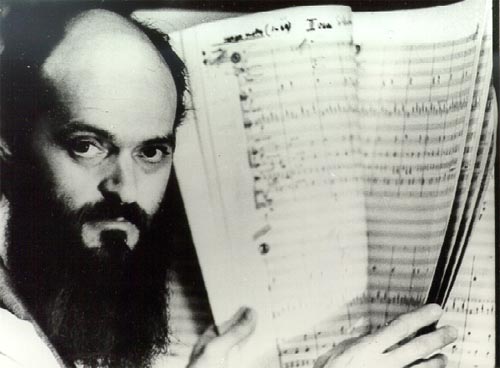
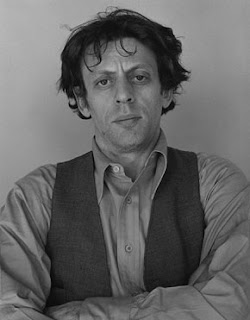
Here's a photo of him from 1976:
A Portrait of the Artist as a Young Man, as probably
Joyce would have noted.
Philip Glass entered this year his seventies.
NY Times published one month ago an article devoted to Minimalist music, putting together opinions from several critics:
James R. Oestreich,
Anthony Tommasini,
Bernard Holland,
Allan Kozin,
Anne Midgette,
Steve Smith,
Vivien Schweitzer. I will offer you a copy at the end of this post.
For
Bernard Holland, Minimalist music means talking much and saying little. So,
Mahler wasn't a Minimalist, as he said as much as he talked.
Saint-Saëns wasn't a Minimalist either: he talked little, said little. As for
Webern, well, he didn't talk at all and said a lot.
So we know at least who are the non-Minimalists (should we name them Maximalists?). We still don't know who are the Minimalists.
James R. Oestreich considers that
Minimalists don't carry cards; they are guilty by association: Minimalist composers are those who befriended Minimalist artists. And we know, of course some Minimalist artists,
Richard Serra for instance, or
Sol LeWitt.
As for
Anne Midgette, she's even found a proto-Minimalist:
Bruckner, who
was composing music like writing great paragraphs (whatever it means).
Okay, but who are the Minimalists in music, after all? Here's a short list:
Philip Glass,
Steve Reich,
John Adams,
John Cage,
Arvo Pärt,
Count Basie (yes, also him). Now, each one denies the label, suggesting that it mischaracterizes his work. But, let me ask you something, what's so bad in being called a Minimalist?
After all, what does it mean this, Minimalism in music? From what I listened myself (my own list being much, much shorter: I listened music by
Glass, by
Adams, and by
Pärt), I would say that essential in their works is the use of repetitive structures that create some kind of obsessive, hypnotic hallo in the listener. It is in the same time an accessible music, user friendly (
Bernard Holland even suggests that you can listen while going to the fridge to take a glass of water or answer the phone, as Minimalist music is anyway repetitive).
My first encounter with Minimalists was
Philip Glass. I was in a bookstore, in the music department, listening excerpts from various composers, at random. So I listened to fragments of his
Aguas da Amazonia. Actually this was a collaboration between
Glass and a Brazilian percussion group,
Uakti.
Glass had composed
12 Pieces for Ballet, for piano, and the Brazilians produced a version for
marimbas. The music was sounding crazily beautiful.
Tiquie River: you feel the sound of the water, playful and serene.
Japura River: the sound is a bit different, like people dancing by the river, sometime in the morning.
Purus River: it seems to be other time of the day, the mood gets a bit more serious.
Negro River: something is flowing on the surface of the river, mixing its sound with the sound of the water.
Madeira River: as the day advances, the mood becomes more meditative.
Tapajos River: the mood is again a bit playful.
Paru River: it's like a small story told nicely.
Xingu River: a tribal ritual seems to take place.
Amazon River: it's carrying the water from all tributaries, their spirit, their mood. Then
Metamorphosis I, played at marimbas!
Then I listened to some excerpts from
A Descent into the Maelström. This time the music was solemn, while in the
Aguas da Amazonia the mood had been mostly playful. I listened then a little bit to
In the Upper Room, and then some other stuff of him, organ and synthesizer sounding greatly.
Eventually I bought a DVD with a movie scored by him:
Koyaanisqatsi. I watched the movie the same evening. To be frank, the movie did not impress me too much, and this because I have just seen the movies of
Maya Deren. Her works are so pure that after the contact with them any other movie sucks.
So,
Koyaanisqatsi seemed for me too
loaded but I enjoyed definitely its language. A language of great images and great music. An environmentalist documentary without words, speaking only through images and music. A great balance between the images and the music! The same repetitive structures in the images, in the music, the same hypnotic effect. The harmonies were reminding me of
Vangelis.
Only
Vangelis means melodicity, and here, at
Glass, it was something else. The repetitive patterns, moving slowly, creating a trance. His music is ritual, a universe of incantations.
Well,
Maya Deren means also the music of
Teiji Ito - only I need to listen to more music of him to make a judgment and to place
Glass in a larger context than Minimalism.
After that movie I bought a CD with music by
Philip Glass. My choice was a disc containing both
Glassworks and
In the Upper Room. Here you can enjoy with a small excerpt from
Glassworks (along with other stuff of him: excerpts from
Metamorphosis,
Einstein on the Beach,
The Hours, etc).
Glassworks sounds nice (and the title is very well chosen, suggesting delicacy and miracle: the delicate miracle of an artwork made from glass). There are six parts: an
Opening that is solo piano, the
Closing repeats the Opening in an orchestrated version. The others (with unexpected titles:
Floe,
Islands,
Rubric,
Façades) are all orchestrated. Each part is based on a repetitive structure - after the atmosphere is created, a development appears, another phrase that is in dialog with the basic structure. Some variations towards the end.
Well, I listened again a bit at the music from
Koyaaniskatsi. The same architecture: a repetitive structure is played by organ, after the atmosphere is created, a development appears, played by the choir, in dialog with the
basso continuo of the organ.
I found then on the web a piano music very much alike with the Glassworks:
Metamorphosis. Again
Opening, then five
Metamorphosis,
The Poet Acts,
Dead Things,
Modern Love Waltz. Music from
Koyaaniskatsi sounds solemn, while here in the
Metamorphosis there is delicacy. I am just listening now to the
Dead Things and trying to follow the meditation... How would sound the
Modern Love Waltz? Yeah, it is of course a bit different, a bit playful, the same delicacy. Click
here to listen yourselves!
But let's come back to the CD with
Glassworks, followed by
In the Upper Room (click
here to listen some excerpts). The music was composed for a ballet, played by the
Twyla Tharp troupe. The CD-s sleeve was giving some information about the dance performance itself: a mix of traditional and modern ballet, dancers dressed from black and white to red, colors mixing with the repetitive patterns from the music of
Glass, to create the hypnotic effect. Universe of ritual, of magic, universe of incantations.
I will come to the music of
Adams and of
Pärt in other post, this one is a bit too large, only let's try to conclude about
Glass.
The joke about
Vivaldi (did he compose 300 concertos or one concerto three hundred times?) fits perfectly to
Glass. If you listen to one piece of him, you know all his pieces. Well, of course it's not true, but many would say that he has no melodic inventiveness, that his repetitive patterns become boring... and this is not true either. The truth is that his musical universe is different. I will say again, his music is not melody, it is incantation.
Composer of operas (
Einstein on the Beach is
Glass's famous opera), ballets, movie scores, symphonies, chamber music, of course very prolific, owning its music ensemble, having great records, I am tending to think that he is a successful composer with all the good and the bad of what success means. A great composer should follow only his way (as
Tenney or
Nancarrow did), while a success story in the music business means to leave your own universe to come to the world of mortals, to make concessions to the taste of the public, and to loose the unique in you: in the case of
Glass, it is about the world of magic where gods are implored through long litanies and real wizardry becomes possible.
-----------------------------------
And here is the copy of the article from
NY Times. Enjoy!
August 10, 2007
Don't Call It Minimalism (Just Listen)
By THE NEW YORK TIMES
BY and large musical Minimalists don't carry cards. But they do know something about guilt by association.
Most composers commonly called Minimalists have disavowed the label at one point or another, suggesting that it mischaracterizes their music, which can be mind-bogglingly intricate -- and huge. And they certainly don't consider themselves part of a school. The designation arose mainly from the friendships of composers with Minimalist artists: Steve Reich and Philip Glass, for example, with the sculptor Richard Serra.
But there certainly was something new and big (however minimal the means) stirring in the second half of the 20th century. With roots in the styles of Lou Harrison, La Monte Young, Morton Feldman, John Cage and others, music characterized by great rhythmic drive, simplified harmonies and hypnotic repetition blossomed in signal works by Terry Riley, John Adams, Mr. Glass and Mr. Reich. The pollen carried far and wide, even to Eastern Europe with the ''mystical Minimalism'' of Arvo Pärt and others as a spiritualized offshoot.
The 70th-birthday year of Philip Glass, which is being widely observed, seems as good a time as any to take stock of the Minimalist achievement by way of recordings. So the classical music critics of The New York Times have singled out favorite recordings of music by various forerunners (including the jazz great Count Basie), the early giants and those who later fell under the influence (including the Dane Poul Ruders).
None of this is likely to settle disputes about what, if anything, the various composers have in common, for the music is wildly varied. But it should at least lay out some of the terms of the argument, in addition to providing good listening. JAMES R. OESTREICH
ANTHONY TOMMASINI
REICH ''Different Trains,'' ''Electric Counterpoint.'' Kronos Quartet (Nonesuch 79176; CD).
ADAMS Piano works. Ralph van Raat, pianist (Naxos 8.559285; CD).
ADAMS ''The Death of Klinghoffer.'' Vocalists; Orchestra of the Opéra de Lyon, conducted by Kent Nagano (Nonesuch 79281; two CDs).
RUDERS Violin Concerto No. 1; other works. Rolf Schulte, violinist; Riverside Symphony, conducted by George Rothman (Bridge BCD 9057; CD).
Well before the spring of 1989, when I first heard the Kronos Quartet perform Steve Reich's ''Different Trains,'' Mr. Reich's music had grown far beyond the confines of the stylistic label Minimalism.
The concept for this ingeniously complex 1988 work came from Mr. Reich's memories of childhood travels on transcontinental trains in the late 1930s and early '40s to visit his divorced parents: his mother in Los Angeles, his father in New York. The constant clacking of the train on the tracks imprinted itself on his musical imagination. While contemplating this piece, Mr. Reich realized that, as a Jew, had he been in Europe during his youth he would probably have been traveling on quite different trains.
The piece's repetitive rhythms, cyclic riffs and persistent whistles convey the nervous, hypnotic sounds and feelings of train travel. Weaved into the textures are the recorded voices of the governess who accompanied Mr. Reich on his journeys and an old Pullman car worker, as well three Jewish refugees. The speeches, as transcribed with uncanny accuracy into pitches and rhythms, become another element in the music. The work is at once exhilarating, haunting and ominous, qualities arrestingly conveyed in the Kronos Quartet's recording.
John Adams was initially associated with Minimalism. A beguiling recent recording of his complete piano music, performed by Ralph van Raat, includes scintillating performances of ''Phrygian Gates'' and ''China Gates,'' early scores that show the composer at his most openly and sonorously Minimalistic.
But Mr. Adams had bigger musical things in mind, like his landmark opera ''Nixon in China.'' Though I greatly admire this work, I am especially affected by ''The Death of Klinghoffer'' (1991), written with the same librettist, Alice Goodman, and director, Peter Sellars. The opera has been attacked for what is perceived as its sympathetic depiction of the Palestinian terrorists who murdered Leon Klinghoffer aboard an Italian cruise ship in 1985. But the creators think of the opera as a reflective work in the spirit of the Bach Passions, which mix storytelling and commentary. The score flows in undulant waves of luminous yet piercing harmonies, with elegiac, melodic writing and violent, searing outbursts.
The Danish composer Poul Ruders acknowledges that he has been influenced by Minimalism. The repetitive figurations, jittery thematic lines and obsessive rhythms that abound in his invigorating Violin Concerto No. 1 (1981) would seem to prove the point, though I'd be careful about labeling it a work of Minimalism, at least in the presence of its formidable composer.
BERNARD HOLLAND
REICH ''Drumming.'' So Percussion (Cantaloupe CA21026; CD).
ADAMS ''Nixon in China.'' Vocalists; Orchestra of St. Luke's, conducted by Edo de Waart (Nonesuch 79177; three CDs).
CAGE ''Two2''; works for two pianos. Double Edge (Edmund Niemann and Nurit Tilles; CRI 732; CD).
BASIE ''Complete Clef/Verve'' (Mosaic Records limited edition; eight CDs).
Minimalism is a musical art that says very few things over long periods of time. This is in opposition to music that takes a long time to say many things (Mahler), music that says very little in normal amounts of time (Saint-Saëns) or music that says a great deal in practically no time at all (Webern).
Minimalism can be employed by several percussionists (''Drumming'' by Steve Reich with So Percussion) or an entire opera company (John Adams's ''Nixon in China''). It is also comfortable on two pianos (''Two2'' by John Cage, played by Edmund Niemann and Nurit Tilles). Minimalism, in other words, is user-friendly.
''Drumming'' is in four parts and goes on for quite a while (73 minutes 8 seconds, to be exact). It starts unpromisingly, but once the mind attaches itself, the music gathers an adhesive strength. As color and complexity of movement gradually evolve, the paradox of Minimalism sets in: Listeners enter a trancelike involvement but can answer the phone or go to the refrigerator and not miss much at all.
''Nixon in China'' translates repetition into a kind of theatrical energy. Diplomatic ritual is made to dance; political and personal anxieties take on a machinelike tic. Minimalism becomes a dramatic tool, proving its further usefulness.
I like the Cage piece precisely because so little happens. It is a slow, calm appropriation of musical space. ''Two2'' is from 1989 and at quite a distance from the two other Cage pieces from the mid-1940s on this recording, ''Experiences'' and ''Three Dances.'' Both are quite busy.
It is hard to leave the subject of Minimalism without mention of Count Basie, master of the art of leaving out. Basie's piano solos framed unspoken musical phrases with dabs of music: chords doing the work of a jazz-music continuo and fragments of melody that point at things present but unsaid. The richness of the silences -- the tantalizing promises therein -- were at odds with the art of Basie's colleague Art Tatum, who seemed determined to fill musical space with as many notes as possible. Minimalism, here as elsewhere, fills time with a minimum of means.
ALLAN KOZINN
ADAMS ''Shaker Loops,'' ''Light Over Water.'' The Ridge Quartet; other performers (New Albion NA014; CD).
GLASS ''Satyagraha.'' Vocalists; New York City Opera Orchestra and Chorus, conducted by Christopher Keene (Sony-BMG Masterworks M3K 39672; three CDs).
GLASS ''Koyaanisqatsi.'' Western Wind Vocal Ensemble; Philip Glass Ensemble, conducted by Michael Riesman (Nonesuch 79506, CD; MGM 1003766, DVD).
REICH ''Tehillim,'' ''The Desert Music.'' Ossia; Alarm Will Sound, conducted by Alan Pierson (Cantaloupe CA21009; CD).
It sounds oddly conservative and spare now, but ''Shaker Loops'' (1978) was a bombshell in its time, and it introduced John Adams as an important voice in the still fresh Minimalist rebellion against modernist complexity. Mr. Adams offered all the repetitive energy that propelled Philip Glass's and Steve Reich's most popular scores, but his quicker harmonic development, sudden dynamic changes and other startling touches pointed toward the next step -- emotional and dramatic -- that this style needed to take.
Mr. Adams's later orchestration gave the work a graceful sheen, but the original chamber recording has an endearingly homespun quality. The companion piece, ''Light Over Water'' (1983), is a pleasantly spacey oddity for brass and synthesizers.
''Satyagraha'' (1980) was Mr. Glass's move toward Romanticism, a leap from his wheezy, rhythmically intricate writing for amplified chamber band to full-fledged scoring for orchestra, chorus and operatic voices. Its stage action shows the development of Gandhi's nonviolent resistance techniques to combat racism during his early years in South Africa. But with the text drawn directly from the Bhagavad-Gita, the story of an epic clan battle, and sung in Sanskrit, the work is also a magnificent oratorio version of this classic Hindu text. Nearly three decades on, it remains Mr. Glass's most wrenching opera. Though a new recording is long overdue, this 1985 performance captures much of the work's spirit.
''Koyaanisqatsi'' (1983) extended the neo-Romanticism of ''Satyagraha'' with picturesque scoring and a refreshed harmonic vocabulary. It also works brilliantly as the soundtrack of the first and best installment of Godfrey Reggio's film trilogy about humanity's mostly malignant influence on the earth, its alternately lyrical and vigorous movements accompanying visions of everything from the grandeur of Southwestern deserts and cloud formations to urban crowds in slow motion and sped-up film of highway traffic. The 1998 remake on Nonesuch is superb, but the way to experience this work is on the DVD.
Except for a few early works in which recorded speech was mined for its rhythmic qualities, Steve Reich devoted himself to instrumental works until 1981, largely because he didn't want his musical line dictated by the text. Biblical Psalms and a William Carlos Williams poem about the nuclear age helped him solve that problem. In ''Tehillim'' (1981) the Hebrew texts lend themselves to Mr. Reich's sharp-edged rhythmic style, which in turn yields a timeless, almost ritualistic quality. And in ''The Desert Music'' (1984; heard here in a texturally transparent 2001 chamber version), the haunting setting of the Williams text is magnified by percussion that evokes a ticking clock, and an eerie instrumental shimmer that suggests the desert after a nuclear test.
ANNE MIDGETTE
RILEY ''In C.'' Bang on a Can (Cantaloupe Records CA21004).
GLASS ''Einstein on the Beach.'' Vocalists; Philip Glass Ensemble, conducted by Michael Riesman (Nonesuch 79323; three CDs).
REICH Music for 18 Musicians. Amadinda Percussion Ensemble (Hungaroton 32208; CD).
ADAMS ''Harmonium''; ''The Death of Klinghoffer'' Choruses. San Francisco Symphony Orchestra and Chorus, conducted by John Adams; Orchestra of the Opéra de Lyon, London Opera Chorus, conducted by Kent Nagano (Nonesuch 79549; CD).
Anton Bruckner was a proto-Minimalist, the composer Ingram Marshall suggests: ''He writes music like he's writing great paragraphs.''
That comment helps define a musical term that has been overused, misunderstood and often rejected by the very composers to whom it is usually applied. Minimalism can be understood as a form of musical dramaturgy in which the music grows not out of the contrast between linear phrases but from the juxtaposition of building blocks of sound.
But the term Minimalism fails to connote the aural richness that can arise even in the early, most repetitive pieces, a richness that is being increasingly mined by the current generation of performers. Minimalism, in its fifth decade, is encountering the same issues of original versus modern instruments that arise with any bygone music.
The early recordings have a scrappiness, a defiance and, in some cases (like the original 1979 recording of ''Einstein on the Beach''), the limitations of old synthesizers. But today the music is in musicians' fingers and ears. Just as it took a generation for pianists to conquer Beethoven's ''Hammerklavier'' Sonata, the most intricate patterns of a Steve Reich are no longer in themselves a challenge.
I like the toughness and aura of what you might call the period instruments of the 1970s, but when it comes to choosing recordings I seem to come down on the side of opulence. Terry Riley's 1964 ''In C,'' the defining work of Minimalism, belongs in every music library, and Bang on a Can's performance has a fluidity that brings out the depth of the repeated, interlocking patterns and the pleasure of listening to them.
''Einstein on the Beach'' is another -- if not the other -- seminal Minimalist work. The Nonesuch recording, made 17 years after this opera's 1976 premiere, approaches it with the reverence due a masterpiece, smoothing down the rough edges and stressing the seriousness. It also restores 30 minutes of music that was cut from the original cast recording. On grounds of completeness alone, not to mention aural beauty, this 1993 recording is the one to get; here, the subtly changing kaleidoscope patterns of sound that grow out of the repeated syllables and notes only gain in color and depth.
Steve Reich himself waxes eloquent about Amadinda, a Hungarian percussion ensemble, and its performance of his seminal Music for 18 Musicians, which becomes a feast for the ears in this reading. Having expressed my enthusiasm for Mr. Reich's music sufficiently elsewhere, I have refrained from filling this list with his works alone.
''Harmonium,'' the first John Adams piece I heard, remains a personal favorite. Mr. Adams, unlike Mr. Glass, shows a specific awareness of vocal timbre; these settings of three Emily Dickinson poems play deliberately with the qualities of vocal sound. There is also a sense of the Americanness of this music: at once straightforward and with a kind of baroque fullness. This quality is increasingly evident in the later work of Mr. Glass and Mr. Reich as well as the work of Mr. Adams, for whom the term Minimalism is today decidedly a misnomer.
STEVE SMITH
GLASS Music in 12 Parts. Philip Glass Ensemble, conducted by Michael Riesman (Nonesuch 79324; three CDs).
GLASS ''Glassworks.'' Philip Glass Ensemble, conducted by Michael Riesman (Sony Classical SK 90394; CD).
ADAMS ''The Chairman Dances''; other works. San Francisco Symphony, conducted by Edo de Waart (Nonesuch 79144; CD).
GLASS ''Akhnaten.'' Vocalists; Stuttgart State Opera Orchestra and Chorus, conducted by Dennis Russell Davies (Sony Classical Germany 91141; two CDs).
Among admirers of Philip Glass's work, Music in 12 Parts has long been considered his rough equivalent of Bach's ''Art of Fugue.'' Written from 1971 to 1974, the extensive cycle is a four-hour compendium of Mr. Glass's early compositional concerns. Fragmentary melodies and pulsating rhythms repeated at length evoke something of a trance state, so that tiny shifts in pitch or meter feel like major events. Yet the work also pointed toward future possibilities; the vocal writing in particular seems to predict ''Einstein on the Beach.''
In 1981 Mr. Glass was signed to an exclusive recording contract with CBS Masterworks, the first composer afforded such a berth since Aaron Copland. ''Glassworks,'' Mr. Glass's first CBS release (now available on its successor label, Sony), acknowledged and even partly enabled his potential for crossover success. Whereas earlier recordings had documented music from his ensemble's active repertory, the six pieces on ''Glassworks'' were specifically conceived as an album accessible to new listeners. Concise, evocative works like ''Floe'' and ''Rubric'' anticipated Mr. Glass's lucrative sideline as a film composer; the melancholy ''Facades'' remains a staple of his concerts.
The music on ''The Chairman Dances,'' a 1987 CD of works by John Adams, might not originally have been conceived as an introduction to his work, but the disc serves that purpose nonetheless. Mr. Adams reconciled techniques pioneered by Mr. Glass and Steve Reich with the resources of the Romantic orchestra in the 1985 title work, an uninhibited explosion of succulent melody and swooping French horns inspired by the scenario of Mr. Adams's first opera, ''Nixon in China.'' Casting his net wider still, he evoked traditional hymnody in ''Christian Zeal and Activity'' and summoned the spirit of Charles Ives with the lonely trumpet lines of ''Tromba Lontana.''
Also in 1987 CBS issued a recording of Mr. Glass's third opera, ''Akhnaten,'' a portrait of the iconoclastic pharaoh who briefly imposed a monotheistic religion in Egypt. Compared with ''Einstein'' and its successor, ''Satyagraha,'' the opera seems almost conventional in its procession of narrative tableaus. But Mr. Glass's lean, percussive score includes some of his most viscerally exciting music, and assigning the lead role to a countertenor was a bold stroke.
''Hymn to the Aten,'' the pharaoh's second-act paean to his deity, is one of the composer's most communicative and ineffably beautiful creations; Mr. Glass, who must have had a sense of his achievement, instructed that the aria always be performed in the native language of the country where it is being performed.
VIVIEN SCHWEITZER
ADAMS ''Shaker Loops,'' ''The Wound-Dresser,'' ''Short Ride in a Fast Machine.'' Bournemouth Symphony, conducted by Marin Alsop (Naxos 8.559031; CD).
GLASS Violin Concerto; other works. Adele Anthony, violinist; Ulster Orchestra, conducted by Takuo Yuasa (Naxos 8.554568; CD).
REICH Music for 18 Musicians. Steve Reich and Musicians (Nonesuch 79448; CD).
REICH ''City Life,'' ''New York Counterpoint,'' ''Eight Lines,'' ''Violin Phase.'' Ensemble Modern (BMG/RCA Victor 74321 66459 2; CD).
The diverse moods of John Adams are alluringly conveyed by Marin Alsop and the Bournemouth Symphony Orchestra on a Naxos disc that opens with a sparkling performance of the wildly exuberant ''Short Ride in a Fast Machine.'' In ''Shaking and Trembling,'' the first movement of ''Shaker Loops,'' the Bournemouth strings play as if possessed, hurling colorful arrows of sound into the kaleidoscopic dartboard of orchestral textures. The frenzied rapture builds to a dizzying fervor before melting into the eerie glissandos of the next movement. Also included is a performance of Mr. Adams's gloomy ''Wound-Dresser,'' sung by the fine baritone Nathan Gunn.
Philip Glass's Violin Concerto is his first major orchestral work. It adheres to a traditional three-movement, fast-slow-fast structure for conventionally scored orchestra, but with its insistent opening chords, chromatically undulating harmonies and the soloist's mournful arpeggios, this theatrical work is signature Glass. On the fine Naxos disc Takuo Yuasa leads the Ulster Orchestra and the violinist Adele Anthony in a vibrant, throbbing performance. Ms. Anthony's sweet-toned, romantic playing soars over the waves of pulsating orchestral rhythms, played here with enough tension to create a taut web of sound. The disc also includes enjoyable renditions of ''Company'' and excerpts from ''Akhnaten.''
Like all masterpieces, when played with integrity and passion Steve Reich's Music for 18 Musicians -- the seminal 1976 chamber work in which he used his broadest palette of harmonic language to date -- never loses its fascination. In this 1996 recording Mr. Reich and his band of musicians build on the layers of blinding colors and hypnotic rhythms in a performance with moods veering from rhythmically energetic and vital to seductively (and deceptively) languid. This performance highlights the work's beautiful surface veneer, underlying levels of complexity and intoxicatingly therapeutic power.
Other notable works from various periods of Mr. Reich's life receive vigorous, intelligent performances by the Ensemble Modern on an RCA recording, which includes ''City Life.'' This aural snapshot of New York streets transforms normally irritating sounds, like sirens and honking horns, into a compelling musical fabric. The turmoil of city life is also aptly conveyed in a taut, jaunty rendition of ''New York Counterpoint,'' performed by Roland Diry, a stellar clarinetist. The disc also includes bristling performances of ''Eight Lines'' and, with Jagdish Mistry as the excellent soloist, ''Violin Phase.''
The recordings mentioned range in price from $9 to $20 for one CD, $24 to $34 for two CDs and $34 to $44 for a three-CD set; the eight-CD set is $136; the DVD is $22.44.
(Musica Nova)Labels: Minimalism, Philip Glass
 Arvo Pärt