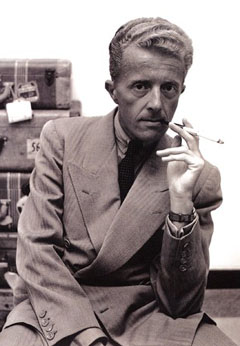
The Tangier of Paul Bowles as viewed by Truman Capote

at a beach in Tangier, Morocco
(published on Facebook by Truman Capote Society)
no copyright infringement intended
It's 1949, and Capote is 25 and has just published, to great acclaim, his first novel. Paris adulates him, and he's asked: Sir, what are you planning now? He pretends to have only one thing in mind, and smilingly answers his admirers: Spend the summer in Tangier.
(Daniel Rondeau, Tanger et autres Marocs, fragment translated in TALIMBLOG)
And in Tangier he went, this 25 years old Truman Capote, spending there some good time with other writers of the epoch. Some were settled there: firstly Jane and Paul Bowles, then David Herbert, a British socialite and memoirist, also the Spanish film critic and cultural animator Emilio Sanz de Soto-Lyons, also José (Pepe) Carleton Abrines, la memoria más exquisita de Tánger y Marbella. Others, like Capote, were just visiting (among them, his well-known literary rival Gore Vidal - their incidental encounter is narrated with humor and wit by Daniel Rondeau in his Tanger et d'autres Marocs).
Were I to visit today's Tangier, I wonder what I'd found from the spirit of that epoch, if something still remained. That special spirit which would much later make Herbert wish to have on his tombstone written he loved Morocco. I'm trying to understand the magic of the Tangier of those times, making it a shelter for both artists in search of the absolute and people on the run. Quoting Capote, a city for someone escaping from the police or merely escaping.
Tangier, a city of moving sands, a place to go there and get forgotten, attracting those looking for a hide, from the world, or from themselves. Capote was right to warn that before coming to Tangier, one should say good-bye to all friends - one might never see them again. People had come here for a brief holiday, to settle down and let the years go by. Among these people, the writers that Capote was visiting there. Paul Bowles came to Tangier in 1947 to remain for 52 years, till his death in 1999. Also David Herbert spent in Tangier almost fifty years. For Capote, this city was a basin holding you, a timeless place, where days were sliding by less noticed than foam in a waterfall.
From the visit Capote made there, it remained a vignette: Tangier, published in his Local Color collection from 1950. A vignette showing a city as a gate toward the unknown. Petit Soko, a café-cluttered square, a display ground for prostitutes, a depot for drug-peddlers, a spy-center - also the place where simpler folk drink their evening apéritif. All this calling maybe in mind the special mix populating Casablanca. Only twenty steps away, you are swallowed by the mists of Casbah, the citadel reminding that from that point it's another world beginning, with other values, other narratives, other heroes.
Some portraits gathered in the area of Petit Soko, drawn by Capote with his characteristic mix of matter of fact and implicit irony - sympathy: Estelle, a beautiful girl who walks like a rope unwinding, Maumi, an exotic young man given to cooling his face with a lacy fan, flamenco dancer and conversationalist, Lady Warbanks and her two hangers-on, with unvarying breakfast - a bowl of fried octopus and a bottle of Pernod - between them they combine every known vice, Nysa, the Europeanized Arab woman, a fact that nobody forgets her.
And above all, the night spent at Sidi Kacem, a limitless Sahara-like beach bordered by olive groves. It was the end of Ramadan, and Arabs from all over Morocco were arriving there to celebrate. Capote and his friends came by midnight and the first glimpse was like seeing a birthday cake blazing in a darkened room, filling you with the same excited awe you knew you could not blow out all the candles. What followed was like a journey in another century, or on another planet, and it took the whole night. In the morning, the rising sun made them know that they were back in their own century.
It's the Tangier of Paul Bowles as viewed by Truman Capote.
Here is the text:
(Truman Capote)
(Paul Bowles)
Labels: Capote, Paul Bowles
posted by Pierre Radulescu at
1:32 PM
|
1 comments