Tuesday, June 12, 2012
Wednesday, May 09, 2012
The F-A-E Sonata
(http://www.classicalm.com/en/composition/2402/FAE-Sonata-for-Piano-and-Violin)
no copyright infringement intended
The F-A-E Sonata has three composers: Robert Schumann (who had the idea), Johannes Brahms, and Albert Dietrich. It was a gift made to their friend, violinist Joseph Joachim, and he was invited by them one evening to play the piece at first view, together with Clara Schumann. The three composers challenged Joachim to identify the author for each part of the Sonata. He had no difficulty to do that.
Joseph Joachim
image by Reutlinger
(http://en.wikipedia.org/wiki/File:JJReutlingerPS1.jpg)
no copyright infringement intended
image by Reutlinger
(http://en.wikipedia.org/wiki/File:JJReutlingerPS1.jpg)
no copyright infringement intended
Why F-A-E? These were the initials of the motto Joachim had chosen for himself: Frei Aber Einsam (Free But Lonely), and the three composers managed to put the F-A-E sequence of notes as a musical cryptogram in each part of the Sonata.
F-A-E Sonata (1853):1. Allegro, by Albert Dietrich
Oliver Colbentson, Violin and Erich Appel, Piano
(video by Nancy Colbentson)
F-A-E Sonata (1853):2. Intermezzo (Romanze), by Robert Schumann
Oliver Colbentson, Violin and Erich Appel, Piano
(video by Nancy Colbentson)
F-A-E Sonata (1853):3. Scherzo (Allegro), by Johannes Brahms
Oliver Colbentson, Violin and Erich Appel, Piano
(video by Nancy Colbentson)
F-A-E Sonata (1853):4. Finale, by Robert Schumann
Oliver Colbentson, Violin and Erich Appel, Piano
(video by Nancy Colbentson)
(Aimez-vous Brahms?)
(Robert Schumann)
Tuesday, May 01, 2012
Heine: Ich wandelte unter den Bäumen
Heine, Buch der Lieder. Erstdruck, 1827
Antiquariat Dr. Haack Leipzig, Privatbesitz Wien
Foto © H.-P. Haack
no copyright infringement intended
(http://en.wikipedia.org/wiki/File:Heine_Buch_der_Lieder_1827.jpg)
Ich wandelte unter den Bäumen
Mit meinem Gram allein;
Da kam das alte Träumen,
Und schlich mir ins Herz hinein.
Wer hat euch dies Wörtlein gelehret,
Ihr Vöglein in luftiger Höh?
Schweigt still! wenn mein Herz es höret,
Dann tut es noch einmal so weh.
»Es kam ein Jungfräulein gegangen,
Die sang es immerfort,
Da haben wir Vöglein gefangen
Das hübsche, goldne Wort.«
Das sollt ihr mir nicht mehr erzählen,
Ihr Vöglein wunderschlau;
Ihr wollt meinen Kummer mir stehlen,
Ich aber niemanden trau.
Mit meinem Gram allein;
Da kam das alte Träumen,
Und schlich mir ins Herz hinein.
Wer hat euch dies Wörtlein gelehret,
Ihr Vöglein in luftiger Höh?
Schweigt still! wenn mein Herz es höret,
Dann tut es noch einmal so weh.
»Es kam ein Jungfräulein gegangen,
Die sang es immerfort,
Da haben wir Vöglein gefangen
Das hübsche, goldne Wort.«
Das sollt ihr mir nicht mehr erzählen,
Ihr Vöglein wunderschlau;
Ihr wollt meinen Kummer mir stehlen,
Ich aber niemanden trau.
Wandering through the forest, alone with your thoughts.You've fallen in love, she ignored you. You hear a little word, whistled by the wind, rustled by the leaves, you don't know where it comes from: a little word like an answer to your love. The birds chirp it. Where did the birds learn the word? The birds, the wind, the leaves? And you realize: that forest is a magic garden.
Stephan Genz and Claar Ter Horst
(video by nadaniente115a)
Wandering among the trees
Alone with my deep sorrow,
I was visited by those old dreams
Which in my heart would burrow.
Who was it taught you to sing that word,
You birds up there on high?
Hush, for should it reach my heart
The pain will multiply.
“A girl who used to walk here,
She sang it all the time.
It was from her we learnt it,
That golden word sublime.”
You should not have let me know that,
You wily, sly old bird.
You’re trying to steal my anguish,
But I take no one’s word.
Alone with my deep sorrow,
I was visited by those old dreams
Which in my heart would burrow.
Who was it taught you to sing that word,
You birds up there on high?
Hush, for should it reach my heart
The pain will multiply.
“A girl who used to walk here,
She sang it all the time.
It was from her we learnt it,
That golden word sublime.”
You should not have let me know that,
You wily, sly old bird.
You’re trying to steal my anguish,
But I take no one’s word.
(Translation copyright © 2012 by Uri Liebrecht)
(Heinrich Heine)
(Robert Schumann)
Monday, April 30, 2012
Schumann: Piano Concerto in A minor
Portrait of Clara Schumann, 1838
Author: Andreas Staub
no copyright infringement intended
(http://en.wikipedia.org/wiki/File:Clara_Schumann_%28Andreas_Staub%29_freigestellt.png)
In 1841, Schumann wrote a fantasy for piano and orchestra, his Phantasie. His pianist wife Clara urged him to expand this piece into a full piano concerto. In 1845 he added the intermezzo and finale to make the completed work. It turned out to be the only piano concerto that Schumann completed. The work premiered in Leipzig on 1 January 1846 with Clara playing the solo part. Ferdinand Hiller, the work's dedicatee, conducted.
(wiki)
Robert Schumann, Piano Concerto in A minor Op.54, 1845
Martha Argerich, piano
Leipzig Gewandhaus Orchestra, Ricardo Chailly, conductor
(00:31) I. Allegro affettuoso(A minor)
(15:35) II. Intermezzo:Andantino grazioso (F Major)
(21:23) III. Allegro vivace(A Major)
(video by capitantotti)
(Robert Schumann)
Labels: Schumann
Schumann: Toccata
Schumann, Toccata op 7
no copyright infringement intended
(http://www.all-music-sheets.com/schumann-robert-m-12.html?page=4&sort=1d)
Geert Dehoux:
Toccata originally comes from toccare, which means to touch. ToccatA is the female passive form of something which is touched, nothing more. Later it became a pièce de bravoure, using lots of notes and a strict rhythm. However, we recognize the poet Schumann in the short melody , he repeats 5 times. In my opinion, no one understood this better than the older Gilels. Therefore, shouldn't the tempo be based on that melody, rather than on empty notes?
Astronomo16:
Crazy performance. Richter is the best.
(Robert Schumann)
Labels: Schumann
Schumann: Träumerei
Room of music in Schumann House, Zwickau
no copyright infringement intended
(http://en.wikipedia.org/wiki/File:Robert-Schumann-Haus.JPG)
Schumann: Träumerei
from Kinderszenen Op.15, 1838
Mark Farago, piano
Recorded live on March 14, 2007
at Schloss Kössern, Germany
(video by Mark Farago)
(Robert Schumann)
Labels: Schumann
Sunday, April 29, 2012
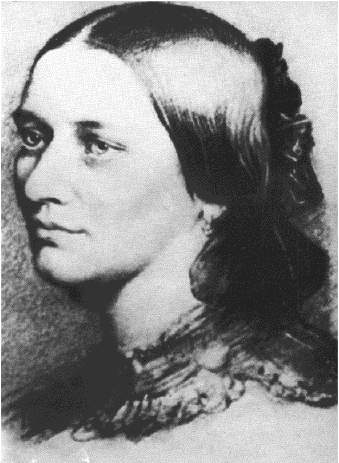
Robert Schumann
Clara (née Wieck) and Robert Schumann
no copyright infringement intended
(http://ecmreviews.com/tag/schumann/)
- Dichterliebe - Allnächtlich im Traume
- Ich wandelte unter den Bäumen, Liederkreis op 24
- Die Lorelei viewed by Clara Schumann
- Träumerei
- Toccata
- Piano Concerto in A minor
- The F-A-E Sonata
(Old Masters)
Labels: Schumann
Saturday, April 28, 2012
Heine: Allnächtlich im Traume
Musical sheet from Schumann's score for Heine's Allnächtlich im Traume
no copyright infringement intended
(http://www.musicalion.com/en/scores/notes/composer/view/id/90?ppage=2)
Allnächtlich im Traume seh ich dich,
Und sehe dich freundlich grüßen,
Und lautaufweinend stürz ich mich
Zu deinen süßen Füßen.
Du siehst mich an wehmütiglich,
Und schüttelst das blonde Köpfchen;
Aus deinen Augen schleichen sich
Die Perlentränentröpfchen.
Du sagst mir heimlich ein leises Wort,
Und gibst mir den Strauß von Zypressen.
Ich wache auf, und der Strauß ist fort,
Und das Wort hab ich vergessen.
A superb example of Heine's elegant balance between lyricism and self-irony. Mendelssohn and Schumann offered scores for this poem.
Robert Schumann: Dichterliebe - Allnächtlich im Traume seh ich Dich
Wiebke Hoogklimmer, Contralto - Patrick Walliser, Piano
(video by wiebkecontralto)
Here is a non-literal translation, done by Hal Draper:
Nightly I see you in dreams-you speak,
With kindliness sincerest,
I throw myself, weeping aloud and weak
At your sweet feet, my dearest.
You look at me with wistful woe,
And shake your golden curls;
And stealing from your eyes there flow
The teardrops like to pearls.
You breathe in my ear a secret word,
A garland of cypress for token.
I wake; it is gone; the dream is blurred,
And forgotten the word that was spoken.
(Heinrich Heine)
(Robert Schumann)
Labels: Hal Draper, Heine, Schumann


_freigestellt.png)