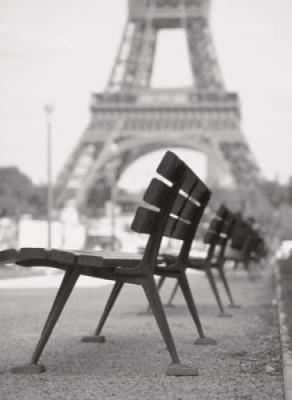
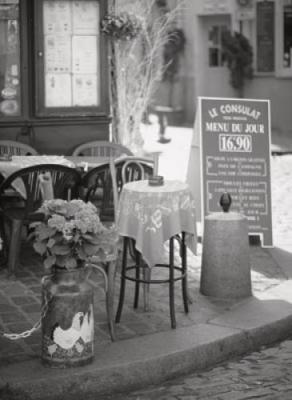
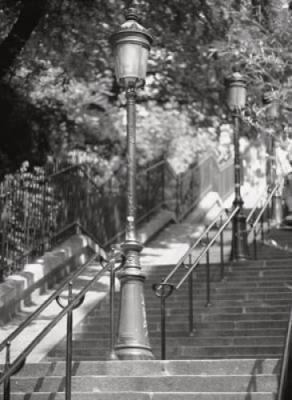
Teo Tarras - Cafe de la Paix
 Paintings and music, street noises, flower markets, modes, fabrics, poems, ideas, everything seemed to lead toward a half-sensual, half-intellectual swoon. Inside the cafes, color, perfume, taste and delirium could be poured together from one bottle or many bottles - from square, cylindrical, conical, tall, squat, brown, green or crimson bottles - but you drank black coffee by choice, believing that Paris itself was sufficient alcohol.
(Malcolm Cowley, Exile's Return: A Literary Odyssey of the 1920s)
Cowley lived in Paris for three years and he was a friend of Hemingway and Scott Fitzgerald. Later in life he edited the works of Hemingway, Faulkner and Nathaniel Hawthorne. Very important his introductions to The Portable Faulkner and to Winesburg, Ohio of Sherwood Anderson. His Exile's Return appeared in 1934 and chronicles the general movement by the Lost Generation out of the United States (Wikipedia).
The Hours was firstly a novel written by Michael Cunningham, and then a movie - the story of how a book affects (and is affected by) the life of three women, living in different epochs. The three women are the author, the reader, and the main character. The author is Virginia Woolf (played by Nicole Kidman) - she is starting to write the first chapter of her Mrs. Dalloway, in 1923 in England. The reader (played by Julianne Moore) filters the universe of Mrs. Dalloway through her own universe - other time (1951), other space (California), other experience of life. And the main character of Mrs. Dalloway (played by Meryl Streep) lives also in her own universe! - once she was created by the author, she got (with or without the author's will) autonomy, an existence of her own, free to chose her time (2001), her space (Manhattan), her career, her issues. Actually a book has three independent players, the author, the character, and the reader - there are so many Don Quixote as many readers are - and Don Quixote is not only what Cervantes decided. Great authors (Chekhov is such an example) understood this need of their characters for autonomy and did not impose too many constraints through the plot of their books.
This album on Parisian cafes, that I follow page after page, shows me also the way the author, the characters and the reader have impact on each other. The author, Val Clark, made the selection of the images and of the texts. The characters of the book are great photographs along with great writers. And I see Paris through the eyes of Brassaï, Kertesz, Doisneau, Boubat, Man Ray, Dennis Stock, Teo Tarras (and also Van Gogh, Manet, Stuart Davis, Pissaro), each one with its own sensibility, with its own obsessions. I am looking on the web for the images from the album, sometimes I found other photos, and as I follow the book, I get more and more intimate with the universes of these masters. Then the writers selected in the book, generally belonging to the so called Lost Generation - each one different, with its own memories of Paris - and each one surprising me in a slightly different way.
And as I follow the pages of the album, looking on the web for the photos, finding sometimes others, understanding little by little the universes of these fabulous artists, photographs, painters or writers - all this is filtered through my own life experience, my memories from Bucharest, as well as my present experience - I think at Paris as I am strolling through the streets of Washington, as I am interested also in other lost generations: the generation of Vietnam (Caputo, Herr, Wolff), the generation of Bosnia (Loyd), along with the generation of writers from the Eastern Europe, my generation, who lived under the Communist rule, having our own dreams, obsessions, hopes... I am just reading Imperium, by the Pole Ryszard Kapuscinski, fantastic journey through a Soviet Union in the moment of collapse.
So my reading (so to speak my own Don Quixote) is not only the Paris of Val Clark and not only her selection of artists – my reading is in the same time Paris and DC, and not only.
Labels: Teo Tarras
posted by Pierre Radulescu at
11:07 PM
|
0 comments