Updates, Live

Saturday, August 31, 2019

Hemingway in Bucharest

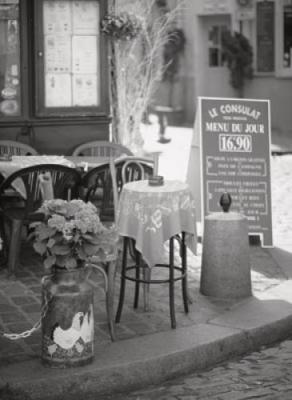
Calea Victoriei, pe lângă Strada Frumoasă
(© Pierre Rădulescu)


Santiago, Hemingway's old pal, came for a little while to Bucharest, seemingly bringing with him his boat, and a bit of his sea, well, all the good stuff. I met him this morning, he was resting somewhere on Calea Victoriei. I asked him ¿Qué pasa, compadre? He didn't answer, just keeping his smile.


(Bucureşti)

(Hemingway)

Labels:

Friday, October 03, 2014

Timothy Egan: Haunted by Hemingway

Timothy Egan
(http://www.omahatownhall.org/speakers/)
no copyright infringement intended

... but in Paris, at least, he (Hemingway) found something real and deep in another mythic setting, though it would not be lasting ... we ate well and cheaply and drank well and cheaply and slept well and warm together and loved each other ... that is the sort of happiness you should not tinker with but nearly everyone you knew tried to adjust it ...


A superb story about Hemingway in today's NY Times, by Timothy Egan:


... just when you think you can quit him, hate him, make fun of him, Hemingway continues to fascinate ...


(Hemingway)

Labels:

Wednesday, May 23, 2012

Portrait of a Bookstore as an Old Man


Shakespeare and Company, on 37 Rue de la Bûcherie, Paris, an incredible place even on the standards of such an incredible city. It is a chaotic English-language bookstore where one can find virtually any book ever (not only in Shakespeare's tongue, possibly in any given gibberish), in the same time a chaotic reading library, also a chaotic shelter for young and older literature lovers. You can find a bed there, among the bookshelves (forget about fresh sheets), also a very bohemian breakfast (forget about food hygiene rules), provided you have written something, or you have in mind to write, in some indefinite future; the general rule is to help in the bookstore during the day in order to sleep there during the night.

Allen Ginsberg, Henry Miller, Anaïs Nin, Jacques Prévert, have been among the customers, and seemingly 40,000 people have spent there a night or two, or more, throughout the decades: it is a shelter for any books, as controversial, outrageous, or damned as they could be, for writers and aspiring writers, anarchists et al. and for ideas, radical or crazy, whatever.

The shop was opened in 1951, by George Whitman, an American intensely living the Beat spirit of those years. It had been, some centuries earlier, a monastery on that site, and George built there a shrine for bohemians, a den of anarchists disguised as a bookstore, as someone would later coin the thing.


An old fountain, one of those delicious Parisian paraphernalia, is in front of the bookstore, and the place is superb especially during April, with the silhouette of Notre Dame delicately emerging behind the blossoming trees. The street is just across l'Île de la Cité, on the Rive Gauche. It's an old street, this Rue de la Bûcherie: its name comes from the Middle Ages, when damaged meats were salted and boiled here to feed the poorest (according to wiki). My first encounter with Rue de la Bûcherie was through a famous photo, that I saw at an exhibition: the image of the street, with l'eau, ruisselant prés du trottoir, had been taken sometime in 1865 or 1869 (or in between, scholars are still debating), by one of the greatest Parisian photographers, Charles Marville (le chanteur triste d'une vielle balade... le témoin élégiaque d'un Paris qui n'est plus).

Charles Marville, Rue de la Bucherie Charles Marville, Rue de la Bûcherie, 1865/1869
l'eau, ruisselant prés du trottoir...
(http://theonlinephotographer.blogspot.com/2006/04/photographic-discoveries-at-national.html)

The first name of the bookstore has been Le Mistral. Later, in 1964, George Whitman renamed it Shakespeare and Company, as a tribute to the first Parisian bookstore carrying this name. Because it had been a first Shakespeare and Company in Paris, opened in 1919 by Sylvia Beach, also an American irresistibly attracted by La Ville-Lumière.

That older bookstore had been an epicenter of the modernism during the years of the Lost Generation (Les Années folles, as the 20's remained known), and later, throughout the 30's. Hemingway, Ezra Pound, Gertrude Stein, Scott Fitzgerald, Man Ray, have been assiduous visitors, and James Joyce (who set his office in the bookstore) nicknamed it Stratford-on-Odéon (as the building was situated on Rue de l'Odéon). The bookstore was a host for famous books initially banned everywhere else, Lady Chatterley's Lover, or Ulysses, for instance. Actually Joyce's novel has been firstly published integrally there, at Shakespeare and Company!

Hemingway would warmly recall the memory of the store from Rue de l'Odéon, in his Moveable Feast:

On a cold windswept street, this was a warm, cheerful place with a big stove in winter, tables and shelves of books, new books in the window, and photographs on the wall of famous writers both dead and living. The photographs all looked like snapshots and even the dead writers looked as though they had really been alive.

That first bookstore was closed in 1940, during the German occupation, and never re-opened (though Hemingway famously entered the building in 1944 to liberate it). And in opening the second bookstore, George Whitman had in mind to revive the spirit of the old Shakespeare and Company. George ran the place till 2003 (he was 93 years old then). After that the responsibility of the venture passed to  his daughter (Sylvia Beach Whitman - she was given the name of the founder of the first bookstore).

A whole story, and, as you would expect, the bookstore rose also the interest of film makers. Shakespeare and Company had a cameo in a 2011 movie of Woody Allen: Midnight in Paris. The main character (Owen Wilson), a sympathetic dreamer who's writing a novel about the Paris of the 20's, takes in the end his courage and decides to break with his too pragmatic fiancée and his too pragmatic well-being in California. He chooses La Ville-Lumière instead, whatever will happen: after all Paris is dead drop gorgeous when it rains! And the bookstore from Rue de la Bûcherie appears on the screen just for a second, maybe to reassure us that finding a place to stay in Paris is not that impossible.

A longer apparition was in 2004's Before Sunset: a young American writer (Ethan Hawke) spends an afternoon in Paris, invited to have a reading at Shakespeare and Company. An old flame (Julie Delpy) is there by chance. They had a brief romance in Vienna, nine years earlier. Life went on and many things happened meanwhile, but the chemistry still exists (maybe subtly fueled by the special universe of the bookstore, who knows?)

Well, Shakespeare and Company has also a movie of its own,  a gorgeous documentary made in 2003, Portrait of a Bookstore as an Old Man. The filmmakers (Gonzague Pichelin and Benjamin Sutherland, directors and screenplayers) mixed archive footage with live shots, and succeeded to render that incredibly bohemian world. George Whitman, his daughter Sylvia, Ferlinghetti, Allen Ginsberg, Sylvia Beach, Lawrence Durrell, and all the others, playing as themselves, interviewed on the spot or brought from the archives, the whole bunch of rebels is there, the utopia is alive. And the little stories coming and going now and then, that student who's trying to fix the carpet in one of the rooms, using pancake batter as glue, or George himself, using the flame of a candle to trim his hair, you have to see that to believe. Add to this the great soundtrack, authored by Michael Galasso, who used here the same theme as in Chungking Express.  And George, everywhere everytime, moody and restless, like a devil in a box, comme un diable au fond de sa boîte.


George Whitman passed away in December 2011. He was 98 years old. Shakespeare and Company has remained a miraculous place in Paris. There is only one more place like that in the world, the City Lights Books in San Francisco, whose founder, Lawrence Ferlinghetti, was a close friend of George Whitman.

Speaking about all this, I have the feeling of witnessing a time-space warp, as everything is becoming ubiquitous. All history of Rue de la Bûcherie is there, together with the Lost Generation and with the Beatniks, with May 68, San Francisco and Paris, all this unified in one denominator: the persistence of free spirit.


(A Life in Books)

(Benjamin Sutherland and Gonzague Pichelin)

(Michael Galasso)

(The Fitzgeralds)

Labels: , , , , , , , ,

Thursday, January 05, 2012

Joris Ivens: The Spanish Earth (1937)


The Spanish Earth (Tierra de España), made in 1937 by Joris Ivens, with a remarkable team of screenwriters: Lilian Hellman authored the story based on which John Dos Passos and Ernest Hemingway wrote the English narration (read in voice-off by Orson Welles - then Hemingway decided to use his own voice, replacing Wells, who remained credited, though). Jean Renoir wrote the French version of the narration. Hemingway and Dos Passos will broke their friendship later, as their life experiences will lead them to very different political views. But by that time all of them were very committed and this documentary about the Spanish Civil War is obviously totally partisan.

I found in Senses of Cinema an interesting remark about this movie: Ivens would return frequently in his films to man’s relationship with the land, and to water and irrigation. For some critics it is a major theme, and Ivens is sometimes seen less as a political filmmaker than a sort of frustrated nature poet. However, as in The Spanish Earth, the land and the water are frequently political in Ivens’ cinema, they are part of the struggle.


The Spanish Earth (1937): Part 1/6
(video by femalerevolution)


The Spanish Earth (1937): Part 2/6
(video by femalerevolution)


The Spanish Earth (1937): Part 3/6
(video by femalerevolution)


The Spanish Earth (1937): Part 4/6
(video by femalerevolution)


The Spanish Earth (1937): Part 5/6
(video by femalerevolution)


The Spanish Earth (1937): Part 6/6
(video by femalerevolution)


(Joris Ivens)


(Hemingway)

Labels: , ,

Friday, October 07, 2011

An Upcoming Movie: Hemingway & Gellhorn

Martha Gellhorn and Ernest Hemingway with unidentified Chinese military officers, Chungking, China, 1941
unknown photographer
(Ernest Hemingway Photograph Collection, John F. Kennedy Presidential Library and Museum, Boston)

HBO announces for 2012 Hemingway & Gellhorn, a movie telling the story of one of XXth century most famous literary couples. Martha Gellhorn and Ernest Hemingway met in 1936 in a bar in Key West, Florida. She was already a renowned journalist, he was a renowned author. They began a relationship, with on and off episodes. In 1937 they went together in Spain to cover the Civil War.

Martha Gellhorn and Ernest Hemingway in Sun Valley, Idaho, at the time of their wedding, November 1940.
The photo was taken for Life magazine. Robert Capa © 2001 by Cornell Capa

(http://www.xtimeline.com/evt/view.aspx?id=39433)

They married in 1940. She traveled extensively during WWII, reporting from Finland, Hong Kong, Burma, Singapore and Britain. Lacking official press credentials to witness the D-Day landings, she impersonated a stretcher bearer! She was then among the first journalists to report from Dachau, after the camp was liberated.

In 1945 she asked for divorce. Both were too independent guys, too determined, too strong personalities, to cope each other.

Maria from Hemingway's For Whom the Bell Tolls was partly modeled after Martha Gellhorn: her hair was the golden brow of a grain field.

After their divorce, Martha Gellhorn continued her carrier of war correspondent, covering the Vietnam War, the Six-Day War, civil wars in Central America, the American invasion of Panama. She had to give up when the Bosnian War started: she was already late in her eighties!

Her end was tragic: at 89 she committed suicide, after a long battle with cancer and near total blindness.

Nicole Kidman will play Martha Gellhorn in the movie. Clive Owen will be Hemingway, and David Strathairn will be in the role of John Dos Passos (it was on the Spanish front that Dos Passos and Hemingway broke their friendship, due to divergent political views).

Read also the HBO Greenlights about the movie:


(Filmofilia)

(Hemingway)

Labels:

Friday, April 15, 2011

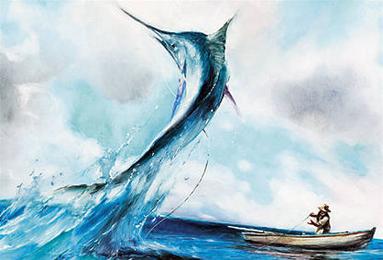
Aleksandr Petrov: The Old Man and the Sea (1999)


He was an old man who fished alone in a skiff in the Gulf Stream and he had gone eighty-four days now without taking a fish. In the first forty days a boy had been with him. But after forty days without a fish the boy's parents had told him that the old man was now definitely and finally salao, which is the worst form of unlucky.
(
Salao is the word used in Mexico and the Caribbean region to name someone who is victim of a curse - Persona que es víctima de un maleficio).

So starts Hemingway's The Old Man and the Sea. You have the full text at http://www.classic-enotes.com/american-literature/american-novel/ernest-hemingway/the-old-man-and-the-sea/full-text-of-the-old-man-and-the-sea-by-ernest-hemingway/.

An old fisherman (everything about him was old except his eyes), once again challenged by fate: facing the giant fish, facing his own frailty. Long time ago he had been a foolhardy sailor, facing the Atlantic, facing the African coast. The memory of those times lasted only in his dreams, populated with lions and elephants.


Now the old man starts again the fight. It is a fight of equals (he is my brother, but I must kill him and keep strong to do it). The giant marlin comes in his imagination as a brother, the same with the lions and elephants of Africa, populating his dreams. And he has to kill the marlin, the noble brother, or to be killed. There is no place for both.

Also his frailty, his lack of confidence, his lack of strength are his brothers. Because he is so old. And he has to kill them, his brothers, or to be killed.

And all these noble brothers, the marlin and his weaknesses, belong to nature. The old man is fighting brother nature: he must kill it, or to be killed.


Aleksandr Petrov worked two years and a half to paint more than 29,000 glass plates, each one four times larger than the usual A4-size. The images were finally shot with an IMAX camera.


The result is a masterpiece. It's difficult, if not impossible, to describe it in words. Hemingway's is a masterpiece of words, difficult to put it in images. Petrov's is a masterpiece of images, difficult to put it in words.

I found on the web a superb comment:

Petrov must have battled to create this just like the old man.


The Old Man and the Sea: part 1/2
(video by dgroza)


The Old Man and the Sea: part 2/2
(video by dgroza)


(Aleksandr Petrov)

(Hemingway)

Labels: ,

Thursday, April 14, 2011

Hemingway


His style is characterized by economy and understatement.


Hemingway: All my life I looked at words as though I were seeing them for the first time.

Hemingway: All modern American literature comes from one book by Mark Twain called Huckleberry Finn.

Hemingway: All good books have one thing in common - they are truer than if they had really happened.


(A Life in Books)

Labels:

Tuesday, July 13, 2010

The Typewriter of Hemingway


Economy and understatement: that was the style of Hemingway. And, through his cult of courage, his taste for adventure, an acceptance of the possibility of fantastic. His economic style puts a restraint to fantastic, a balance.

I read his Farewell to Arms long time ago; my English was still very poor, and I was able to read it easily, without the help of a dictionary.

(Hemingway)

Labels:

Saturday, June 14, 2008

Floyd Davis - Bar in Hôtel Scribe, Paris, 1944

Floyd Davis - Bar in Hôtel Scribe, Paris, 1944

1944, end of August: Paris was free again, the allies were pressing further the Wermacht toward Germany.

Hôtel Scribe (located between l'Opera and Place Vendôme: so downtown Paris that nothing else could express more accurately what downtown Paris means) had been the German press center during the Occupation; it was now hosting the Allied press headquarters. The red flag with black Swastika was now down, replaced by the banners of the Allies: Stars and Strips, Scythe and Hammer (the Cold War was to begin only a few years later), along with the French tricolor and the Union Jack.

So the bar of the hotel became a watering hole for the Allied war correspondents: the place where journalists coming from the front were chatting with the ones who were to go in mission.

Hemingway was among them: you can see him at the table in the low center. Robert Capa was also there.

The artist who depicted the bar was Floyd Davis: the guy was working for Life magazine.


Close-up on Ernest Hemingway


Close Up on Robert Capa


The painting is now at the National Portrait Gallery in DC, in the same room with portraits of great personalities from that epoch: generals, and scientists, and political leaders. So here they are, together Eisenhower, Oppenheimer, Einstein, Patton, Marshall, MacArthur, Churchill. Watch the video!


(American Art and Portraiture)

(Hemingway)

Labels: ,

Saturday, July 15, 2006

Teo Tarras - La Terrasse

Teo Tarras - La TerrasseIt was late and every one had left the cafe except an old man who sat in the shadow the leaves of the tree made against the electric light. In the day time the street was dusty, but at night the dew settled the dust and the old man liked to sit late because he was deaf and now at night it was quiet and he felt the difference.
Ernest Hemingway, A Clean, Well-Lighted Place


I was today in Clarendon firstly and then in Georgetown. I was looking for a book, A Rumor of War, by Philip Caputo, I found it in the bookstore in Clarendon. I read the first pages and it is remarcably written - only it should wait, I am now reading the Imperium of Ryszard Kapuscinski. In Georgetown I went to see an art gallery, the Attis Art, displaying only French artists: Tobiasse, Ferrer, Cayrac, among others. Cayrac has a splendid cut-out, Carnet de voyage, I will come later to it. I'd like to link the story behind Carnet de voyage to a work of Ferrer, Orient, also on view in the gallery. Here is an image of Carnet de Voyage:

Oliver de Cayron, Carnet de Voyage, Attis Art Gallery, Washington DC


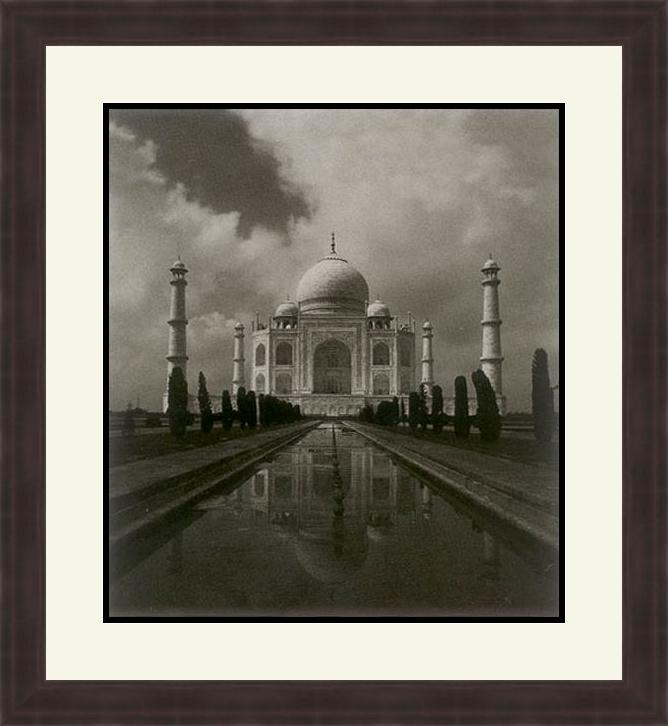
Teo Tarras was born in Barcelone, in 1960. Here is another photo made by him, the Taj Mahal:


Taj Mahal


(Washington, District of Columbia)

(Hemingway)

Labels: ,

Friday, July 14, 2006

Dennis Stock, Cafe de Flore

Dennis Stock, Cafe de Flore I am of those who like to stay late at the cafe, the older waiter said. With all those who do not want to go to bed. With all those who need a light for the night. I want to go home and into bed. We are of two different kinds, the older waiter said. He was now dressed to go home. It is not only a question of youth and confidence although those things are very beautiful. Each night I am reluctant to close up because there may be some one who needs the cafe.
Ernest Hemingway, A Clean, Well Lighted Place

I was in Prague, attending a symposium at the Polytechnics, at the School of Electrical Engineering, and I remember their elevator. It was the Pater type - running continuously, very slowly, to allow people to get on and off. It was going up, at the top it was moving horizontally from one pit to the other, then it was going down, where again was moving horizontally.

A special dinner was organized on the last evening, the restaurant was in the middle of a huge garden. We were all very young and noisy, so after the dinner we went out in the garden and started to sing and to make fun. An old waiter came to us and asked in German, is this your last evening in Prague? I was the only one of the group speaking a bit of German, so I was supposed always to be the spokesman. Yes, it's our last evening. Then have fun, said the old waiter, with a mild smile.

You know, they say the finest German is spoken in Prague, while Vienna is the place for the finest Czech.

My first encounter with Hemingway was a movie, The Old Man and the Sea, it was also my first encounter with Spencer Tracy. After some years, I found A Farewell to Arms. I was in the Sadoveanu bookstore in Bucharest, and by that time they had a special section with books printed in the USSR - most of them in Russian, some were in English or French. The first time I was reading something in English, and to my great surprise I read it quite easily.

There are many ways leading to Hemingway. Some books that I am trying now to read are of authors in the great line of him: Anthony Loyd (My War Gone By I Miss It So), Michael Herr (Dispatches), Ryszard Kapuscinski (The Soccer War, Imperium). Kapuscinski is really great. John Le Carre says about him, if Marquez is the grand wizard of modern fiction, Kapuscinski is the conjuror extraordinary of modern reportage. I'd like to write more about him, I have something in mind, let's see how it'll look like.

As for Dennis Stock, he is well known for his photographic portraits of James Dean, as well as of Satchmo, Billie Holiday, Duke Ellington ... American jazz is a religion, it is humor, it is vitality and sadness.

Dennis Stock, James Dean, 1955Dennis Stock, Billie Holliday


(Hemingway)

Labels:

Tuesday, July 11, 2006

Van Gogh, Cafe Terrace at Night

Vincent Van Gogh, Cafe Terrace at Night
(Click here for the Romanian Version)
The lights grew bright along the Boulevard St. Michel and the cafe terraces filled with people ... Night settled like a blue blanket over Paris.
Langston Hughes, The Big Sea: An Autobiography

I came to a good cafe that I knew on the Place St.-Michel. It was a pleasant cafe, warm and clean and friendly, and I hung up my old waterproof on the coat rack to dry and put my worn and weathered felt hat on the rack above the bench and ordered a cafe au lait. The waiter brought it and I took out a notebook from the pocket of the coat and a pencil and started to write.
Ernest Hemingway, A Moveable Feast


Clarendon - part of the Arlington County, in Greater DC area. Spending sometimes the evening there. Not Paris, of course - it's very small, only one block actually - but it has style, and it has a certain taste for the savoir vivre.

People stay at the terraces of the cafes - La Tasca, with sangria and the tapas cuisine, marisscos, or Chorizo al vino, you have there the feeling of the South of Spain universe - then the Cheesecake Factory, with huge cakes and great wines - and the Harry's Tap Room, and a bit farther the Dr. Dremo's Tap House- there is also in Clarendon a wine store, very classy, then some other restaurants, each one with a personality of its own, and a coffee house - there I like to go often, to stay at a table on the small terrace, watching the scenery of the street, while nightfall is veiling everything with its blue sprinkles - Langston Hughes was speaking about his Parisian evenings - the terraces of the cafes, on Boul Saint Mich, I was once there, in 1999, only for a too short period - a week passed so quickly... the Paris of Hemingway and Henry Miller, the Paris from the movies of Pola Rapaport - and I remember now one evening in New York, the Gramercy Theater on the 23rd Street, a show with old Parisian documentaries, gathered in a lifetime by Jack Goelman ...

I'm leaving the coffee house, a bookstore is in close distance, I would go again there one of these evenings - or maybe in DuPont Circle, at the Kramer Books - I found a book by Philip Caputo last time, Horn of Africa.

Clarendon, or Bethesda, or the Friendship Heights ... the Washingtonian charme.


(Clarendon)

(Hemingway)

(Van Gogh)

Labels: , ,