Updates, Live

Thursday, April 04, 2013

The Doomed Golden Couple: Zelda and Scott

(Southern Literary Trail)
no copyright infringement intended


Says Nick Wallace-Smith, who didn't read Scott Fitzgerald's A Diamond as Big as the Ritz or The Great Gatsby at university; and not for any Eng. Lit. course but for the sheer Jazz Age excess expressed in the stories; and of course for the delicious writing - like crème brûlée; curiously though, and when I think back, I had no strong mental image of either the writer or his wife; so I started to look at what photographs there were around and was stunned to find so much film footage of them existed; so I've gathered up what I could find:
[1] Zelda as a young woman and walking about rather saucily and hip-swinging in a garden.
[2] Zelda a little older and playing gaily about in a street.
[3] the couple with daughter Frances and in a garden.
[4] on the Riviera in 1924.
[5] And in a cafe.
[6] Finally, F Scott Fitzgerald working on The Great Gatsby.


rare footage of the Fitzgeralds from the 1920s
(video by Nick Wallace-Smith)


(The Fitzgeralds)

Labels:

The Fitzgeralds


Scott was inspired and prodded along in his dissipation by the notoriously eccentric Zelda. As Ring Lardner once put it, Mr. Fitzgerald is a novelist and Mrs. Fitzgerald is a novelty .


(A Life in Books)

Labels:

Wednesday, May 23, 2012

Portrait of a Bookstore as an Old Man


Shakespeare and Company, on 37 Rue de la Bûcherie, Paris, an incredible place even on the standards of such an incredible city. It is a chaotic English-language bookstore where one can find virtually any book ever (not only in Shakespeare's tongue, possibly in any given gibberish), in the same time a chaotic reading library, also a chaotic shelter for young and older literature lovers. You can find a bed there, among the bookshelves (forget about fresh sheets), also a very bohemian breakfast (forget about food hygiene rules), provided you have written something, or you have in mind to write, in some indefinite future; the general rule is to help in the bookstore during the day in order to sleep there during the night.

Allen Ginsberg, Henry Miller, Anaïs Nin, Jacques Prévert, have been among the customers, and seemingly 40,000 people have spent there a night or two, or more, throughout the decades: it is a shelter for any books, as controversial, outrageous, or damned as they could be, for writers and aspiring writers, anarchists et al. and for ideas, radical or crazy, whatever.

The shop was opened in 1951, by George Whitman, an American intensely living the Beat spirit of those years. It had been, some centuries earlier, a monastery on that site, and George built there a shrine for bohemians, a den of anarchists disguised as a bookstore, as someone would later coin the thing.


An old fountain, one of those delicious Parisian paraphernalia, is in front of the bookstore, and the place is superb especially during April, with the silhouette of Notre Dame delicately emerging behind the blossoming trees. The street is just across l'Île de la Cité, on the Rive Gauche. It's an old street, this Rue de la Bûcherie: its name comes from the Middle Ages, when damaged meats were salted and boiled here to feed the poorest (according to wiki). My first encounter with Rue de la Bûcherie was through a famous photo, that I saw at an exhibition: the image of the street, with l'eau, ruisselant prés du trottoir, had been taken sometime in 1865 or 1869 (or in between, scholars are still debating), by one of the greatest Parisian photographers, Charles Marville (le chanteur triste d'une vielle balade... le témoin élégiaque d'un Paris qui n'est plus).

Charles Marville, Rue de la Bucherie Charles Marville, Rue de la Bûcherie, 1865/1869
l'eau, ruisselant prés du trottoir...
(http://theonlinephotographer.blogspot.com/2006/04/photographic-discoveries-at-national.html)

The first name of the bookstore has been Le Mistral. Later, in 1964, George Whitman renamed it Shakespeare and Company, as a tribute to the first Parisian bookstore carrying this name. Because it had been a first Shakespeare and Company in Paris, opened in 1919 by Sylvia Beach, also an American irresistibly attracted by La Ville-Lumière.

That older bookstore had been an epicenter of the modernism during the years of the Lost Generation (Les Années folles, as the 20's remained known), and later, throughout the 30's. Hemingway, Ezra Pound, Gertrude Stein, Scott Fitzgerald, Man Ray, have been assiduous visitors, and James Joyce (who set his office in the bookstore) nicknamed it Stratford-on-Odéon (as the building was situated on Rue de l'Odéon). The bookstore was a host for famous books initially banned everywhere else, Lady Chatterley's Lover, or Ulysses, for instance. Actually Joyce's novel has been firstly published integrally there, at Shakespeare and Company!

Hemingway would warmly recall the memory of the store from Rue de l'Odéon, in his Moveable Feast:

On a cold windswept street, this was a warm, cheerful place with a big stove in winter, tables and shelves of books, new books in the window, and photographs on the wall of famous writers both dead and living. The photographs all looked like snapshots and even the dead writers looked as though they had really been alive.

That first bookstore was closed in 1940, during the German occupation, and never re-opened (though Hemingway famously entered the building in 1944 to liberate it). And in opening the second bookstore, George Whitman had in mind to revive the spirit of the old Shakespeare and Company. George ran the place till 2003 (he was 93 years old then). After that the responsibility of the venture passed to  his daughter (Sylvia Beach Whitman - she was given the name of the founder of the first bookstore).

A whole story, and, as you would expect, the bookstore rose also the interest of film makers. Shakespeare and Company had a cameo in a 2011 movie of Woody Allen: Midnight in Paris. The main character (Owen Wilson), a sympathetic dreamer who's writing a novel about the Paris of the 20's, takes in the end his courage and decides to break with his too pragmatic fiancée and his too pragmatic well-being in California. He chooses La Ville-Lumière instead, whatever will happen: after all Paris is dead drop gorgeous when it rains! And the bookstore from Rue de la Bûcherie appears on the screen just for a second, maybe to reassure us that finding a place to stay in Paris is not that impossible.

A longer apparition was in 2004's Before Sunset: a young American writer (Ethan Hawke) spends an afternoon in Paris, invited to have a reading at Shakespeare and Company. An old flame (Julie Delpy) is there by chance. They had a brief romance in Vienna, nine years earlier. Life went on and many things happened meanwhile, but the chemistry still exists (maybe subtly fueled by the special universe of the bookstore, who knows?)

Well, Shakespeare and Company has also a movie of its own,  a gorgeous documentary made in 2003, Portrait of a Bookstore as an Old Man. The filmmakers (Gonzague Pichelin and Benjamin Sutherland, directors and screenplayers) mixed archive footage with live shots, and succeeded to render that incredibly bohemian world. George Whitman, his daughter Sylvia, Ferlinghetti, Allen Ginsberg, Sylvia Beach, Lawrence Durrell, and all the others, playing as themselves, interviewed on the spot or brought from the archives, the whole bunch of rebels is there, the utopia is alive. And the little stories coming and going now and then, that student who's trying to fix the carpet in one of the rooms, using pancake batter as glue, or George himself, using the flame of a candle to trim his hair, you have to see that to believe. Add to this the great soundtrack, authored by Michael Galasso, who used here the same theme as in Chungking Express.  And George, everywhere everytime, moody and restless, like a devil in a box, comme un diable au fond de sa boîte.


George Whitman passed away in December 2011. He was 98 years old. Shakespeare and Company has remained a miraculous place in Paris. There is only one more place like that in the world, the City Lights Books in San Francisco, whose founder, Lawrence Ferlinghetti, was a close friend of George Whitman.

Speaking about all this, I have the feeling of witnessing a time-space warp, as everything is becoming ubiquitous. All history of Rue de la Bûcherie is there, together with the Lost Generation and with the Beatniks, with May 68, San Francisco and Paris, all this unified in one denominator: the persistence of free spirit.


(A Life in Books)

(Benjamin Sutherland and Gonzague Pichelin)

(Michael Galasso)

(The Fitzgeralds)

Labels: , , , , , , , ,

Friday, September 09, 2011

My Paris


(click here for the Romanian version)


It could start the way the movie of Woody Allen is telling us, in a nostalgia store, with vinyl records and ebonite plates, and old musical scores, with old photos, with posters for movies from the sixties, and books printed in Paris by 1860 or 1865, and all that kind of stuff, requiring patience, to be browsed quietly, while hours are passing, and evening is coming.

It's midnight now here in Paris, and the rain has just started. Are you still there, in the nostalgia store? Or are you out, walking in the rain, without care? Who is that girl smiling at you? La Môme? How could that be? Edith Piaf, is it she? Someone is humming a song without words, you know the song, you cannot figure out the title, but you know it, and a few tears begin to flow, as from nowhere. Is it nostalgia? No, it is joy, only you cannot believe the miracle.

Is it Edith Piaf, is it rather Marion Cotillard? Does it matter any more? Or is it Kiki, the Kiki of Montparnasse, and you are competing Man Ray?

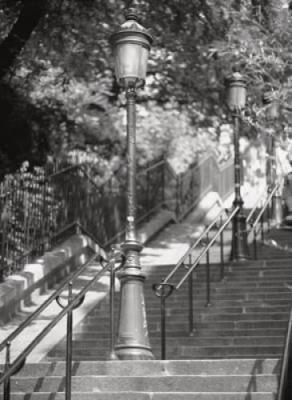
Wait, who is the girl, and where are you now? Is it Zelda, and you are on the stairs at Montmartre? The same song, without words, you know it, you still can't remember the title.

No, it's not Zelda Fitzgerald, this image of the Escaliers de Montmartre comes from 1950. Have you arrived there from the nostalgia store, letting your dreams float without haste? Or were you staring at the old poster showing an image from 1950, a poster that you had bought one day in that small boutique in New Hope? You had bought it in 2003, now it was the summer of 2009, you were ready to leave the small apartment where you had spent seven years of your life, to move in another town, far away, and the poster was there, and you were ready to take it down from the wall, and your dreams were floating around, and your nostalgia. And you took your cheap camera and tried a shot.

(image of a poster that hanged in my apartment)

So it is 1950, and you are in Paris. It's midnight and you are out, in the rain. And that song, without words, a song of love and nostalgia. And you start thinking at an earlier age, the third decade of the century, the Mad Years, Les Années Folles, as you remember another movie, it was the only movie made by Mirea Alexandresco.

Mirea
, a man who crossed my life twice. Once in Paris, in 1945, I was just born, and my mother got from the parents of Mirea the baby carriage that had been his, and then, years later, at the beginning of the eighties, when Mirea came to Bucharest in a short visit, with his wife and little daughter. He passed away prematurely sometime in the nineties. I watched his movie on TV, long time ago.

I discovered today on the web the image of a poster of Les Années Folles. A vintage poster, no question about this, with a history of its own: once folded (oops!), then kept flat for a long period of time (to get in shape again), with a bit of paper loss in the right of top edge. The poster had been used in Belgian theaters, so you can note the movie's title both in French and Flemish (Zotte Jahren). It was auctioned in 2011, and sold for ten dollars.


Well, that poster brought me again in the Paris of the twenties, Hemingway and Scott Fitzgerald were there, and all those guys, and Gertrude Stein who was just coining the term of Lost Generation. And Buñuel, and Dalí. Is it he, Dalí, or Adrien Brody, impersonating Dalí in the movie of Woody Allen? Why is this movie coming again and again in my mind? I'm talking now to Dalí, about my walks in the rain on empty Parisian streets, browsing decades, and he's not surprised. It is quite normal, he says, time is just a convention, keep dreaming.

Was this the Paris I wanted to be in? Maybe not, my dreams were floating towards a much earlier age, the epoch of Emonds and Marville, a city about to change its face, the mid of ninetieth century. Old streets were to disappear, and the photographers were taking photos in haste, to document the old homes, and the old pavements. And the art of Painting was about to change face. The artists had discovered at Barbizon the plein air, and Impressionism was about to come. Well, yes, that would be the Paris to be in.

And maybe the journey should start in that small antiquarian shop, Rue du Cherche Midi, just next to the house where I spent the first three years of my life. I came back there tens of years later, in 1999, and I entered the store: a place to browse those old books, and old photos, drawings and engravings, and let your dreams free.

And I am out. It's midnight and it's raining (to quote Dan, who was quoting in turn Woody Allen). And I start to remember the words of the song, it's Plaisir d'Amour, it was written in Paris, only much, much earlier, in 1780! Berlioz would compose the music a bit later, in the first half of the nineteenth century.

And it's so beautiful the song, that my tears are mixing with the drops of rain. I will come back to this, it's much to say.


(Cinéma Français)

(A Life in Books)

(The Fitzgeralds)

Labels: ,

Tuesday, July 25, 2006

Stuart Davis, The Paris Bit

Stuart Davis, The Paris Bit


(Click here for the Romanian Version)
By ten in the evening the whole corner would take on the fullness of its own life with the terraces crowded and the well-known drunken poets or painters... wandering across the road from café to café.
(Morley Callaghan, That Summer in Paris: Memories of Tangled Friendships with Hemingway, Fitzgerald, and Some Others)


Some time in the 1920's Callaghan lived briefly in Paris, and he was part of the group that later would become known as The Lost Generation, term coined by Gertrude Stein, only by that time they were just a gang of young friends sharing enthusiasms and dreams in Montparnasse. That Summer in Paris is about them, about Hemingway, about Scott Fitzgerald, about Joyce - and about a boxing match! Yeah, Hemingway challenged Callaghan, who was a better boxer, so he knocked his friend to the ground. Scott Fitzgerald was keeping the time.

The 1920's in Paris, an epoch chronicled by the photos of Brassaï, of Kertesz, of Man Ray - you feel the spirit of those years in the paintings of Stuart Davis, Picasso, Van Dongen, or Mondrian. They still live, those years, in so many pages of Hemingway, Scott Fitzgerald, Henry Miller, Anaïs Nin, and Callaghan, and Cowley...

Hemingway and the others, The Lost Generation and The Mad Years, Les Années Folles.

A movie, Les Années Folles, was telling the story of the twenties in Paris. The film director was Mirea Alexandresco. His parents were Romanians and they lived many years in Paris where Mirea was born. They came back to Romania, but Mirea remained in France. My parents were good friends with them and I remember how Mrs. Alexandrescu was telling us about the plans of her son to make the film. So I knew the movie before seeing it. Les Années Folles was produced in 1960, I saw it several years later, at the Romanian TV. Serge Reggiani was the narrator, and the history of the Parisian twenties remained for me associated with his baritone.

Much later Mirea Alexandresco came briefly to Bucharest, and he visited our family one evening. He came with his wife and his daughter and we spent a fine evening together. He was speaking Romanian quite well, with French accent, of course. A very nice man. He died prematurely, and Les Années Folles remained his only movie.

(The Fitzgeralds)

Labels:

Saturday, July 15, 2006

Teo Tarras - Les Escaliers de Montmartre

Teo Tarras - Les Escaliers de Montmartre
Was it fun? ... did the blue creep out from the Colonades of the rue de Rivoli through the grill of the Tuilleries... was the Louvre gray and metallic in the sun and did the trees hang brooding over the cafes and were the lights at night and the click of saucers and the auto horns that play de Bussey?

Zelda Fitzgerald in a letter to F. Scott Fitzgerald, Summer 1930


What would have been the answer of Scott Fitzgerald? Well, perhaps, it was so fun, only now I'm lonely - I was today aux Escaliers de Montmartre, and I was missing you, and les Escaliers were looking a bit sad, without you ...

Actually he set his short story Babylon Revisited along the same boulevards, and at one point there is a paraphrase to Zelda's letter, he wanted to see the blue hour spread over the magnificent facade, and imagine... the cab horns, playing endlessly the first few bars of La Plus que Lente.


(The Fitzgeralds)

Labels: , ,