Updates, Live

Saturday, December 04, 2010

Hou Hsiao-Hsien: Dust in the Wind (1986)

The screen is totally black and after a few moments a very unclear spot seems to flicker in the middle; just a few more moments and the tiny white spot gets clear; the spot gets bigger: it's the end of a railroad tunnel, and a train is running through the mountains. The movie has just started.

Made in 1986, Dust in the Wind (戀戀風塵 - Lian lian feng chen) belongs to the first artistic decade of Hou Hsiao-Hsien. This was a period when the Taiwanese director was preoccupied by the story of his own generation: the youngsters from the sixties, coming to age while their country was coming to age. Teenagers leaving the countryside for the big cities, facing the challenges of an unknown environment, trying to understand the new realities and to adapt, while still reluctant. Youngsters behaving erratically, like dust in the wind, dreaming big, till confronted by time and fate: time to erode all illusions, fate to treat all dreams like dust in the wind.

Nothing remarkable happens in this movie. You can consider the plot as extremely boring, only this is not the point. Also some reviewers stressed out the unsentimental approach of the director in telling a story that after all implies sentiments. It's true, but again, this is not the point. Like in all films of Hou Hsiao-Hsien, the plot has the unique role to create a universe, and to leave room for meditation. The language of images is here essential, to operate on the subconscious level. Watching Dust in the Wind calls immediately in mind the world from the movies of De Sica, but the Taiwanese master gets subtly beyond. It's just amazing how this director takes the sordid (in good neorealist tradition), finds the perfect place for each actor, for each object, and processes everything in hypnotic long takes.

The influence of Ozu is also present in this movie (let away the same love for railroad scenes, think at the last scene, showing the ocean: it's the moment of stasis, the way all Ozu's works end; coming immediately after the dramatic outcome of the plot, it suggests that whatever happens is unimportant in the cosmic order of things; life will go on anyway). What differentiates Ozu and Hou is the way they treat the plot. If you watch any movie created by Ozu, you have the feeling that the Japanese master is seated near you, enjoying the events from the screen as much as you do. For Hou the story is like an executive summary, detailed just to the point where the images can exist on their own to play on the hypnotic register.

I found Dust in the Wind on youTube, in ten consecutive videos (published by whateverhte). As embedding them was disabled, I have indicated here the address of each video. I know that watching a movie by Hou Hsiao-Hsien on youTube can be painful, so I suggest you get a dvd copy, if possible. I watched it on youTube, and my Internet connection was getting slower every now and then. However it paid.


(Hou Hsiao-Hsien)

Labels:

Saturday, December 05, 2009

Hou Hsiao-Hsien on Ozu


In the movies of Ozu family is a backdrop, says Hou Hsiao-Hsien: it's a study of a society in evolution: a daughter gets eventually married; only, this is observed on slightly different historic periods, and the difference is of two or three years, the end of the forties, the beginning of the fifties, the middle of the fifties: the evolution of post-war Japanese society followed very slowly, with great patience and love for the detail.

(Hou Hsiao-Hsien)

Labels: ,

Monday, November 23, 2009

Hou Hsiao-Hsien: Daughter of the Nile (1987)


Ni luo he nyu er (Daughter of the Nile) made by Hou Hsiao-Hsien in 1987

I made today a crazy experience: two movies watched in a row. A classic of Naruse from 1954 (Lost Chrysanthemums), followed by a movie of one of the most modern (or post-modern, if you like) directors, Hou with Daughter of the Nile. But I was eager to see movies made in the 80's by the Taiwanese master: I haven't seen any of them so far, only read about, so I couldn't resist the temptation.

Hou is an extremely difficult director, and each movie of him claims several days after watching it to be fully tasted, and this is because the plot is just a support for the atmosphere, and what the movie has to say is there, dissolved in the atmosphere; and so, several days are needed for you to taste slowly the atmosphere of what you watched, to get the meaning.

That is why each of Hou's movies has so many long takes: because it's atmosphere what he is interested in.

It seems to me that this Daughter of the Nile is not one of the most difficult of Hou's movies; but this could be an impression due to the fact that I have already watched Millennium Mambo, made in 2001, a film exploring the same universe.

Anyway, Daughter of the Nile offers for a connoisseur the opportunity to see a very young Jack Kao (Flowers of Shanghai, Goodbye, South, Goodbye, Millennium Mambo), as well as Li Tian-Lu, the patriarch of the puppet art in Taiwan (here he plays a sympathetic grandpa; Hou would made for him a great movie, The Puppetmaster, in 1993).


(Hou Hsiao-Hsien)

Labels:

Monday, October 26, 2009

The Movie I'll Ever Miss: A City of Sadness


Bei Qing Cheng Shi (A City of Sadness), made by Hou Hsiao-Hsien in 1989, the movie that I'll ever miss. Impossible to find, even on Amazon, till today: one used copy of four hundred dollars!

A movie about the so-called 228 Incident, the infamous massacre from February 28, 1947, in Taiwan. And about that whole period.
Taiwan had been since 1895 under Japanese administration. Naturally the Japanese influence had been strong in all respects. Taiwanese intelligentsia was dreaming at China as their Motherland, while being actually shaped in the Japanese culture.
In 1945 Taiwan passed to China, only to find a new country in harsh civil war. KMT versus Communists in a ruthless struggle that left no room for nuances, genuine disagreements and the like. Anyone who was not keeping straight to the rules of your camp was suspected. Taiwan fell under KMT control, so naturally all Taiwanese were suspected; especially Taiwanese intelligentsia.
It would take a very long period of time to emerge a unique society in Taiwan, a unique nation. Now Taiwan is a vibrant democratic society: it emerged through lots of innocent blood; the massacre from February 28, 1947 made tens of thousands of victims, and it was followed by other brutal events, along the late forties and the fifties, and even later: the whole period is known as the White Terror; the martial law would remain in effect till 1987!
As I said, I haven't had the chance to watch the movie of Hou. It seems, from what I have read about, that Hou tried to understand the whole, that he avoided simplistic judgement: there are no bad guys and good guys in his movie, only two camps in a tragic conflict, that would eventually end in a unique nation. Today's Taiwanese inherit both the victims and the perpetrators, and it is good to fully understand both sides.
Naturally the 228 Massacre still raise passions in the Taiwanese society, so the movie raised many critics there (and I am making here a parallel with another great movie, made this time in Mainland China, Huozhe - To Live, of Zhang Y-Mou).
But I think in both movies the historical approach was right: your own past should be understood as a whole.
Anyway, it's sad I would not have the opportunity to watch A City of Sadness.

-----------------------------------------

And however, here it is:


Labels:

Tuesday, May 05, 2009

Three Times again - One Video from Time for Youth


(video by jeuce)


The author of this video, jeuce, was born in Hangzhou. He lives now in Sydney, where he keeps a blog in Chinese.

(Hou Hsiao-Hsien)

Labels:

Monday, May 04, 2009

A Reenactment of Time for Love


A superb reenactment in animation of the first part of Hou Hsiao-Hsien's Three Times (Time for Love). A piece of jewelry!

Here is what the video's author (minoumaster) says about this jewel:

May (girl in red) takes a temporary job at a billiards parlour where she meets Chen. This film is set in the golden age of Taiwan when holding hands was a major gesture of love. Instead of the typical makeout and woohoo animations, I have tried to capture the awkwardness and excitement of young love through subtle eye contact and facial expressions.

(Hou Hsiao-Hsien)

Labels:

Friday, April 10, 2009

Hou Hsiao-Hsien


Hou Hsiao-Hsien: born in 1947; makes rigorously minimalist dramas; his storytelling is elliptical and his style marked by extreme long takes with minimal camera movement but intricate choreography of actors and space within the frame; collaborates with screenwriter Chu T'ien-Wen and cameraman Lee Ping-Bing (I took most of this info from Wikipedia).


(Taiwanese Cinema)

Labels:

Wednesday, April 08, 2009

Hou Hsiao-Hsien - Three Times


Three Times (Zu Hao De Shi Guang), a movie made by Hou Hsiao-Hsien in 2005. Two actors (Shu Qi and Chen Chang) playing three stories of love, from 1966, 1911, 2005.

This is an exquisite movie; it is as beautiful as only a painting by Vermeer can be. It has subtlety of tones, a warm touch, it is deep in nested levels of understanding: a meditation on love and woman condition, on Taiwan history and present, on Hou Hsiao-Hsien's cinematic universe. These levels send signals one another: a world of reflecting mirrors.


==========================

1966: in Mainland China it is the Cultural Revolution: youngsters are in the Red Guards, and the country closes itself in terror and absurdity. In Taiwan, though the regime still keeps a firm hand, it's an opening, you breath it in the air: Taiwanese youngsters are in the military getting ready for war, while listening Beatles and dreaming love. During short permissions they hang out in pool parlors and fall for the girls there. Yet they are too shy to speak to the girls, so they send them very polite letters where feelings are suggested by some rhymes from a song, the kind of Rain and Tears,

Rain and tears are the same,
but in the sun
you've got to play the game.

When you cry in winter time,
you can pretend
it's nothing but the rain.

Hey, it's us, the boomers: our portrait of forty or forty-five years ago, our time for love. Hou Hsiao-Hsien, the director, is like us a baby-boomer, he was born in 1947. His memories are there, he at twenty years, passionate for billiard, easy falling in love, writing long letters full of rhymes and songs, running during short permissions after the girl of his dreams, finding her, both discovering the magic of love, both too shy to have the courage of a kiss, only looking at each other while sipping tea together.

The purity of young age rendered by the purity of cinematic minimalism. And the great image of the pool table, where the bills are telling their own stories, about strategies of play, about desire to win, and despair to loose. It's an unforgettable image this one of the pool table, and it speaks volumes about the talent of the cameraman Lee Pin-Bing, one of the two or three greatest cinematographers of today.


This is the first vignette of the movie, the Time for Love. Full of warmth and nostalgia. It's Hou at the beginning of his twenties, observed by Hou now in his sixties: his movies from the 1980's come in support, as this vignette is mirroring them. The spirit of The Boys of Fengkuei is floating freely in Time for Love. Most part of the action takes place in the same port-city of Kaohsiung. The Green Grass of Home sends its echoes in Time for Love, along with Hou's very first two movies, Cute Girl and Blind of Love. A cineast thinks at the epoch of his youth through his own language of cinematic structures.


==========================

From the memories of our youth we travel back in time, down to 1911.

In Mainland China the Time for Freedom has arrived. It's the Wuchang Uprising, leading to the Revolution that would put down the Empire and proclaim the Republic. Meanwhile Taiwan is under Japanese rule: it just started, in 1895.

The young intellectuals dream of freedom and write patriotic poems and passionate columns in newspapers. A young woman, courtesan in a luxurious brothel, falls in love for one of these intellectuals and hopes he would take her out. He is too absorbed by his dreams for Taiwan to notice her own desire. She's still hoping ... after some months a letter comes: he is now in Shanghai, taking part at the Chinese Revolution. Her tears are discreet, the rules are very formal there. Capable of conveying such intensity with so much restraint: it is in this vignette, Time for Freedom, that I had the revelation what a great actress is Shu Qi.


Another masterpiece of Hou comes in mind: Flowers of Shanghai. But, not only that one: Dust in the Wind tells a love story destroyed by indifferent times; and all his movies from the 1990's (The Puppetmaster for instance, or A City of Sadness) find somehow in this vignette their starting point, because Time for Freedom is situated in the point of departure for modern Taiwan's history, that 1911 when in Mainland China the Revolution was proclaiming the Republic, while in Taiwan, independence as well as woman dignity were still dreams.

Hou Hsiao-Hsien decided to make this vignette in a silent movie format. He had some reasons: first of all, the Taiwanese dialect spoken by 1911 would have been incomprehensible for today's Chinese viewers (as full as it was of archaic regionalisms amalgamated with Japanese words). There was also another reason, I think: the ascetic restraint that Hou used for this vignette, to avoid any cheap pathetic. The story is running in a brothel, yet it is of great distinction. One more note only would have spoiled the whole.

==========================

From 1911 we travel forward, up to our time. The third vignette is taking place in 2005. Despite their radical differences, Mainland China and Taiwan are now in many ways in sync: similar values shared by common people; similar look and feel in the cities; not too distant approaches in the economics. The most obvious similarity is in the youth's behavior: they are at last their own masters.

The plot in this vignette (Time for Youth) seems chaotic. The old way of sending elaborate love letters is now superfluous, as we have eMail and SMS: you can express yourself directly and get what you want. He works in a digital photographic shop. During the day he runs on his motorcycle on the highways of Taipei (the guy from 1966 was using a bicycle, by the way). She sings in underground clubs, where he spends his nights to take shots. They meet by chance and make passionate sex the following day. He is torn between her and his own girlfriend. She is a bisexual, torn between him and her own female partner.


Actually in all this hectic amalgam of digital photos, techno music, night life, sex and sexual orientation, rides on motorcycle, rapid conversation on SMS, there is something that they are doing while being unaware of it: a search for a sense. Now the country found its identity, its sense, and they are free of any restraint. It is time for them to discover their own selves.

And here comes another great image created by the cameraman Lee Pin-Bing in plays of mirrors and ambiguous identities:


Of course, Millennium Mambo comes in mind immediately, for all the fans of Hou's movies (it is also the same actress, Shu Qi). But, as in the second vignette, there's not only one movie echoed here. This chaotic universe is also in Goodbye, South, Goodbye, and in the contemporary sequences of Good Men, Good Women as well.

Many critics of Hou's movies consider that he is very skeptical about the young generation. I don't think so.

Hou Hsiao-Hsien has actually a special empathy for these young people on the brink. For him, I think, the mundane is the best way to understand the present; maybe because mundane is devoid of any rhetoric.

The lack of horizon is not their fault. It is life that offers no horizons. At the end of Millennium Mambo, Vicky (the personage interpreted by Shu Qi) realizes that we live in the country of snowmen: we built our dreams in the snow, unaware that they will melt down.

Living in a perpetual carpe diem is just natural: the lead female character from Time for Youth suffers from epilepsy, along with all kind of other health issues (it seems that Hou depicted here the real case of a young singer who eventually died; it is anyway a symbol for the fragility of our times). An SMS from her says, there is no past, no future, only a hungry present.

So, arriving at the end of this movie, it is like we arrive at the end of history, just to realize that history was just an illusion.

==========================

So, what is Three Times about? Is it about love in various moments of history? Or is it more about history itself? And why don't the three episodes come chronologically?

Actually Three Times is a reflection of Hou Hsiao-Hsien on his own movies, and through them on his own life. He made his movies to answer his questions: the answers and the questions of his generation, of my generation.

When I started to read about Hou Hsiao-Hsien, before watching any of his movies, only reading about them, I was asking myself what I was looking for. Was I in quest for his answers to discover through them my own answers? The answers of my generation? Of my time?

And with each of his movies, I was realizing that he was making them just to understand, to find the answer, or to free himself of some too overwhelming inner truth.

As a young man, he was trying to find the answer for questions put by mother nature. Does she love me? Does he love me? What is love?

As years were passing, other questions became obvious. He was realizing more and more that his search was for identity. To find it you need a larger context: the space of history.

And years kept on passing, a new generation came to the age of love, and then another one, and he realized that the answer had to be found through them. Was it love? Well, love looked very different now. Was it history? Well, the past was of no more interest.

What was the aim of their search (even if they were not aware)? And he realized that they were looking for a sense: for that particular moment, essential in their lives.

Aisareru isshun ga watashi no subete ni naru: the moment you feel that you are loved is a kernel that grasps all your life (I looked a lot to find the translation, it came from a friend, Mr.Larsen).

Three Times: the correct translation from Chinese is The Best Times. The time you feel that it grasps everything, it explains all. Is it to be found by you? In love? In history? In the future?

And here's what he found: we live in the country of snowmen; so times of our life and times of history are just snowmen, nothing more.

==========================

Does all this sound tragic? Well, it is life.

And in the end, to make the pill less sour, a surprise for those like me, teenagers in the sixties: Demis Russos with Rain and Tears; it was our time for love, you remember?


(Hou Hsiao-Hsien)

Labels:

Monday, March 30, 2009

Le Voyage du Ballon Rouge


Hou Hsiao-Hsien is the darling of French movie elite. They discovered him at the beginning of the nineties (when he already had behind him a decade of masterpieces, known only in Taiwan). Since then, French connaiseurs remained constant in keeping Hou in the top of preferences. Jean-Michel Frodon and Olivier Assayas explained well the phenomenon in their monograph.

So, after Hou made in 2003 the movie about Tokyo (Café Lumière), it was expected he would be invited to make also a movie about Paris.

I watched Hou in several interviews: he speaks only Chinese (and anyway all his movies up to Café Lumière were about Taiwan and a little bit about mainland China). So the Taiwanese Maestro took a systematic approach: he bought a book speaking about Paris and learned that Parisian fast-foods have flippers (i.e. pinball machines), and that in Jardin du Luxembourg the carousel has little rings the children catch on sticks as they ride around (just for connaisseurs: the book is Paris to the Moon, by Adam Gopnik).

Hou also got from his Parisian friends a DVD with a French movie from 1956, just to understand a bit the spirit of the place. The movie was Le Ballon Rouge of Albert Lamorisse. Fortunate choice, as this gave Hou the idea to make Le Voyage du Ballon Rouge: a movie that is very Parisian as it is very Chinese (in its finesse of depicting the magic of Paris); magic details ignored by Parisians (though they see them everyday).

Is it such a thing as the magic of Paris? And, if so, where is it to be found today? To find the answer, Hou chose to remain a Chinese in Paris, and to look for the spirit of the city from inside his Chinese spirit.

There is no real plot in the movie (which couldn't be a surprise for Hou fans): a woman (Juliette Binoche) is working in a Parisian puppet theater (specialized in Chinese puppetry); she has a son of about eight or nine (Simon Iteanu); the mother hires a nanny, a Chinese film student who's studying in Paris (Fang Song); the mother is busy and nervous; the kid is a dreamer who enjoys playing at the flippers and is befriended by a red balloon, floating quietly over the streets and houses and following the boy on his strolls; the nanny is a dreamer too, who's trying to catch with her camera that je ne sais quoi of the Parisian street.

Well, the nanny has the sudden revelation that the je ne sais quoi she's looking for can be found inside the universe of the little boy.


And this way the Chinese film student (and watching her behind the camera, Hou Hsiao-Hsien himself) discovers the magic of streets, of small theaters and small apartments in the attics, and the discovery is for us: it is the Paris where small kids will dream always, having red balloons as companions, the Paris of dreamers of all ages and of balloons of all colors floating freely and befriending the kids; the Paris of Lamorisse and Hou. Thank you, Taiwanese Maestro!


(Hou Hsiao-Hsien)

Labels: ,

Monday, March 23, 2009

Café Lumière


A movie starting with the logo of Shochiku Company. My heart is warming up: the logo Ozu's movies were starting with, his almost sixty movies, all produced at Shochiku.


Then it is the image of a light train, again reminding Ozu. From now on though, you feel there is another moviemaker, with a totally different style: director Hou Hsiao-Hsien. It's Café Lumière (Kôhî jikô), made in 2003, a homage to Yasujiro Ozu's centennial (a splendid video by AsianVirusNet could not be inserted here, unfortunately, due to its size).

I saw three such movies dedicated to Ozu: each one expressing a very different personality (Kiarostami, Wenders, Hou). An Iranian, a German, a Taiwanese. Hopefully I will find time to write about each one.

The movie of Hou Hsiao-Hsien is possibly the most disconcerting among the three. Kiarostami's Five Dedicated to Ozu is programmatically experimental: five cinematic poems about contingent facing eternity. You know what it is about from the very beginning. It's like an abstract painting: if you disagree with the non-figurative, then you don't look at. While the movie of Hou apparently has a plot, only it's just a pretext. So you are waiting for something to happen, in vain: Café Lumière is about something else.

Yoko is a young free-lance writer or something, living in today's Tokyo. She's trying to find some traces of a Taiwanese musician who lived in Japan between the two world wars. We are told at some point in the story that Yoko is three months pregnant; she is determined to remain a single mother (which worries her parents; Yoko sees them now and then).

Okay. There is also a young antiquarian (Hajime) who is a train buff and rides trains to record sounds: trains stopping in stations, doors opening, public announcements, doors closing, trains starting again, passengers' conversations. The guy is clearly in love for Yoko; they remain only best friends.

Meanwhile she goes by train here and there, enters cafés and bookstores, talks by phone with the antiquarian.

And this is it. Don't ask about the father of the future baby. Don't ask about things to happen. Don't ask about any outcome.


(video by ruidina)


In any movie of Ozu something happens, while the movies of Hou are meditative, depict an atmosphere (even when they are dedicated to Ozu :). Actually Hou's passion for Ozu is visible also in other movies. The final part in Millennium Mambo is clearly suggesting Ozu (while remaining Hou hundred percent). Or one of the first sequences in Good Men, Good Women: there is a TV monitor and a movie is running; it's Late Spring, the scene of the bikes (it was my first encounter with Ozu).

I'm trying to understand: is there a difference in the scale of values between the movies made by Hou Hsiao-Hsien up to the start of the new millennium and his newer movies? I saw Flowers of Shanghai, then The Puppetmaster, and I was impressed. I saw Good Men, Good Women, then Goodbye, South, Goodbye, then Millennium Mambo: it took a long time to get their point, to range them on my scale.

Flowers of Shanghai calls in mind Chekhov (and Mateiu Caragiale - if you haven't heard about him it's bad for you - only you'd need Romanian knowledge to read him, even very good knowledge). Millennium Mambo is a journey in the sordid world of youngsters good of nothing, small thieves (now and then), night club hostesses, petty gangsters; it is an initiatic journey, to discover that our dreams are snowmen who melt at sunrise - we live in the country of snowmen and we don't know it.

Well, you cannot say that these movies have a definite plot, either; it's all about exploring universes; the thing is that their universes are large, while Hou's newer movies are intimist. Café Lumière: a young writer who doesn't find topics of discussion with her parents and befriends a young antiquarian with a passion for train sounds. Three Times: three couples of lovers who talk and look at each other in 1911, 1965, 2005. Le Voyage du Ballon Rouge: a kid, a single mother, a young Taiwanese, all three exploring Parisian streets, Chinese puppet theaters in Paris, Parisian attics - while the director is trying with his movie to find the atmosphere of an older Paris, the one of Lamorisse (do you remember his Ballon Rouge?)

It was Le Voyage du Ballon Rouge that gave me the clue for Café Lumière. The plot is just a pretext. It's actually about Hou Hsiao-Hsien himself: the Taiwanese director coming to Tokyo and looking for some old Nippon atmosphere of good Ozu's times.

And everything starts to make sense. The main character often travels to Taiwan where she teaches Japanese. The musician who lived in Tokyo between the two world wars was a Taiwanese.

He was a real person (Jiang Wen-Ye), who composed delicate music resembling jazz, Formosan Dance, Three Dances, Maggio Suite, Bagatelles - they sound fine and as I was listening to them another great musician came to my mind, maybe one of the greatest of the past century: Conlon Nancarrow.

Watching Café Lumière and listening, together with Yoko and Hajime, to a piano piece of the Taiwanese who became a Japanese, while feeling how your memory's calling a player-piano piece by Nancarrow: that's the movie, it has no plot at all; it has charm a lot.


Yes, everything makes now sense. Yoko befriended the young antiquarian and visits him at the bookstore, they browse together old books, and old maps of Tokyo, trying to locate an old café, DAT, that was frequented by the Taiwanese musician in the thirties: he was spending evenings and nights there, listening jazz, thinking at his compositions.

It is the journey of Hou, actually, towards the Tokyo of between the wars and of the fifties; a journey suggested by old books and old maps examined within old second-hand bookstores; suggested by old pieces of music, listened in narrow spaces, so narrow that only a whisper could find room between the two friends; suggested by elegant cafés or old neighborhoods.


And of course DAT, the old café, is no more, replaced by an impersonal office building (the site is hardly discovered, by asking old waiters in small pubs, the folks who always keep pieces of history within themselves).

The family from Ozu's time is no more, either. Yoko is not Noriko of Setsuko Hara, ready to sacrifice herself for the parents; on the contrary, she is a very independent girl, very remote to her parents' values and worries, taking her pregnancy very matter of factly, committed to remain a single mother rather than giving up freedom, taking a friendship with a boy her age as it is, nothing more.

Is it anything that remained, from the old times of Ozu? Not much, or rather nothing. The nostalgia for those years, that's all. They are dreaming at traditional dishes with old spices, at a small drink slowly tasted : there is a scene in the movie, with Yoko and her parents together in a small restaurant - it is in vain. Ozu died and his world is over.


However, there is something that remained. It's hardly to define it: that special warmth between two people, Yoko and her friend, lonely together, even when they are looking for each other: a superb scene with her traveling in a train, while he is in another train on a parallel track; the two are like together for a second, then the trains take each one its tunnel; after a while, she's falling asleep in a train car, he enters the place and is looking at her with a warm smile, letting her sleep; minimalism at its best.


What about Ozu's trains? Well, Hou creates with them a world of its own, tracks over tracks in all directions, with trains leaving tunnels to enter other tunnels to meet never; but this is the merit of the great image director, Lee Pin-Bing, one of the greatest in the world. He made the image for almost all Hou's movies (and also for Tian's Springtime in a Small Town).


Is now Hou inferior to his older movies? Maybe not, but his universe became condensed as aiming to be a black hole. The great subjects of Taiwan's history were in the past. Now it's about studying a detail, a single detail, with delicacy and patience, to pull up a diamond.

---------------------------------------------------

A small surprise in the end: I found on the web something you'll enjoy; the Formosan Dance:


(Hou Hsiao-Hsien)

Labels: ,

Monday, February 16, 2009

Mono No Aware


Matt made another superb video: it's snowing a lot and he's going home. The title is Mono No Aware: the elegiac feeling of the transience of things; more than that: your empathy toward things, your sadness that they are passing. Lacrimae rerum says Virgil in Aeneid, tears for things: sunt lacrimae rerum et mentem mortalia tangunt.

The term Mono No Aware was coined in Japan in the Edo period and it is essential to understand the Japanese aesthetic. You see, some structures transcend civilizations: Mono No Aware has a correspondent in Lacrimae rerum.

How do they get this effect of Mono No Aware, the Japanese artists? Look at the video of Matt: he is a Briton, but he loves the movies of Ozu and Hou. I talked here about Millennium Mambo; the video of Matt calls in mind the final scene of Millennium Mambo, and that in turn is a tribute paid by Hou to Ozu: it snowed in Tokyo that winter. It is not by pure chance that Hou moves suddenly the action of his film to Japan, and creates a Mono No Aware effect.

The video of Matt, like the final scene of Millennium Mambo, puts us in front of a reality that is beyond our power to control things; we live in the country of snowmen, our dreams will die once the sun melts the snow, things and dreams and our lives will pass, while snow will come again, and again, and again. Here, in front of the snow that keeps on falling, we have the revelation of the transcendental: the moment of stasis.

(image from Tôkyô boshoku - Tokio Twilight of Ozu)

(Vlog of Mattie)

Labels: , , ,

Sunday, December 28, 2008

Hou Hsiao-Hsien: Millennium Mambo


A girl is advancing graciously along a walkaway, giving sometimes the impression of floating; she's talking presumably about herself, but at the third person. Or is it about another girl? She's saying that the story has happened ten years ago, in 2001. It's about an abusive boyfriend and about her dependence on him, but her tone is detached, and she's smiling. Are we really in 2011 in this scene? Or the girl from 2001 is imagining her future (Millennium Mambo was made actually in 2001)? As she is advancing, the walkaway becomes a tunnel going down: is it a metaphor for the road that life follows toward the end? The whole scene seems surreal, sending subtle signals: maybe the story in the movie is just symbolic, like in a medieval morality.


(Opening Sequence - video by shanghanigan)


Actually the walkaway exists in reality. It is in Keelung, a city on the border of the ocean. The girl exists also in reality, and she is from that city, too. One evening, in a bar in Taipei, she told Hou Hsiao-Hsien her story, talking about herself at the third person, and with the same detachment as the personage from the movie.

Why did she tell her story to the filmmaker? I think because Hou Hsiao-Hsien is a good listener, and people feel confidence and sympathy in good listeners. The movies of Hou Hsiao-Hsien show a particular respect and empathy for people like Vicky, and Hao-Hao, and Jack: young people floating freely over the borders of promiscuity, guys good of nothing, bar girls, small thieves, petty gangsters.


(The whole movie - video by Tom Eveney)


The plot could be told in just a couple of sentences: a teenage girl (Vicky) is trying to break with her abusive boyfriend (Hao-Hao), only she always comes back to him; it's like a spell; she needs a job as he doesn't work; she becomes a stripper in a bar where a small gangster (Jack) offers her protection; will the new relation evolve beyond camaraderie? will she rather come back once more to Hao-Hao?

There are three great masters here: Hou Hsiao-Hsien, the filmmaker, Chu Tien-Wen, the author of the screenplay, and Lee Ping-Bing, the cinematographer. Each scene of Millennium Mambo carries some kind of magic and seems unreal: it comes in a halo of blue tones; people and objects are taking shape, to repeat the same basic action; he is abusive, she is submissive, again and again. Taipei: a city of young people, populating the night bars, living the rhythms of techno music, sleeping during the day.

As the movie is developing slowly on the screen, you are looking for a sense in all that. The action is not linear and some scenes are even repeated. As it happens with all movies of Hou Hsiao-Hsien, the effect is not immediate. It is like depot medication: the feeling about the movie is penetrating you slowly, long after it has ended. Sometimes it can take years. The art of Hou is of a special kind: words like wizardry or slow poison are not out of context.


(Trailer - video by ShuQiFanBase)


To get the sense of the movie, you should watch carefully the ending scene, taking place in Japan during winter. The fact that a story from Taiwan moves suddenly to Japan is not important: the reason there is the snow! It snowed in Tokyo that winter, remembers Vicky (the sentence sounds so great! the author of the screenplay, Chu Tien-Wen, is one of the most important names in Taiwanese literature).

The movie is about our dreams: they are pure, our dreams, we build them in immaculate snow, we live our lives in the country of snowmen. We dream about eternity: they will live, our dreams, only as long as snowmen live.


(Ending Scene - video by shanghanigan)


(Hou Hsiao-Hsien)

Labels:

Monday, June 16, 2008

On the Skyway in Rockville, Thinking at Asian Movies


The bridge is between the metro station and downtown Rockville. I tried twice to make a video of it:


Each time I pass on it, I think at the opening sequence in Millennium Mambo of Hou Hsiao-Hsien. The metro train is just leaving the station in front of me. I think at so many train scenes from the movies of Ozu. I have just seen Maborosi, the movie of Kore-eda. Trains are also in that movie, as a central element to support the narrative, also as a tribute to Ozu. It's a shame Ozu is virtually unknown in my country, Romania. He's one of the greatest film directors ever.

Well, there are also British movies to remember, as a jogger appears suddenly: The Loneliness of the Long Distance Runner, of course.


Millennium Mambo, opening scene
(video by shanghanigan)


(Rockville)

(Hou Hsiao-Hsien)

Labels:

Tuesday, September 12, 2006

Hou Hsiao-Hsien - cehovian si matein

Scena de debut a filmului


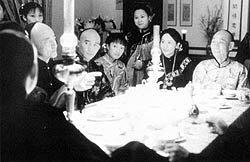
Shanhaiul anilor 1880. Acolo suntem, cu filmul acesta al lui Hou Hsiao-Hsien, Flowers of Shanghai. Patru bordeluri de mare clasa, aflate in cartierul cel mai select, in Concesiunea Britanica. Sigur, vor fi fost in Shanhaiul anilor acelora si bordeluri sordide, pentru lumpen, sau pentru matelotii care acostau pe acolo, se imbatau crita si cautau o partida de sex ieftin, dar casele acestea de toleranta sunt cu totul altceva, un univers inchis, frecventat exclusiv de oameni foarte bogati si buni cunoscatori ai artei erotice.

Flower Houses, case de flori - bordelurile acestea sunt adevarate sere - suntem in adancul Orientului, mirosurile te ametesc, vinurile sunt drese cu mirodenii, luleaua cu opiu este la indemana - peretii camerelor sunt capitonati in lemn de culoare inchisa - tot filmul se petrece inauntrul acestor camere.

Si este un erotism ametitor - fara ca filmul sa aiba nici o scena erotica de fapt - dar imaginile sunt incarcate in subliminal de un erotism greu.

In fiecare bordel exista o prostituata aflata in anii ei de apogeu, marea curtezana - si un client care a cumparat un abonament exclusiv pe mai multi ani. Sunt apoi fetele tinere, scolite din mers, si fireste batranele, prostituatele iesite din uz. Candva vor fi fost ele marile curtezane, acum sunt slujitoare, si incearca sa mai controleze putin universul acesta, printr-un joc subtil de intrigi, de aliante si dusmanii, de santaj...

Desigur, este si madama, i se spune cu multa afectiune matusica. Trebuie sa aiba o mana de fier - fetele tinere se mai indragostesc de cate un tasti-basti fara bani, apoi trebuie pastrat controlul asupra marii curtezane, exista in fiecare din cele patru case de flori conflicte surde. Uneori matusica se mai indragosteste de cate un tanar care ii cere toti banii - se mai imprumuta de la curtezana, viata are suisuri si coborasuri.

Este o lume privita cu un ochi intelegator, cu multa simpatie, dar in acelasi timp fara nici o crutare. Il simti parca pe Cehov, venit la taifasurile interminabile, rezemandu-si falca in pumn si privind cu ochii mijiti la cei de pe acolo, zambitor, putin obosit, urmarindu-l cu simpatie pe fiecare, fara iluzii, dar fara sa judece pe nimeni, stiind ca si aici se desfasoara aceeasi mare comedie a lumii de pretutindeni.

Este Cehov aici, dar imaginatia baroca este a lui Mateiu Caragiale - ma intreb cum ar arata un film al Crailor de Curtea Veche facut de Hou Hsiao-Hsien?

Un comentator al fimului ne sfatuieste sa renuntam la subtitluri. Cum asa, noi nu stim chineza! Ei bine, si pentru chinezi limba vorbita in film este dificila - este un dialect, diferit de mandarina, si plin de expresii care se foloseau in Shanhaiul anilor 1880' - iesite de mult din uz.

A traduce filmul acesta inseamna a-l saraci. E pacat sa fie tradus chiar si in chineza.

Ca si Craii de Curtea Veche, cu grecismele si turcismele savuroase din veacul al nouasprezecelea, iesite si ele de mult din uz.

Bine, bine, si atunci cum sa intelegi filmul?
Povestea lui este spusa de imagini, iar sonoritatea fascinanta a cuvintelor ne este de ajuns, nu mai e nevoie sa le stim intelesul concret - si iarasi imi vin in minte Craii.

Imi pare rau ca nu am vazut filmul lui Mircea Veroiu, banuiesc ca si el a inteles ca povestea Crailor nu se poate spune pe ecran decat in imagini - numai atunci i se face lui Mateiu dreptate si povestea lui devine universala.

Flowers of Shanghai - ochiul lui Cehov si viziunea lui Mateiu - am vazut filmul de mai multe ori, si de fiecare data am avut senzatia ca in spatele camerei de filmat se aflau Cehov si Mateiu Caragiale, angajati intr-un jam session in care fiecare intra pe rand sa ne spuna povestea.

Esmerald - o curtezana care negociaza cu clientul ei pentru a completa suma de rascumparare - candva de mult a fost vanduta pentru bordel de catre parintii ei, matusica a facut apoi cheltuieli mari cu ea pentru a o educa si o pune in valoare - clientul ei ar putea sa o ajute acum - este un moment prielnic pentru ca matusica are un amant tanar si are nevoie disperata de bani - clientul (interpretat de Jack Kao, un actor pe care aveam apoi sa il vad in multe alte filme ale lui Hou Hsiao-Hsien), tine foarte mult la banii lui asa ca negocierile intre el, Esmerald si matusica sunt foarte stranse.

Pearl (interpretata de Carina Lau, aveam sa o revad in 2046 al lui Wong Kar-Wai) - aici ea este o curtezana care incepe sa nu mai fie chiar tanara - stie foarte bine ca urmarirea controlului se poate face si altfel decat prin seductie erotica, si e in primul rand interesata sa aibe controlul asupra bordelului. Iar clientul ei este chiar unchesul - si el vine la bordel nu pentru sex, ci pentru a avea controlul asupra clientilor, iar relatia lui cu Pearl este o relatie politica, intre ei exista schimburi de informatii si discutii in vederea adoptarii unor strategii comune.

Si Crimson - curtezana superba de care Master Wang, clientul ei, este de fapt indragostit. Si de fapt ar vrea sa se insoare cu ea, dar nu are curajul. Ar vrea sa si scape de ea, dar se simte legat. In fiecare seara ar vrea sa plece, pana la urma ramane. Intr-o seara nu mai poate suporta tensiunea, bea pana isi pierde mintile si distruge toate portelanurile - tot el le-a cumparat. Crede la un moment dat ca a gasit solutia (daca ar fi fost roman, ar fi stiut expresia cui pe cui se scoate), incepe sa frecventeze o prostituata mai tanara.

Si atunci filmul are una din cele mai superbe imagini pe care le-am vazut vreodata pe ecran - as vrea sa le povestesc odata si odata pe rand, aceste imagini pe care le cred cele mai frumoase din istoria cinematografiei.

Da, aici in Flowers of Shangai este una din imaginile la care tin cel mai mult - camera de filmat staruie pe figura lui Crimson, care intelege ca a pierdut lupta, de acum urmeaza imbatranirea, va mai avea poate niste clienti de duzina, va trebui sa se mute apoi in odaile slugilor...

Se va intoarce la ea Master Wang? Filmul este voit ambiguu, s-ar parea ca da, el se va intoarce, desi intre timp se casatorise cu prostituata cea tanara! - dar nu este prea clar - si aici este un alt merit al filmului care de fapt sugereaza ca lupta dintre Wang si Crimson, cu impacari si despartiri, nu are cum sa se sfarseasca.

Tony Leung il joaca pe melancolicul Master Wang - a fost primul film in care l-am vazut, aveam sa il vad dupa aceea in filmele lui Wong Kar-Wai.

Un fir muzical care revine pe tot parcursul filmului - inebunitor, dar avand rostul lui, sugerand un univers circular din care nu ai cum sa iesi.

Si scena cu care incepe filmul, cu clientii asezati in jurul mesei, angajati intr-un joc stupid de societate pe care nimeni dintre noi nu il intelege, o scena lunga de tot, si care trebuie sa fie atat de lunga pentru a ne da ragazul de a intra in universul creat pentru noi de catre Hou Hsiao-Hsien.

Un univers in tonuri rosietice si aurii, luminat difuz de lumanari si lampi cu ulei, limitat de panouri de lemn de culoare inhisa, unde curtezanele se lupta sa devina sotiile clientilor, clientii se lupta sa isi pastreze curtezanele fara a se casatori cu ele, prostituatele tinere se lupta sa ia locul curtezanelor, prostituatele batrane sunt un memento mori, matusicile au de controlat un business care se poate duce naibii oricand - filmul nu paraseste o clipa interiorul bordelurilor, dar nu vorbeste despre sex, ci despre lupta nemiloasa pe care o da fiecare pentru a avea controlul.

O lupta care se duce cu respectarea absoluta a unor reguli pe care nimeni nu are curajul sa le incalce. Exista un cod de la care prostituatele nu se abat. Pana la urma matusica are autoritate absoluta. Si exista de fapt un cod caruia i se supun si clientii. Exista unchesul, cel care are intotdeauna ultimul cuvant, cel care negociaza compromisurile intre ei si prostituate.

Si mult timp dupa ce ai vazut filmul, incepi sa intelegi ca povestea aceasta nu este despre prostituate si clienti, ci despre noi, despre setea noastra de putere, despre intrigile noastre, despre regulile si ierarhiile stupide carora ne supunem, despre faptul ca nu avem curaj si ne balbaim toata viata, despre faptul ca imbatranim si ne ducem dracului - Flowers of Shanghai este tabloul universului nostru din care nu putem scapa, inchisoarea noastra cea de toate zilele.


(Hou Hsiao-Hsien)

(Mateiu Caragiale)

Labels: ,

Sunday, September 03, 2006

Hou Hsiao-Hsien - efectul de hipnoza

Rembrandt, Return of Prodigal Son, Hermitage Museum, Sankt PetersburgRembrandt a tratat Parabola Intoarcerii Fiului Risipitor schimband accentele. Aici, in tabloul aflat la Ermitaj, esentiala este relatia dintre batranul tata si fiul care s-a intors. Tatal este in tabloul acesta foarte batran. Mainile lui parca il cauta pe fiu, parca il pipaie sa se convinga - poate ca tatal a orbit de batranete. Este oricum aproape de moarte, iar mainile lui vor sa afle ca este adevarat, ca fiul pe care il iubeste atat de mult s-a intors, ca el, tatal, a apucat sa nu moara cu fiul ratacind undeva in lume. Este dorinta batranului de a sti ca poate fi in sfarsit fericit.
Si este baiatul, intors cu spatele spre noi. Straiele ii sunt ferfenita, este ras in cap - este cu spatele la noi, dar simti ca a avut parte de toate umilintele, nimeni nu l-a crutat - este umilit, este distrus moral, dar este inapoi si se strange si el cu inversunare in tatal sau, ca sa se convinga ca acum e in siguranta.
Si sunt barbatii ceilalti, printre ei este desigur si fiul care a ramas sub autoritatea tatalui si acum carteste - dar nu asta e important in tablou.
Important este altceva - Rembrandt ii aseaza acolo pe barbati, ca sa porneasca un cerc care se continua cu noi, cei aflati in fata tabloului. Ei si noi suntem martorii scenei dintre tata si fiu.
Si desi fiul este intors cu spatele spre noi, simtim tot dramatismul lui, pentru ca apartinem acelui cerc inceput cu barbatii privitori din tablou - si in felul acesta participam activ la dinamismul scenei. Nu mai conteaza ca fiul este cu spatele la noi, conteaza ca este in centrul cercului nostru si in felul acesta il putem focaliza.

Este o problema cu care se confrunta nu numai pictorii, dar si regizorii de film - ai de filmat o scena in care personajele sunt asezate in jurul unei mese - unul dintre eroi va fi evident cu spatele la noi. Sa ne amintim numai de scena de debut din Reservoir Dogs a lui Quentin Tarantino. David Bordwell are un capitol intreg consacrat acestei probleme in cartea sa, Figures Traced in Light.

Cea mai mare parte a regizorilor rezolva problema aceasta la montaj. Scena este filmata pe bucati, bucatile se aseaza ca sa se potriveasca la montaj, iar spectatorul vede imaginea plimbandu-se pe rand pe fata fiecarui personaj. Exista doua riscuri. In primul rand intre doua filmari detaliile se mai pot schimba din greseala, iar spectatorul vede ca o furculita devina lingurita pentru a deveni din nou furculita dupa doua secunde. In al doilea rand plimbarea camerei de filmat de pe fata unui personaj pe a altuia trebuie sa para naturala - altfel este ca si cand aduci fiecare personaj pe rand in fata microfonului pentru a-si debita partitura. Aici intervine maiestria regizorului, iar David Bordwell descrie in cartea sa cateva scene de acest fel care au fost rezolvate cu succes.

Hou Hsiao-Hsien nu foloseste principiul filmarilor pe bucati care sa fie apoi asamblate la montaj. La el fiecare scena dureaza extrem de mult - cu riscul de a plictisi sau enerva spectatorii. Este insa o decizie asumata constient de Hou, care mizeaza pe efectul de hipnoza. Durata extrem de lunga a scenelor te poate enerva, dar de fapt in felul acesta esti prins in mrejele povestii, care ramane in tine mult timp dupa ce filmul s-a terminat.

Si atunci Hou Hsiao-Hsien adopta solutia lui Rembrandt. Unul din personaje va fi intotdeauna cu spatele la spectatori, dar cercul se inchide prin noi, suntem in ceafa lui, il simtim, tensiunea lui ni se transmite si nu mai e nevoie sa ii vedem fata - simtim ca noi suntem de fapt personajul acela, reactiile lui i le simtim foarte bine, pentru ca sunt reactiile noastre.

Scena de debut a filmului Flowers of Shangai este cea mai cunoscuta - dar si in celelalte filme exista scene rezolvate la fel - de exemplu in Maestrul Papusar.

(Hou Hsiao-Hsien)

Labels: