Updates, Live

Monday, February 23, 2009

Notes on Shinto

This happened a couple of years ago. I wanted to watch Kurosawa's Dreams; I considered important to look firstly for some information of help to enter the universe of the movie. So I started with Shinto. Here are some basics (I took these notes from a guide on Japan).

Shinto does not have have Sacred Scriptures (however, two ancient texts could be considered as some kind of Holy Tradition: Kojiki - The Records of Ancient Matters and Nihongi - Chronicles of Japan). Propaganda and preaching are not common either.

Shinto gods are called kami. They are sacred spirits which take the form of things and concepts important to life, such as wind, rain, mountains, trees, rivers and fertility. Humans become kami after they die. The Sun Goddess Amaterasu is considered Shinto's most important kami.


- Some prominent rocks are worshiped as kami -


There are no absolutes in Shinto. There is no absolute right and wrong, and nobody is perfect. Shinto is an optimistic faith, as humans are thought to be fundamentally good, and evil is believed to be caused by evil spirits. Consequently, the purpose of most Shinto rituals is to keep away evil spirits by purification, prayers and offerings to the kami. Shinto shrines are the places of worship and the homes of kami. Most shrines celebrate matsuri regularly in order to show the kami the outside world. Shinto priests often live on the shrine grounds. Men and women can become priests, and they are allowed to marry and have children. Priests are supported by young ladies (miko) during rituals and concerning other tasks at the shrine. Miko wear white kimono, must be unmarried and are often the priest's daughters.

- Miko at Aso shrine -

The introduction of Buddhism in the 6th century was followed by a few initial conflicts, however, the two religions were soon able to co-exist harmonically and even complement each other. Many Buddhists viewed the kami as manifestations of Buddhas. A large number of wedding ceremonies are held in Shinto style. Death, however, is considered a source of impurity, and is left to Buddhism to deal with.

- Ise Jingu is Shinto's most sacred shrine -

And here is my comment:

There is no definite barrier in Shinto between immanent and transcendent: we live in a wonderful world populated by kami: nature and divine are metamorphosing each other continually.

(A Life in Books)

Labels: ,

Sunday, February 22, 2009

Vlog of Mattie


Mattie (or Mat, or Matt) is a formidable vlogger; his videos speak in unforgettable images of his passion for some great movie makers.

Here are some thoughts Mattie has put on the frontispiece of his youTube channel. Three short meditations leading to the conclusion. Each one calls remotely in mind some organization of a haiku while it has the apparent weirdness of a koan. I recognize in them the philosophical approach expressed by the movies of Ozu: it is the void that gives sense to our immanent.

We put thirty spokes together and call it a wheel,


But it is on the space where there is nothing that the usefulness of the wheel depends.


We turn clay to make a vessel,


But it is on the space where there is nothing that the usefulness of the vessel depends.


We pierce doors and windows to make a house,


And it is on these spaces where there is nothing that the usefulness of the house depends.


Therefore just as we take advantage of what is, we should recognize the usefulness of what is not.

(Blogosphere)


(Filmofilia)

Labels: , ,

Friday, February 20, 2009

Micro-stasis in Ozu's Movies


I have talked about the transcendental structure of Ozu's movies: banality of everyday, cascading disruptions up tot he point of explosion, stasis. He also uses sometimes transcendental micro-structures, within the global frame, just to balance the cinematic tension.

Here is a fine example: in Banshun (Late Spring), after Noriko was convinced to get married, she and her father make a farewell trip to Kyoto. One of the last evenings starts with a warm discussion between them. Noriko is commenting the events of the day, her father is listening with his usual smile, mix of sophisticated politeness and sincere kindness. From a moment on, her talk is sliding in a direction her father would rather avoid, about her desire to remain unmarried to continue to take care of him, even if he would get re-married. He cannot tell her the truth, that he doesn't think at a new marriage. He cannot insist in lying either: it would be too painful for him, to stand her reproachful eyes. The only outcome for him is to fake falling asleep.

So Noriko hears his quiet snoring and you can read on her face a slight frustration: it is the moment of disruption.

The camera focuses immediately on a superb China vase in the background: the moment of stasis. Her worries would not find a resolve, and daughters leaving fathers to start a new family have been since the beginnings and will be to the end, while that perfect artwork stands there defying time.


---


And here is another example of micro-stasis in the same movie: Noriko's father is talking to his friend and complaining about the fate of fathers - it's pointless to have a daughter, when she grows up someone other will take her as wife, and you remain alone. But we did the same, observes the friend and both of them start smiling. In that moment the camera moves to the yard in front of them: the yard of a temple, with sand and stones. What are worth our sorrows in face of eternity?


(Yasujiro Ozu and Setsuko Hara)

Labels: , , , ,

Ozu: The Transcendental Structure

- Le moment décisif -
(Chishu Ryu in Banshun - Late Spring)

André Bazin studied this movie structure and used the terms of quotidien, moment décisif, and stasis.

The films of Ozu start in the everyday, in the perfect normality, dans le quotidien. Late Spring starts with a ceremony of tea preparation and we learn that the father of one of the young ladies there is teaching at a university and is just preparing a scientific paper. We see then the father working at home on the paper, along with his assistant; the daughter comes from the tea ceremony and asks the two men whether they would like something to drink or eat. Bakushû (Early Summer), starts with a morning scene at home: Noriko is helping her sister-in-law to feed the kids and then is leaving for office. In Tôkyô Monogatari (Tokyo Story) the old parents are preparing for their trip to Tokyo, a neighbor is passing by the window, they tell her that one of their sons will meet them at Osaka.

Ozu takes much care in the rigor this everyday is formalized in his movies: nothing special happens in the starting sequences, nothing is above normality, above banality.

The story then evolves rapidly in disruptions: weird signs suggest that something is not perfect. The son and the daughter are not actually happy with the coming of their parents. Noriko is not married and that's a problem. Or Noriko is a widow and her in-laws exploit her generosity.

These disruptions multiply in cascade and the situation gets more and more off control, up to the point of explosion: the decisive moment, le moment décisif.

In Late Spring the father, now alone, is peeling slowly an apple. It's one of the great cinema scenes of all times! He is silent and serious, at a certain moment we do not see any more his face, his shoulders seem to shiver a bit, then his chin is bowing down and he looses the apple.

In Tokyo Story, Noriko is suddenly bursting into tears.

It is interesting, the disruptions have accumulated up to the point. Some of those disruptions were overwhelmingly dramatic. The decisive moment is coming as the outcome of the whole story: the father will live from now on alone (Late Spring); the widow is realizing the desert of her life (Tokyo Story).

And immediately after the point of explosion, the moment of stasis comes: a frozen image revealing us that anything that happens is not that important in the cosmical order, life goes on no matter what: old folks will remain alone and eventually die, new babies will come to the world, some of us will be lucky, some not, while sea waves will continue their ride over the shore, the clouds will continue to change their shape slowly, there will be sundown and sunset, day after day.

----

And we come again at Late Spring; here is the last scene: the decisive moment followed by the stasis.


(Yasujiro Ozu and Setsuko Hara)

Labels: , , ,

Wednesday, February 18, 2009

Transcendental Experience Captured in a Movie

(Setsuko Hara and Yôko Tsukasa in Ozu's Kohayagawa-ke no aki - The End of Summer)

There are three categories of transcendental experience:
  1. direct experience
  2. indirect experience
  3. active search of the transcendental
Mystical movies dream at the contact with the Holly One. Actually direct experience of the transcendental is each contact of us with something that transcends our immanent. Milorad Pavić gave a crazy example in his Dictionary of the Khazars: the fly ignores humans till one of us flicks it on his palm. Well, this sounds funny, but think at the Dead Man of Jarmusch: a parable about our entrance in the transcendent!

Transcendental movies follow the indirect experience: an image suggesting the transcendent (while the active search of the transcendental is the realm of religious movies).

Paul Schrader uses in his book about Transcendental Style in Film the Eliade - Wölfflin model. Let's note here that it is a sui generis model. Eliade and Wölfflin never met.

But their association in the book of Schrader makes sense: in order to describe accurately the transcendental in a movie there was need of an historian of religions (Eliade) along with an art historian (Wölfflin).

Eliade used the term of hierophany (the appearance of the sacre) in opposition with theophany (the appearance of divinity). Which gives actually the difference of meaning between direct and indirect contact with the transcendent.

Wölfflin used the term of closed (tectonic) form in opposition to open (a-tectonic form). The term of tectonic was used by Wölfflin to designate a self-contained composition where everything pointed back to itself, the typical form of ceremonial style, while the a-tectonic was used to designate a composition where everything tended to reach out.

Wölfflin coined this oppositional pair to describe the evolution from Renaissance to Baroque (the four other pairs coined by him were linear - painterly, plane - recession, multiplicity - unity and absolute clarity - relative clarity).

But the term of tectonic (characteristic, as we saw, to the ceremonial style) greatly applies to the work art that suggest the indirect experience of transcendental, i.e. the hierophany.

Schrader uses the term of stasis: a frozen image that suggest the atemporal: the sea waves riding over the shore, an ancestral ritual, an art object defying us by its classical perfection, the slow motion of clouds, the immaculate white of the snow... all these create in us a Zen mono no aware, a Virgilian lacrimae rerum: our sad revelation of the difference between temporal and eternity.

(Filmofilia)

Labels: , ,

Tuesday, February 17, 2009

Immanent and Transcendent

(Ozu directing)

Before speaking about the transcendental structure of Ozu's movies, it is worth to clarify some terms.

Transcendental movies and mystical movies are of different kind: think at Ozu and Tarkovski. Mystical and religious movies are of different kind: think at Tarkovsky and Defillipis.

Not all transcendental movies follow the structure used by Ozu or Bresson: think at some transcendental movies of Pasolini.

Not all creators of transcendental movies are believers: again, think at Pasolini.

The existence of transcendental and the existence of divinity are issues of different kind. Simply put, we live in the immanent and everything beyond our power of understanding belongs to the transcendent. Some of us believe in one or more gods, some don't. Some say that we invented gods in order to protect ourselves of our fears. Only gods, whether they are there in the transcendent, or not, do not need to be invented by us in order to exist: our powers exist only in the immanent.

I would ask myself whether we did not invent rather history than gods; it means a sense for our events: just in order to protect ourselves of our fears. Because history exists in the immanent: it is under our control.

It is said that Western civilizations live in History, while eastern civilizations live in Cosmos; it is a way to say that the East is more inclined toward the Transcendental.

Hence the movies of Ozu :) Just kidding.


(Filmofilia)

Labels: ,

Monday, February 16, 2009

Mono No Aware


Matt made another superb video: it's snowing a lot and he's going home. The title is Mono No Aware: the elegiac feeling of the transience of things; more than that: your empathy toward things, your sadness that they are passing. Lacrimae rerum says Virgil in Aeneid, tears for things: sunt lacrimae rerum et mentem mortalia tangunt.

The term Mono No Aware was coined in Japan in the Edo period and it is essential to understand the Japanese aesthetic. You see, some structures transcend civilizations: Mono No Aware has a correspondent in Lacrimae rerum.

How do they get this effect of Mono No Aware, the Japanese artists? Look at the video of Matt: he is a Briton, but he loves the movies of Ozu and Hou. I talked here about Millennium Mambo; the video of Matt calls in mind the final scene of Millennium Mambo, and that in turn is a tribute paid by Hou to Ozu: it snowed in Tokyo that winter. It is not by pure chance that Hou moves suddenly the action of his film to Japan, and creates a Mono No Aware effect.

The video of Matt, like the final scene of Millennium Mambo, puts us in front of a reality that is beyond our power to control things; we live in the country of snowmen, our dreams will die once the sun melts the snow, things and dreams and our lives will pass, while snow will come again, and again, and again. Here, in front of the snow that keeps on falling, we have the revelation of the transcendental: the moment of stasis.

(image from Tôkyô boshoku - Tokio Twilight of Ozu)

(Vlog of Mattie)

Labels: , , ,

Friday, February 13, 2009

Ozu - The Present Continuous

- image from Sanma no aji (An Autumn Afternoon) - the last movie of Ozu -

Diverse forms of Oriental art emphasize the focus on the present moment. Think at the ritual of tea preparation, think at yoga. While we live in time, in history, focused on the past and the future, the traditional cultures seem to be rather unhistorical. I'm clearly exaggerating, however I need to do this to come closer to the cultural space of the East: Cosmos does not know History, there is no such thing as temporal dimension for the Universe; no past, no future, only a present moment repeating itself endlessly.

I think the Apu Trilogy of Satyajit Ray is mainly about the conflict between Cosmos and History, between Eternity and Time. I hope I will find once the energy to put here my thoughts about Pather Panchali, Aparajito and Apur Sansar: these movies are very difficult to find, there are DVD copies of them that cost very much; but if you find them, they are worth the price, even if their technical condition is poor - these three movies are like giants, like the gods carved by Unkei!

Well, the movies of Ozu, despite the mundane contemporaneity they are depicting, belong to this cultural space of the Orient, where time has no importance, events, as tragic as they can be, are viewed in their relativity, and there is a feeling that life goes on no matter what.

Ozu's movies express so strongly this feeling of life goes on because they follow the stages of Zen enlightenment:
  1. when I started to study Zen, the mountain looked like a mountain
  2. when I started to understand Zen, the mountain was not looking like a mountain any more
  3. as I was coming closer to enlightenment, the mountain started to look again like a mountain (however carrying in its image the awareness of the moment of disruption)
Each of his movies starts by depicting a seemingly normal situation of everyday life. As the story goes on, more and more things contradict the normality, the situation becomes more and more conflictual, more and more intolerable, up to the point of explosion. In the end, conflicts remain unresolved, but something suggests that such conflicts, as intolerable as we perceive them, are not that important and life will go on. People die, babies get born, old fellows remain alone, youngsters will become one day old and and will remain alone. The conflicts in the movies of Ozu remain unresolved, but they are transcended.

Actually the movies of Ozu explore the rapport between immanent and transcendent. No wonder, as they are so strictly Japanese. Only this way Ozu follows in his movies a structure that transcends the barriers between civilizations. This rapport between immanent and transcendent structures also movies created in civilizational spaces that are very different from the Japanese: Paul Schrader compares the movies of Ozu, Bresson and Dreyer; and here come to mind also some movies of such different filmmakers as Pasolini, Brakhage, Kiarostami, Ray (and the list is actually much longer: think at Away from Her of Sarah Polley, or at Blind Light of Pola Rapaport).


(Yasujiro Ozu and Setsuko Hara)

Labels: , ,

Monday, July 30, 2007

Listening Koncertas Stan Brakhage

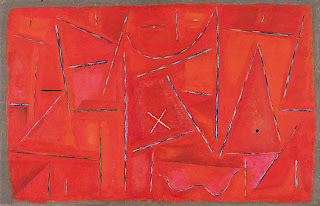
Kenneth Noland, In the Garden


Kenneth Noland, In the Garden. The girl in the middle, marked with an X. Could be Alice, exploring delicately a garden of wonders? Or one of my granddaughters? Bianca? Or Daria?

Noland would later go on his own way, here he is still in the universe of Paul Klee. But it's Noland, for sure. Such a delicate sense of the color! And another wonder, there is a suggestion of bidimensionality, the way Byzantine icons organize their space, in the same time a suggestion of perspective.

I was yesterday at the Phillips Collection and I considered selecting ten images for my own imaginary: ten paintings telling me something special just in that particular moment. My first choice was this Noland.

This was yesterday. I am listening now SYR 6 , the record of Sonic Youth: Koncertas Stan Brakhage. He didn't want music for his movies. He didn't want plot, either. The cinematographic language in its purity, nothing more. Almost 400 movies - his quest for the purity of cinematographic language.

Brakhage didn't want music for his films, however James Tenney composed music for Interim, for Desistfilm, for Loving, for Matins, for Christ Mass Sex Dance. A musical complement, or a parallel? I have just ordered a CD with some pieces by Tenney. My own search to discover parallel structures in painting, movie, music, the language structures of Noland, Brakhage, Tenney.


Adolph Gottlieb, The Seer, 1950


Here is the second choice, not far from the universe where Noland was following the roads of Klee. It's Adolph Gottlieb, Seer, made in 1950. Trying to have the eye of a primitive, like Klee did. The pictographs of Gottlieb, his alphabet to tell us the unseen. Klee, and Noland, and Gottlieb, in search of the universe of kids and primitives, to be able to see beyond the obvious.

The concert of Sonic Youth was a homage to Brakhage who had died one year earlier. Only this homage was against his wishes, I don't make my films out of caprice. I feel they need a silent attention.

His declaration seems arrogant. It is not. I was watching Regen, the movie made by Joris Ivens, in 1928. The music was kind of chansonette, subtle and poetic, only the movie was much more - I watched Regen then without music and the whole poetry inundated my senses.

I am curios to listen Tenney.


Georgia O'Keeffe, Ranchos Church


My third choice: Georgia O'Keeffe, Ranchos Church.

Today Ingmar Bergman died. I'm listening Koncertas Stan Brakhage, recorded one year after Brakhage's death.

I saw many times this Ranchos Church. It brings me always in mind a scene which comes again and again in The Ashes of Time, of Wong Kar-Wai. The place where the characters come to meet each other for matters of life and death.

I would enter and pray in this Ranchos Church, only it attracts and scares me altogether. There is nothing but God in that church, you are far from your world, in front of the turning point in life and death. You and the Eye of God.

Vincent Van Gogh, The Road Menders


And here is the fourth choice: the Road Menders of Van Gogh. The menders are only weak shapes, the trees are inflamed, like in fire, like crazy dancers. The vitality of the background, the road that will go further towards Klimt and Art Nouveau.

The music of Koncertas Stan Brakhage Prisiminimui: a music for movies that detest music.

Is it dark humor? Well, I saw only four of his movies, so far, I am waiting for a dvd with more films by Brakhage - it will come probably in a couple of days - this is the music for those movies. I'm trying to enter in their world by this loose jazz. Music to imagine movies that detest music. Trying to get into the Weltanschaung of Brakhage, by using music, against his wishes.
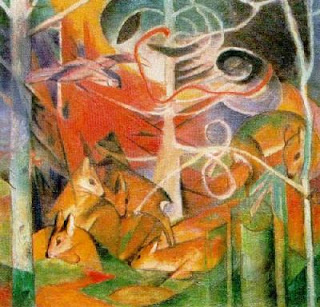

Franz Marc, Deer in the Forest I


My fifth choice: Franz Marc, Deer in Forest (there are two versions, this is the first). It reminds me of the art of Pirosmani.

I'm trying to imagine myself in a small tea house in Tbilisi, with Pirosmani hanging around, listening the Sonic Youth: Koncertas Stan Brakhage. How would it sound there? Metallic pulses, catalytic drums, and railing strings fall apart, and skeletal guitar radiates brief noir themes? (SYR 6)

Rockwell Kent, Tierra del Fuego


Rockwell Kent, Tierra del Fuego, the sixth choice. It's like a photo and I like it precisely for this reason. By being like a photo, it is a formal declaration: this is not the reality, it is an image, with it own reality.

Bergman, with all dilemmas and paradoxes of the Protestant universe. Whether a believer or not, you belong to your universe. The terrible focus on predestination: it means actually the inevitability of Eternal Punishment. The characters of Bergman live under damnation. A fallen world, far from God: it means happiness is impossible. Love is far; here is only lust and repentance. And now comes the paradox: if damnation is certain and happiness is unattainable, you are free, nothing more to loose, and you challenge everything. And so the Protestant universe paradoxically questioned all taboos. No sacred value was exempted: neither church, nor family, nor sexuality.

Augustus Vincent Tack, Windswept


Augustus Vincent Tack, Windswept, the seventh choice. The painting was made around 1900, in New England (in Leyden, Massachusetts).

Windswept, the snow mountain, the snow painting: the white is almost absolute. Again alone, on the edge.

The first movie made by Brakhage, Interim: a boy and a girl meet by pure chance. He just went down from an enormous viaduct, she was coming from the opposite direction. Industrial landscape. The street is crossed by a railway, and a train is just passing, slowly. The two teenagers wait, each one on the other side. The train has passed, they notice each other and smile. They start to talk and walk a bit together. There is a stream nearby and they sit down. The rain starts suddenly and a small crumbling shelter is at view. They run inside and start to embrace and kiss for a brief moment. The rain ends, they come out. He leaves, taking the stairs to the viaduct, she waits for another train to pass, slowly. There is a story here, but it's only the pretext. The movie builds a small Neo-Realist world and plays a little bit inside. That's all. Brakhage was 19 years old. Tenney scored the movie. He was 18. It was 1952.


Robert Spencer, Across the Delaware


Robert Spencer, Across the Delaware, the eighth choice. The town across is New Hope, in Bucks County. I was there many times. The small restaurants and boutiques on the main street keep still some bohème air - it was once the place of the Pennsylvanian Impressionists: the New Hope School. By that time, at the beginning of the twentieth century, Impressionism was still new in America, and the Pennsylvanians were considered the democrats of the new style. Compared to the artists that created in New England (like Tack or Weir), their focus was much more on the everyday life, the subjects they were interested in were much more in the popular universe.

Unglassed Windows Cast a Terrible Reflection, the second film of Brakhage, made in 1953. About 20 minutes, like the first one, Interim. Only the universe is totally different. Now it's the landscape of Stalker. Only we should note that Tarkovsky made his movie in 1979!


Let's be clear: Stalker is to be understood on multiple levels. Here, in the movie of Brakhage, there is no such thing. The plot is only a pretext again, like in Interim. A group of teenagers make an excursion in the mountains, the car breaks, the driver is busy to fix the thing, the others look around. A group of strange wooden houses on the hill. Kind of shacks. Unfinished while crumbled. Through the unglassed windows, the light from within the houses plays with the light from outside. They start to explore. Soon each one looses the others and is alone, like prisoner in a labyrinth. Each new step brings each one in a totally new place. Through the unglassed windows light plays with darkness. They find each other, only to start a fight. One boy is killed. The other steps on a wooden board, looses his equilibrium and dies in the fall. We don't know the reaction of the others, because the camera moves to the ridge of the trees and the movie ends.


So, no multiple levels of understanding, like in Stalker. Only the same growing dread on each step in an alien territory, rendered here in pure cinematographic language, in changes of light rhythm. For Brakhage, it seems, plot is only a pretext, to explore light in motion, in interaction with the eye of the onlooker.


J Alden Weir, Woodland Rocks


Julian Alden Weir, Woodland Rocks, the ninth choice. It reminded me a photo that I had seen some time ago at Phillips: Martha's Vineyard by Aaron Siskind. Each with a different story. The painting of Weir is a moment in a mountain journey, the photo of Siskind is a gate where space ends.

Phillips Collection
is hosting an exhibition devoted to American Impressionists, artists from New York, from New England, from Pennsylvania, Hassam, Prendergast, Weir, Lawson, Tack, Twachtman, Spencer, Robinson, Luks, among others.

Yesterday there was also the last day for another exhibition at Phillips: the Washington Color School, artists who became known in the sixties, Noland, Gene Davis, Morris Louis, Willem de Looper, Alma Thomas, Mehring, Downing, Paul Reed. Impressionists in between the nineteenth and twentieth centuries and Colorists from the sixties and beyond... Works from one exhibition were finding the balance in the other. A room with paintings by Georgia O'Keeffe, Van Gogh, Franz Marc, Rousseau le Douanier was making the transition easier.

I am thinking again at Brakhage's movie, Unglassed Windows Cast a Terrible Reflection (by the way, titles were perhaps not his strongest point). The last image, of the ridge of trees, suggested me another dimension of the movie.

Paul Schrader studied the transcendental dimension in the movies of Ozu, Bresson and Dreyer. He noted in their movies three steps: the everyday, the disruption, the stasis. Each of their movies starts by presenting a normal situation of life, where everything is comprehensible, and the characters are in control. Unexpected events create a growing tension, the situation is more and more incomprehensible, the characters loose more and more the control, everything evolves up to a disruptive moment. The movie's coda is an image that does not explain the incomprehensible, does not resolve the disruption, but transcends it. Schrader names the final step stasis because it is kind of a frozen view of the reality. So at the end we accept the incomprehensible as we realize that all that happened finds a reason in a superior order.

Well, the movie of Brakhage starts with a group of youngsters in an excursion. There is an erotic suggestion, there is a possible love triangle, but every character seems to be in control. It is the banality of the everyday.

The car breaks and all that follows leads to the disruptive moment, the death of the two boys. Here Brakhage is a master of the cinematic language: the growing tension is rendered by subtle changes of light rhythm.

The coda does not explain the reality, only transcends it. The image of the trees makes us realize that there is a superior order of things, and all events have their reasons above our understanding.

It is interesting to analyze in this view the other movie of Brakhage that I have seen, The Way to Shadow Garden, made in 1954. It was his fourth film. 11 minutes long. This time the plot is no more, it is a pure symbolic film.

A young boy walks through the night. The storm is approaching. He enters his room, closes the windows, but looses gradually the control. Though he tries to do normal actions, to take a glass of water, to read a book, etc, the room becomes his trap. He breaks the glass and gouges his eyes with the splinters. He leaves tSpnecerhe room only to find himself in the shadow garden: the image turns to negative, the darkness is white, his eyes are white. His skin is black, the flowers are black.


I believe that here we have a negative stasis: the transcendental (the shadow garden) does not bring the solace, and man remains prisoner of space. And space for Brakhage means light in motion in dialog with our subjectivity. It would be interesting to make a parallel between Brakhage and Moholy-Nagy (Lichtspiel: Schwartz - Weiss - Grau) or Schlemmer (Das Triadische Ballett)


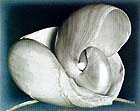
Edward Weston, Shells, 1927


Edward Weston, Shells, the tenth choice. A photo made in 1927. His nudes taking the shape of his shells, his shells celebrating the beauty of his nudes.

Yesterday Ingmar Bergman died. I was too tired to finish this message, so here I am, again in front of my laptop. Today Michelangelo Antonioni passed away.


(By Brakhage)

(Van Gogh)

Labels: ,

Sunday, June 03, 2007

Note la Teorema lui Pasolini

Pasolini, imagine preluata din ziarul Cotidianul Imaginea am preluat-o din ziarul Cotidianul.
Incerc sa imi argumentez punctul de vedere privind Teorema lui Pasolini cu cateva note pe care mi le-am facut la o noua vizionare a filmului.
Prologul - ziaristul intreaba, este un act izolat sau avem de-a face cu un nou trend? Prin middle class este inteleasa in film burghezia. Daca este un trend (se refera la eroul interpretat de Massimo Girotti care renunta la fabrica in favoarea muncitorilor) , inseamna ca middle-class (repet: aici in sensul de burghezie) devine intreaga omenire.
Cred ca aici e un hint catre a doua cheie a filmului - care se poate citi ca o parabola antiburgheza, dar si ca o parabola a conditiei umane.
Urmeaza leitmotivul desertului - dunele rascolite de vant: Though God led the people through the desert, He visited them now and then - epifanii.
Everyday is a march through the desert, only we are unaware, till an epihany occurs.
Eroina (Silvana Mangano) citeste din Rimbaud - versurile citite la un moment dat de Terence Stamp sunt din cartea ei:
He belonged to his own life and the turn of goodness
would have taken longer to recreate than a star.
The loved one who came without my ever hoping he would,
has not come back and never will again.
Cheie spre intelegerea epifaniei. Acestor versuri sunt puse in replica unui text din Ieremia 1:
You have seduced me Lord and I let myself be seduced. You have taken me by force and You have prevailed. I have become a laughingstock every day. Yes, I have heard many slanders. Terrors on all side. You denounce him and then we'll denounce him. All my friends kept an eye close on my fall. Maybe he'll let himself be seduced and we'll reap our vengeance on him.
Tatalui bolnav, i se citeste din Moartea lui Ivan Ilici - el face o comparatie intre eroul jucat de catre Terence Stamp si Gherasim - tu nu esti Gherasim, pe tine omul nu te poate infrunta cu privirea.
Epifania iti distruge indentitatea dinainte. Coma lui Odette - extaz mistic. Culoarea picturilor baiatului: blue reminds me of him (pe urma urineaza pe albastru).
Secera si ciocanul cand servitoarea se ingroapa de vie. Nu te teme, nu am venit aici ca sa mor ci sa plang lacrimi de bucurie - din lacrimile mele va tasni un izvor. Secera si ciocanul in locul crucii.
Turnul care apare la un moment dat imi aminteste de Nostalgia Infinitului a lui Chirico (chiar daca in film turnul este o structura metalica)

Giorgio de Chirico, Nostalgia Infinitului, 1911


(Italian Movies)

Labels: , , ,

Friday, June 01, 2007

Teorema lui Pasolini

Terence Stamp si Silvana Mangano

Teorema lui Pasolini a trezit reactii extreme. The kind of movie that should be seen at least twice, but I'm afraid that a lot of people will have difficulty sitting through it even once (NY Times). Rosary beads in the hands of an atheist (Kieran F. Johnston, intr-o cronica facuta pe Amazon). Iar pe de alta parte, there are only 923 words spoken in Teorema - but it says everything (tagline din pagina filmului de pe imdb).
Nici nu e de mirare. Un film minimalist - naratiunea nu avea cum sa fie redusa mai mult - singurul rol al naratiunii este acela de suport al unor imagini care manipuleaza simboluri. Inainte de a provoca spectatorii un asemenea film este o provocare pentru el insusi.

Pier Paolo PasoliniFilmul a aparut in 1968, odata cu romanul (o cronica a romanului in ziarul Cotidianul). 1968 - Primavara de la Praga, Primavara de la Paris. Un film si un roman definitorii pentru epoca, antiburghez si iconoclast. Dar sa citez cateva randuri din cronica publicata de Cotidianul: Ce urmareste sa demonstreze Teorema? Ca burghezia este o categorie al carei continut a disparut, o eticheta a carei semnificatie s-a golit de sens, ca toata aceasta clasa sociala si-a pierdut identitatea, ramanand o forma fara functie, suspendata din inertie intr-un context istoric. Pier Paolo Pasolini, comunistul exclus din Partidul Comunist: prea independent, prea iconoclast, prea incomod.
Cine vrea sa vada in Teorema numai o demonstratie antiburgheza, se poate opri aici.
Insa filmul poate fi citit in doua planuri. Unul este demonstratia antiburgheza explicata poetic printr-o metafora religioasa (oricum sacrilega). Intr-un al doilea plan, radiografierea conditiei burgheze devine o meditatie asupra conditiei umane. Pentru ca o parabola este universala.
Poate ca Pasolini a dorit intr-adevar sa vorbeasca numai despre burghezie. Poate ca intr-adevar el a crezut ca dimensiunea transcendenta a filmului este o metafora, nimic mai mult. Dar opera de arta, odata ce iese din chinurile facerii isi porneste o viata a ei care nu mai depinde de creator. Iar Pasolini, ateul fascinat de universurile Bibliei, a creat in Teorema o opera a carei viata se desfasoara undeva intre mundan si sacral. Rosary beads in the hands of an atheist? Da, numai ca mataniile odata insirate printre degete isi pornesc un dans al lor care te duce unde vor ele.
Imanent si transcendent. Sunt mai multe feluri de a te apropia de relatie. Pentru Ozu, Bresson, Dreyer (si Sarah Polley in Away from Her), imanentul si transcendentul se confunda. Viata e un miracol. Este de ajuns sa o privesti. E viziunea lui Cehov si a lui Jane Austin. Noi suntem sfintii, noi suntem ingerii, noi pacatosii. Orice tufis arde si poarta in el Glasul Domnului.
Pentru Tarkvosky, pentru von Trier, pentru Zviaghintev (Intoarcerea), pentru Polanski (din Cutitul in apa), pentru Kim Ki-Duk, transcendentul si imanentul sunt separate - doua universuri - iar universul nostru este vizitat din cand in cand de mesageri ciudati. Este cazul Teoremei lui Pasolini. El este obsedat de Biblie, dar in felul lui Kazantzakis din The Last Temptation of
Christ
.
Cei patruzeci de ani in care poporul lui Dumnezeu a ratacit prin Desert sunt pentru Pasolini povestea fundamentala a devenirii umane - din cand in cand de-a lungul peregrinarii Dumnezeu a mai intrat in contact cu oamenii - imaginea dunelor scuturate de vant reapare ca un leitmotiv - contactul poate fi exprimat cel mai bine prin sex - un tanar (Terence Stamp) apare pe neasteptate intr-o familie burgheza si fiecare membru al familiei este fecundat - experienta sexuala este in mod clar in film o epifanie - imaginea este deodata luminata, fiecare pe rand intelege si urmeaza experienta sexuala - o fraza ciudata din Cartea Exodului este pomenita la un moment dat - mi-a amintit de titlul unei carti de Evdokimov, Iubirea nebuna a lui Dumnezeu - mari mistici (sa-l pomenim aici numai pe Rumi) au inteles ca iubirea lui Dumnezeu este erotica, pentru ca iubirea adevarata este erotica.
Un tanar cu ochi de inger, care te atrag, dar te sperie totodata, pentru ca nu par umani. Este un inger? Este Dumnezeu? Este Diavolul? Eliade pomenea la un moment dat de cativa cercetatori ai religiilor preocupati de ceea ce ei numeau ambiguitatea divinului.
Si apoi tanarul dispare - la fel de brusc si nemotivat cum a aparut - iar nimic nu va mai fi la fel ca inainte. Servitoarea va deveni o sfanta si va zbura prin fata credinciosilor, fata (Anne Wiazemsky) va intra in coma, baiatul va incepe sa picteze ca un nebun, mama (Silvana Mangano) va deveni o curva, tatal (Massimo Girotti) isi va da fabrica muncitorilor si va incepe sa alerge in pielea goala prin desertul Iudeii, desertul nostru existential, urland ca un sacal. Experienta imanentului ne transforma pentru totdeauna.
Ce este Teorema lui Pasolini? Este o meditatie in imagini superbe (felul in care se face aici cadrajul imaginii mi-a amintit de Ozu) - pentru ca filmul se graieste in imagini si nu in vorbe. Se spun doar 932 de cuvinte in acest film. cel mai mult se tace. Vorbesc imaginile. Minimalismul filmului este superb. Filmul acesta fara naratiune are ritmul filmelor lui Griffith si Eisenstein. Ca si acolo, nu ai de fapt timp sa respiri.
Parajanov era fermecat de arta lui Pasolini, dar cred ca el a mers intr-o directie putin diferita, pentru ca Sayat Nova (tot din 1968) este altfel - pentru Parajanov exista numai imanentul, de la inceput pana la sfarsit - iar transcendentul este doar un suport, atat. Inca nu am vazut Umbrele Stramosilor Uitati.
Sa ma intorc insa la Teorema. La imaginea ultima, a tatalui alergand gol prin desert si urland. O metafora a conditiei umane? A omului dupa epifanie? Filmele lui Ozu si Bresson se termina in momentul epifaniei. Momentul cand omul intelege ca exista un rost superior in care se incadreaza si incercarile lui. Pasolini duce meditatia mai departe. Ramanem acolo, in momentul epifaniei? Nu. Ne vom nevoi mai departe in peregrinarea noastra prin desert, dar de acum vom sti ca suntem goi si vom tanji mereu dupa un moment al epifaniei care a trecut tot atat de brusc cum a venit.
Este o meditatie dincolo de sacrilegiu. Dar si sacrilegiul isi are un rost cateodata.


(Italian Movies)

Labels: , ,

Saturday, May 26, 2007

Arhitecturi cinematografice - un outline rapid

EisensteinEste un subiect vast. Incerc un outline, la repezeala.
Hou Hsiao-Hsien in Maestrul Papusar conduce povestea filmului pe trei planuri - actiunea se desfasora in paralel cu povestirea ei de catre erou (voce in off) si cu comentariile pe care le face acelasi erou la actiune si la povestea ei - de data asta asezat pe un scaun in fata aparatului de filmat. Aceeasi actiune in trei planuri - care se misca intre ele precum miscarea norilor pe cer!
In alt film al lui, Good Men, Good Women, doua actiuni in paralel - o actrita joaca intr-un film despre o eroina din timpul razboiului, actiunea adevarata a eroinei in paralel cu actiunea din filmul despre ea - eroina inca mai traieste si comenteaza. Tip de arhitectura folosit si de Atom Egoyan in Ararat.
Arhitectura pana la un punct asemanatoare si in filmele lui Julio Medem (Lucia y el Sexo, Los Amantes del Circulo Polar) - povestea este creata din bucati spuse de fiecare erou, ca niste bucati de mozaic pe care insa trebuie sa le asezam noi cap la cap - aceeasi poveste poate insemna cu totul altceva dupa cum ne decidem noi - si fiecare versiune este perfect credibila. Inteleg ca aceeasi arhitectura este si in filmul Tierra, pe care nu l-am vazut.
Oricum, Atom Egoyan foloseste de fapt aceeasi arhitectura in alte filme ale lui (de ex. in Where the Truth Lies, pe care l-am vazut, se pare ca si in The Sweat Hereafter pe care inca nu l-am vazut) - insa la el ideea pare a fi ca adevarul nu poate fi cunoscut - nu ca noi trebuie sa il reconstituim din fragmentele care ni se prezinta.
Almodovar in Hable con Ella - o serie de episoade care nu au nici o semnificatie pentru ele insele - dar care isi trimit semnificatia catre intregul filmului - o catedrala baroca formata din capele kitsch - rostul fiecarei capele este sa se explice nu pe ea, ci sa sprijine celelalte capele si sa trimita totul catre barocul catedralei.
Guillermo del Torro in Labirintul lui Pan - doua universuri contradictorii care evolueaza unul langa altul - universul fetitei, in care copacii sunt oameni intelepti si insectele sunt spiridusi, universul maturilor, care este atroce - schimburi subtile de informatii intre cele doua universuri.
Cutitul in apa al lui Polanski - tanarul vine din alt univers si pleaca inapoi in universul lui - barbatul nu il intelege si se simte amenintat - femeia este atrasa de universul tanarului.
Toate filmele lui Kim Ki Duk au aceeasi arhitectura ca si Cutitul in apa - coliziunea dintre doua universuri - cel al nostru, de toate zilele, cel transcendent, coliziune, atractie, respingere - limbajul lui Kim Ki-Duk este altul - magia exprimata prin violenta si sordid. Universul transcendent ni se arata doar in Spring, Summer, Fall, Winter, again Spring, dar e in toate celelalte.
Arhitectura transcendenta din filmele lui Ozu, Bresson, Dreyer, dar si in Away from Her (al Sarei Polley)- explicata prin koan-ul zen:
1. cand am inceput sa studiez zen, muntele arata ca un munte
2. cand am crezut ca stiu zen, muntele nu mai arata ca un munte
3. cand am ajuns sa cunosc cu adevarat ceva din zen, muntele arata din nou ca un munte, dar altfel (pentru ca intelegeam si de ce nu mai aratase ca un munte)
Filmul ca structura muzicala - Symphonie diagonale, Regen, Ballet Mecanique, The Hearts of Age, Berlin: Die Sinfonie der Großstadt, Opus I, Romance Sentimentale, Le Retour a la Raison, Rhythmus 21, H2O- paralela dintre structura de imagini si structura muzicala - incercare de a vedea fiecare din filmele acestea si fara sonor - imaginile filmleor sunt muzica fara sunete - e un limbaj la fel de coerent ca si limbajul sunetelor.
Filmul ca un tot inseparabil - cameraman si ceea ce cameramanul filmeaza, editare, spectacol - deci film care se creaza in fata spectatorilor - Dziga Vertov, Omul cu camera de filmat.
Filmul ca o poveste care se spune numai de catre imagini, asa cum muzica nu are nevoie decat de sunete - Eisenstein, Parajanov, Hou Hsiao-Hsien, Egoyan, Almodovar, Wong Kar-Wai, Ang Lee.
Vigoarea naratiunii prin imagini, montaj, ritm: Griffith, Eisenstein.
Cu Wong Kar-Wai incepe noua varsta a filmului?

(Filmofilia)

Labels: