Updates, Live

Monday, January 04, 2016

A vulnerabilidade do corpo (Lucian Freud)

(source: Revista IDEAFIXA)
no copyright infringement intended

Lucian Freud era neto de Sigmund Freud, o progenitor da psicanálise. Assim como Sigmund Freud que passou centenas de horas com seus pacientes deitados em um sofá, tentando penetrar em suas mentes e interpretando seus sonhos, Lucian Freud também passou centenas de horas com seus modelos deitados em um sofá, mas ele manteve um intenso foco na superfície. Provavelmente ele sentiu que o corpo físico, visto de forma verdadeira, poderia revelar profundezas ocultas.

Um belo artigo sobre o hiper-realismo de Lucian Freud na revista IDEAFIXA de São Paulo: A vulnerabilidade do corpo.


(source: Revista IDEAFIXA)
no copyright infringement intended


(Contemporary Art)

Labels: ,

Friday, July 22, 2011

Lucian Freud Passed Away


He started from the Neue Sachlichkeit (Otto Dix, Georg Gross), fed also with much older masters (Albrecht Dürer, Hans Memling); he was briefly attracted by Surrealism, only to reject it decisively (I could never put anything into a picture that wasn’t actually there in front of me); and the encounter with the art of Francis Bacon proved decisive. Lucian Freud (who died yesterday, at 88) has been one of the great masters of Hyperrealism.

There is an article about his life and work in NY Times:


si un rezumat pentru prietenii mei care nu stiu englezeste nici macar cat sa ma citeasca pe mine: Lucian Freud a pornit dela Noua Obiectivitate a lui Otto Dix si Georg Gross, hranit si din maestri mult mai vechi (Dürer si Memling); a fost tentat cateodata sa se aventureze si pe campiile suprarealismului (cine oare nu a fost?), ca pana la urma sa se scuture de el cu oroare (cum sa pictez ceva ce nu e acolo in fata mea?); intalnirea cu arta lui Francis Bacon s-a dovedit decisiva; cu femeile a avut el ce-a avut: nudurile sale nu sunt doar dezbracate, sunt obtruziv despuiate, goliciunea lor urla ca o rana deschisa din care se prelinge puroi, pana la punctul in care te prefaci ca nu o vezi si ii spui doamnei, 'va rog sa ma scuzati domnule, nu am stiut ca sunteti dezbracat'; a stiut insa sa fie si suav, dovada portretele primei sale sotii (care totusi a divortat de el, era in viata de toate zilele o pacoste); nici a doua nevasta nu a putut sa il suporte prea mult; a avut dupa aceea amante: era un romantic; totusi povestea ca el a dat foc scolii de pictura unde era elev este o legenda nedreapta; americanii s-au mirat multa vreme de unde pana unde faima lui de mare artist; pana cand la Hirshhorn a fost organizata o expozitie Lucian Freud; a urmat dupa aceea o expozitie la MoMA iar americanii au inceput sa il adore; asa sunt americanii, pana la urma baieti buni; daca ma intrebati pe mine, eu cred ca este genial: picteaza cu 'guts' (cum tot americanii zic) si spune in tablourile lui al naibii de bine tot ce are de spus; dar toate astea sunt incepand de ieri la timpul trecut; Lucian Freud ne-a parasit; ne raman capodoperele sale hiperrealiste, greu de inghitit pentru cei slabi; sunt patrunse si picturile lui, cum este toata arta veacuilui al douazecillea, de tensiunea insuportabila dintre imagine si realitate; asta este, ne-a parasit; sa se odihneasca in pace!


(Contemporary Art)

Labels: ,

Thursday, January 07, 2010

David Park, Struggling Between Figurative and Abstract

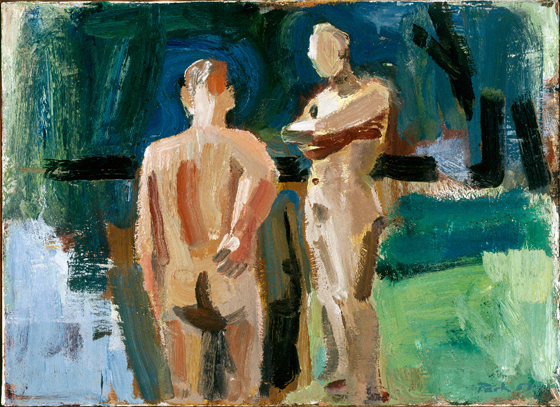
David Park - Male Nudes at the Water, 1957
oil on canvas

David Park was a pioneer of the Bay Area Figurative School, and like other artists of this movement he went back and forth between representational and non-figurative. Park's struggle to get out of Abstract Expressionism and to find the truth of his art in Figurative was intense for all his life and in certain moments dramatic. He said once, I was concerned with big abstract ideas like vitality, energy, profundity, warmth; they became my gods; they still are; I disciplined myself rigidly to work in ways I hoped might symbolize these ideals; I still hold these ideals today, but I realize that those paintings never, even vaguely, approximated any achievement of my aims.

Sometimes this journey was taking place in the same artwork, with contradictory styles in coexistence and interaction. Says Mark W. Scala, in Male Nudes at the Water sensuous textures and broad passages of color are blended sufficiently to suggest the physicality of the figures, but without compromising the free flowing essence of abstraction; the subjects remain anonymous, dislocated in the agitated materiality of aquamarine, cerulean, viridian, vermilion, neutral and flesh-toned paint; ironically Park achieves in figurative painting the gestural freedom that eluded him in the years he was pursuing Abstract Expressionism.

(Paint Made Flesh)

Labels:

Thursday, September 17, 2009

Francis Bacon


Diptych - Study of the Human Body From a Drawing by Ingres, 1982-1984
oil paint and transfer type on linen

Do I like the work of Francis Bacon? The short answer would be no, a more serious answer should be that I am not familiar with his art, and it needs time to understand it and to make a judgment.

Perhaps it is better now to tell you just how I met with his paintings.

My first meeting with Bacon's art was at Hirshhorn, in an exhibition with a shocking name: Strange Bodies. There was a diptych and I recorded a video. Why had he chosen such a contorsionated rendering of the bodies was for me an open question.

I had then the opportunity to visit an impressive retrospective of his work, at the Met in New York. This was really a great opportunity as it gave me the perspective.

I would dare to say that his works called me in mind the universe of Kafka: the same powerful emotional charge. But I need much more time to become familiar with Francis Bacon's work and to be able to make a judgment.

I met again with his paintings at Phillips: another exhibition with a strange name (Paint Made Flesh) and these three works of him:


Head in Grey, 1955
oil on canvas


Walking Figure, 1959-1960
oil on canvas
Dallas Museum of Art


Three Studies for the Portrait of Henrietta Moraes, 1963
oil on canvas, three panels
MoMA


(Hirshhorn Museum)

(Paint Made Flesh)

Labels:

Wednesday, September 16, 2009

Lucian Freud

Naked Man, Backed View, 1991-92
oil on canvas

I met for the first time with the work of Lucian Freud at Hirshhorn. The exhibition there had a very suggestive name: Strange Bodies. I repeat here the quote from Lucian Freud: I would wish my portraits to be of the people, not like them, not having the look of the sitter, being them.


Standing by the Rags, 1988-89
oil on canvas


(Paint Made Flesh)


(Contemporary Art)

Labels: ,

Monday, September 07, 2009

Hyperrealism and Neo-Expressionism As the Same Thing: Jack Levine

Jack Levine - 35 Minutes from Times Square, 1956
oil on canvas
Hirshhorn

Levine is a realist at heart who distorts forms, blurs surfaces, and decomposes flesh in a clinical manner. Here, in his 35 Minutes from Times Square, the women are matter of fact, resigned, unglamorous, socially marginalized working girls, neither threatening nor alluring (Mark W. Scala).

A realist at heart who distorts forms: this is a perfect definition for Expressionism, and also for Hyerrealism. Some call it Hyerrealism, others call it Neo-Expressionism: it is basically the same thing.

(Paint Made Flesh)

Labels:

Hyman Bloom - The Hull

Hyman Bloom - The Hull, 1952
oil on canvas

An extreme rendering of an autopsy, it is hard to look at it. The once living body is now just flesh and carcass.

Bloom is a loner in the guise of Soutine and Ryder. His spirituality rivals Rembrandt and Odilon Redon. HIs colors are as stark as Vlaminck or Derain, yet his paintings maintain the shock value of something never seen before (Mark W. Scala).

(Paint Made Flesh)

Labels:

Friday, September 04, 2009

Playing Against Type: John Currin

John Currin - The Hobo, 1999
oil on canvas
Museum of Contemporary Art San Diego

In an attraction - repulsion strategy, the type of female beauty shown as a hobo (a vagabond). The woman from the canvas is actually Currin's wife, the artist Rachel Feinstein.

(Paint Made Flesh)

Labels:

The Self Portraits of Tony Bevan

Tony Bevan - Self-Portrait (PC9211), 1992
powdered pigment and acrylic on canvas

The Self Portrait of Tony Bevan shows all possible scars. It is like the artist carries all wounds of the world. These wounds are at once independent of the body (as they would have an existence of their own), masters of the body (strictly controlling its degrees of liberty) and pure mental representations, pure products of a schizophrenic imagination. This way, external and internal, the universes of the outside world and of the inside mind, become a whole and schizophrenia is no more.

In the words of art historian Klaus Ottmann, the self portraits of Tony Bevan possess a first order of presentness and intensity that transcends the schizophrenic split of the external world of objects and the internal world of the mind.

You should look also at this other work of Bevan, entitled Head. As I took a shot from the image in the catalog of the exhibition, it is not particularly fidel to the original. It is actually a sphere, delimiting the inner of the head from the exterior world. Whom belong all these networks of nervous ramifications, drops of blood, signs of injuries? To the exterior world or to the inner? The answer cannot be otherwise than ambiguous: are the injuries and pains assumed by the artist real or just schizophrenically imaginary? The canvas would suggest that in fact it does not matter that much.

Tony Bevan - Head, 2005
acrylic and charcoal on canvas


(Paint Made Flesh)

Labels:

Friday, August 28, 2009

Julian Schnabel - Corine Near Armenia

Julian Schnabel - Corine Near Armenia, 1984
oil, plates, and auto-body filler on wood

The vertically fractured image of a naked woman surrounded by pieces of broken crockery: the woman seems to stay confused between worlds of past and worlds of present, between a new beginning of the Universe and a cataclysm that just destroyed the Universe, between ambiguous signs of technology and ambiguous remnants of ancient history. Corine is near Armenia, the place where the horrible massacre shattered history and future for ever.

(Paint Made Flesh)

Labels:

Francesco Clemente

Francesco Clemente - Self-Portrait with Two Heads, 2002
oil on canvas

The Self Portrait with Two Heads that I have seen at the Paint Made Flesh exhibition looks undoubtedly provocative (and ambiguous, playing on a subtle confusion sexual identity), but it is good to compare it with another self portrait that I have found on a web site of Gagosian (Self Portrait with and without the Mask): we'll have a better understanding of Francesco Clemente's art. He takes the whole, decomposes it in parts and rearranges them to propose us some kind of unexpected statements. In this sense we could think at him as a Conceptualist. But it is more here.

Francesco Clemente - Self Portrait with and without the Mask, 2005
oil on linen
Says Rainer Crone, Clemente exploits figurative images for non-narrative purposes... (He) has something original to contribute: figure-words, as Novalis would call it, pictorial discoveries from a pre-conscious, pre-linguistic world, releasing associations in the observer through the power of their expressiveness. This pictorial means is one we are most familiar with through fairy tales, myths and dreams - meanings of possible, conceivable worlds. His pictures question a reality that only exists by approximation, and whose existence we intimate through the power of our own desires.

(Paint Made Flesh)

Labels: ,

Sunday, August 23, 2009

Background as Battleground

Arnaldo Roche-Rabell - We Have to Eat, 1986
oil on canvas

A racially indeterminate face (with traits denoting an African descent, while the light-blue eyes send to North American Caucasians) surrounded by a tangled web of some kind of Carribean foliage: it is in such details that the social message is wrapped in. It is about bicultural conflicting identities (the artist is born in Puerto-Rico and lives in Chicago). For Arnaldo Roche-Rabell background equals battleground.

Wangechi Mutu (born in Kenya in 1972, living in New York since early nineties) is also preoccupied by multiple distant identities, leading to strong internal interactions between what are essentially globalism and tribalism. She creates collages that combine fragments of photographs, spots of blood, hair, African fetiches, along with mechanical parts: the resulting hybrids speak about female identities as confused, layered, mutable; her works can be seen as poetic embodiments of modern-day transformative forces, but also as aenigmas - monsters formed by conjoining nameable parts taken from nameable creatures (Mark W. Scala) - after all, with all advances in bio-technology and all that stuff, are we still humans?

Wangechi Mutu - Squiggly Wiggly Demon Hair, 2004
paint, ink, collage, mixed media on Mylar


Here are some close-ups:


(Paint Made Flesh)

Labels:

Saturday, August 22, 2009

If Life Were Life There Would Be No Death

Ivan Albright - The Vermonter
(If Life Were Life There Would Be No Death)
1966-1977
at Dartmouth College
oil on masonite

Ivan Le Lorraine Albright (1897 - 1983) liked to give to his works long and enigmatic titles. Does this Vermonter know some secret that we don't, of life forever; or is he rather well prepared for what will come?

Ivan Albright is considered to belong to Magical Realism (which should bring him near the Latino-American writers: his works, rigorously real in their appearance, contain something strange, difficult to describe, that bring them suddenly in the realm of imaginary).

Ivan Albright, Self-Portrait in Georgia, 1967-1968
oil on panel

Erich Fischl (born in 1948) takes another view on the end of life. It is no more magic in his work, just an account of the way we regress. A naked old man, whose skin has the translucence of an old parchment, advancing with fear along a Roman hallway: a mixed meditation about aging and eroticism. Sexual desire within the context of decay and of death approaching: we are defined by the erotic dimension and our life has a terminus. Is it really toward the end our desire balanced by self-reflection?

It is a tribute for the father of the artist, who had died one year before Eric Fischl made the portrait.

Eric Fischl - Frailty Is a Moment of Self-Reflection, 1996
oil on linen

(Paint Made Flesh)

Labels:

Friday, August 21, 2009

Daniel Richter: Duisen

Daniel Richter - Duisen, 2004
oil on canvas


The personages seem unreal, you don't know why, there is something: it's like a choir in an opera, they try to convince you that it's about real time and space, but you know that's just opera. This is not reality, while it is carrying a powerful message about reality.

From a cycle of four works, titled in anagrams indicating the cardinal direction, Duisen is a scrambled version for Süden: the reference relates to the influx of immigrants coming from Islamic countries (thus, from South) to Germany, leading to new political realities, igniting conflicting social issues.

To understand him better, here is an interview given by Daniel Richter.


(Paint Made Flesh)

Labels:

A.R. Penk : Skizze

A R Penck - Sketch (Skizze), 1983
acrylic on canvas

It is one of the works that impressed me the most at the Paint Made Flesh exhibition from Phillips. I thought immediately at The Seer of Gottlieb (viewed also at Phillips, some time ago): a imilar pictorial alphabet of Primitive ideograms, the same bi-dimensional space, in quest for the purity of the Primitive Art.

A. R. Penk could be revendicated by two contemporary art directions: Neo-Primitivism and Neo-Expressionism. If you agree, his Neo-Primitivist approach is a way of expressing his Neo-Expressionsit feelings: witnessing as a child the bombardment of Dresden, leaving then in East Germany under the constant pressures of the Communist regime, surveyed by the political police, he expressed by his art (painting, sculpture, along with jazz) his dissident attitude. And Expressionism is a propper way to speak about your disdain for the ugly realities of the universe you are constrained to live.

(Paint Made Flesh)

Labels:

Thursday, August 20, 2009

Paint Made Flesh


An exhibition at Phillips Collection: it's not about human flesh used as raw material by some quirky artists of today, or some crazy form of performance art. No, it is about the effort to show the human flesh in all its frailty and thus to make the image in likeness with what it is essential in human nature: desire and failure, illusion and despair.


Art was always marked by the tension between image and reality, and long time it was considered that the solution was to follow strictly the canons of beauty. Well, Rembrandt discovered that people are not always young and gorgeous, and Goya found out that behind grandeur there was silly ridicule. And then, little by little, artists took the courage to depart from canons. They discovered that perspective was just a convention and that colors did not match always one another. And they went further, giving up completely the representation of reality and looking for their own universes of lines and circles.

Only it happened that these lines and circles started to claim their own stories, their own plots, and thus became again images; and the tension came back.

Pop Art tried to bring the real objects into the work art: only it happened that these real objects lost their quality of being real objects and became images. Photorealism tried to follow consciously the reality by examining carefully the objective image given by a photo, finding this way those elements in the reality that human eye does not perceive: only the reality carefully reconstructed by Photorealists was not ours; it was their own.

Hyperrealism took another way: to look for what are essentially our weaknesses and to speak honestly about them: ugliness, ridicule, suffering, and so on.

Now, coming back to the exhibition at Phillips, not all artists there belong to Hyperrealism, of course; some were active long time before this term was coined; some Germans belong rather to Neo-Expressionism; some artists (like Francis Bacon) are too much their own guys to be possibly framed.

There is a video (authored by PhillipsArtMuseum) that will give you an idea about the exhibition. Unfortunately its width does not fit with the size of the blog page.

It was not allowed to take pictures inside, of course, but I will show you in some future posts images that I found in the album of the exhibition:


(Phillips Collection)
(Contemporary Art)

Labels:

Monday, May 25, 2009

Hyperrealism: Tony Cragg

Tony Cragg - Inverted Sugar Crop, 1966
bronze and steel


(Hirshhorn Museum)

(Contemporary Art)

Labels:

Friday, December 12, 2008

Hyperrealism: Strange Bodies at Hirshhorn

Ron Mueck - Untitled (Big Man), 2000
pigmented polyester resin on fiberglass


Lucian Freud - Nude with Leg Up (Leigh Bowery), 1992
oil paint on linen

I would wish my portraits to be of the people, not like them, not having the look of the sitter, being them (Lucian Freud): I think this is a good explanation for hyperrealism. A person becomes real only when the ugly, the imperfect, the sordid, the unpleasant, are present; otherwise it's an image.


John Currin - The Pink Tree, 1999
oil paint on linen

Strange Bodies is on view at Hirshhorn.


(Hirshhorn Museum)
(Contemporary Art)

Labels: ,