Updates, Live

Thursday, June 21, 2012

Bărbânţe, doniţe, ciubere


Another image meditated by Casian Balabasciuc, calling in mind Parajanov's Shadows of Forgotten Ancestors...

Cuminţi stau rânduite-n stână
Bărbânţe, doniţe, ciubere,
Ce spun că datina română
Cât vor mai fi de lemn, nu piere.


(Casian Balabasciuc)

(Parajanov)

Labels: ,

Sunday, February 05, 2012

Casian Balabasciuc: Singurătatea Strămoşilor


O imagine uluitoare, care imi aduce din nou aminte de Umbrele Stramosilor Uitati, filmul lui Parajanov de care inca nu am curajul sa scriu. Sunt oare singure umbrele mosilor si stramosilor pe care i-am uitat de mult? Sau poate dintotdeauna? Nu, noi suntem singuri, pentru ca nu le vedem, dar ele, umbrele, se misca printre noi si ne stau alaturi, fara sa o stim, brat si tarie. Ne spun cine suntem, chiar daca nu avem vreme sa ii auzim.

In seara razvratita care vine
De la strabunii mei pana la tine,
Prin rapi si gropi adanci,
Suite de batranii mei pe branci,
Si care, tanar, sa le urci te-asteapta,


La Washington, la Galeria Nationala de acolo, am vazut un potir din sardonix despre care se stie ca a fost folosit intr-o biserica din Alexandria Egiptului in primul veac al erei noastre. Pe la anul 1000 se afla la o abatie de langa Paris, unde i-a fost adaugat un cadru de aur si argint, cu o montura de pietre pretioase. Unii se avanta sa spuna ca este cupa Graalului - dar asta nu este decat o speculatie, fireste. Sunt insa tot stramosii, pe care i-am uitat, si care ne asteapta rabdatori.


(Casian Balabasciuc)

(Parajanov)

Labels: ,

Casian Balabasciuc


Tot încerc să scriu despre un film care mi-e drag, Umbrele Strămoşilor Uitaţi, merge însă greu, pentru că e un film pe care îl consider esenţial, şi nu poţi să scrii orice despre el. Şi tot amân.

Este un film care se petrece într-o vreme nedefinită, undeva în nordul Carpaţilor, într-un sat de huţuli. Localizarea geografică este de fapt vagă şi ea, cum este şi localizarea temporală, şi este voit aşa, pentru că Parajanov a vrut de fapt să ne introducă în lumea mitului, adică acolo unde identitatea unei etnii este definită fără a se mai face nici un fel de adaos: nu contează unde suntem şi când suntem, însă ăştia suntem.

Tini zabutykh predkiv, acesta este titlul original al filmului, nu este nici în rusă şi nici în ucraineană, ci în graiul acela pe care Casian Balabasciuc îl pricepe (fiindcă este al lui): un grai înrudit cu ucraineana, dar din care un ucrainean pricepe tot atât de puţin cât ar pricepe şi un român (http://www.gandul.info/reportaj/stapanii-dracilor-3205140).

Cine sunt huţulii? Sunt câteva sate prin Bucovina, îşi au graiul lor, şi obiceiurile lor, şi poveştile lor: despre nişte comori îngropate de le ştiu numai ei locul, despre duhurile pădurii de care e bine să te fereşti, atât cât poţi, că tot dau duhurile astea de tine, şi alte poveşti tot aşa. Sunt creştini ortodocşi, însă ei ştiu că farmecele şi descântecele îşi au rostul lor. Iar vrăjitorii lor se numesc solomonari, pentru că, aşa cred huţulii, învăţătura le vine de demult, dela regele Solomon.

Din păcate, huţulii au început să îşi piardă identitatea, fiind absorbiţi de populaţiile majoritare, de români şi de ucrainieni. Seamănă desigur poveştile lor şi cu cele pe care le ştiu ţăranii români, şi cu cele ale ţăranilor ucrainieni, însă poate că s-au păstrat mai bine, iar dacă le studiem îi vom înţelege pe ei, pe huţuli, cine sunt, dar poate ne vom înţelege şi pe noi mai bine, chiar dacă limbile noastre diferă atât de mult.

Iar Casian Balabasciuc este un scriitor care trăieşte acolo şi care încearcă să adune mărturii despre huţuli şi despre cultura lor, ca să fie păstrate. În cărţile lui (nu am reuşit până acum să le găsesc, doar ştiu de ele), prin fotografii, prin emisiuni de televiziune. De fapt l-am descoperit urmărind întâmplător o emisiune la televizor. Poate voi reuşi să îi găsesc cărţile şi să vă scriu despre ele. Deocamdată voi posta aici fotografii făcute de el, le-am găsit pe Facebook.


(Bucovina)

(Parajanov)

Labels: ,

Sunday, January 23, 2011

Sergei Parajanov


Parajanov was one of the greatest. His life was a tragedy. He paid for his huge talent with years of prison. They did not tolerate his deep understanding of myths and rituals as foundation of our human identity. We are what we are because a long chain of ancestors built a civilization, and they sent it to us through rituals perpetrating the myths: the myths justifying what we are. All major movies of Parajanov meditate on this. And he paid it with years of prison.

It is not easy to watch any of his movies: he is talking in a pure cinematic language; he is meditating through images.

Here is a video which contains some footage from his masterpiece (Sayat Nova); footage left out for the final release.


(Russian and Soviet Cinema)

Labels:

Monday, December 22, 2008

Parajanov Museum in Yerevan


I had never the chance to visit Yerevan; I met with the Armenian civilization on many occasions. There is the Armenian community in Romania, with its history that is strong on its own values. It is in the same time a mirror toward their country of origin: I understood the Armenian ethos from them.

Parajanov belongs to the Armenian ethos, but his genius embraced much more than that. His movies tell us about the whole Eastern Christian culture, from the Carpathians woods to the Caspian borders. Well, better said, not the whole: his movies followed just the borders of the Imperium; the center was the space of Tarkovsky. Only, you know, Armenian and Georgian Christianism is much older than the Imperium.

I am now following Hasmik and Jim (the authors of the video) in their visit to the museum of Parajanov in Yerevan. It is overwhelming: too many great objects gathered together; the space is too tiny and Parajanov has so much to say...

(Parajanov)

Labels:

Monday, August 28, 2006

Parajanov - Arabeskebi Pirosmanis Temaze

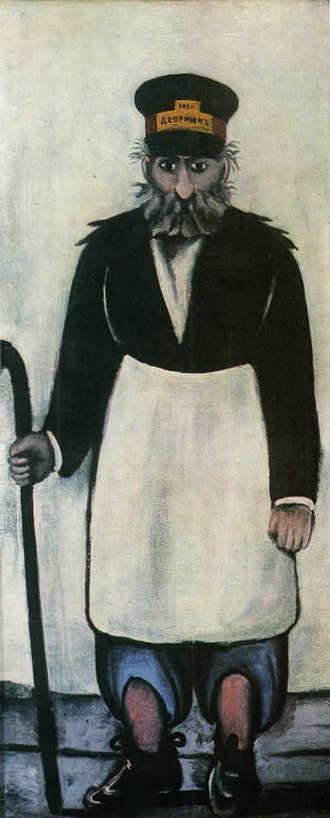
Niko Pirosmani, A Janitor

(Click here for the Romanian version)

This Janitor opens the Arabesques on the Pirosmani Theme. No wonder. Parajanov made this short movie after spending a good part of the 1970's in the detention camps - it sounds now absurd, but the Soviet regime was not willing to tolerate his masterpieces, Tini Zabutykh Predkiv (Shadows of Forgotten Ancestors), and Sayat Nova (even the name of the Armenian troubadour of the XVIII-th century was for them unbearable, so the title was changed to Color of Pomegranates).
So Parajanov knew too well all the facets of the oppression, and this Janitor painted by Pirosmani is a terrific portrait, there is a forceful lesson in it, because this stupid brute is also very human - what we realize with horror is that any of us can become such a janitor, it is enough to get some authority.

And Parajanov's movie stays a lot on the face of the janitor, then slowly comes down to his feet, then again on the face.

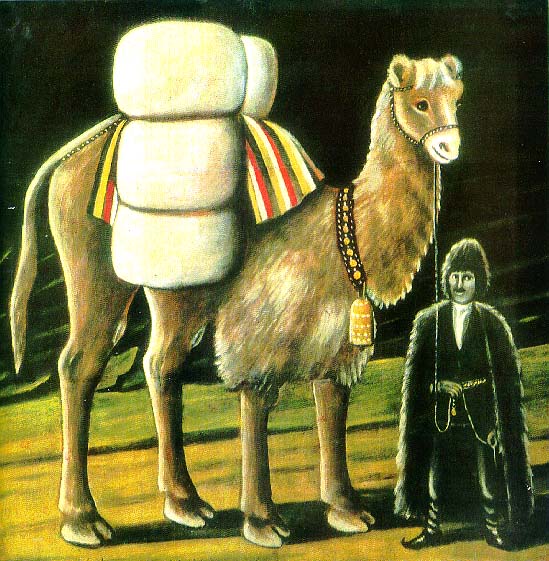
Then follows this camel with its master, an image chosen by Parajanov just to allow us to come back from the Hell. However, there is here a story, between the Tatar and the camel. Pirosmani does not tell us the story, it's left for us to imagine it. What Pirosmani does here is to render a subtle tension which forces us to assume our responsibility of deciding on the story.

Niko Pirosmani, A Tatar Cameleer
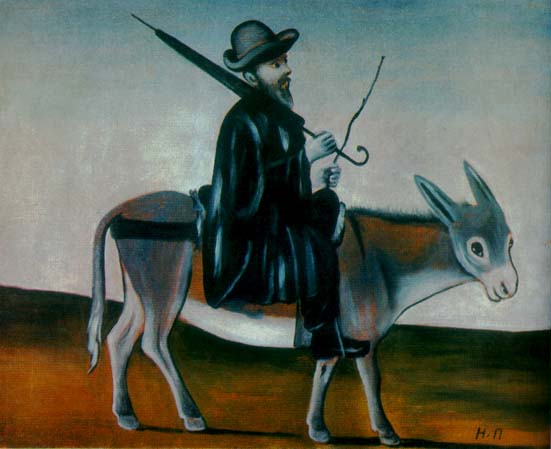
With this physician riding a donkey we are for sure far away from the Hell of the Janitor. Through Pirosmani themes, Parajanov draws the Arabesques on our human nature - there is the evil in us, there are the untold stories, but it is much more, we can be nice, sometimes a bit ridiculous, not necessarily the bad guys.


Niko Pirosmani, Physician on a Donkey

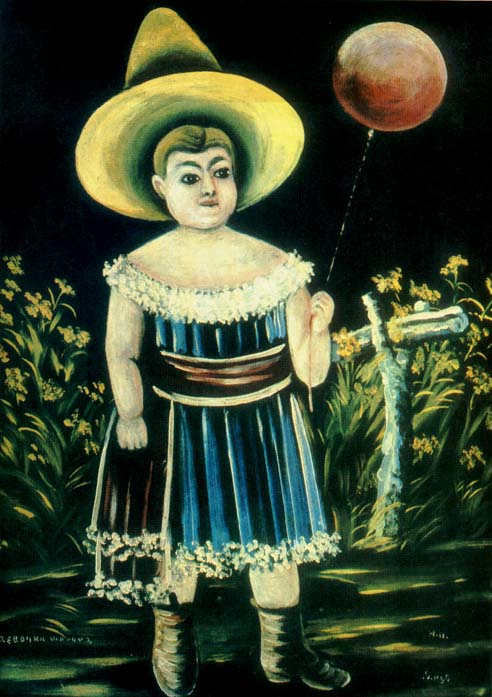
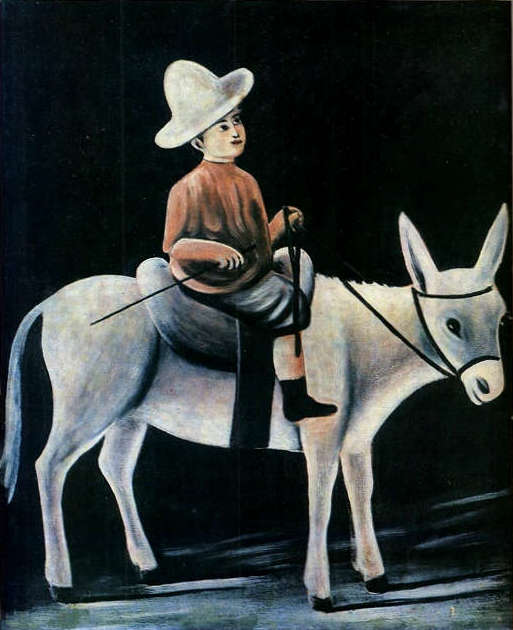
This little girl with a patterned balloon accompanies in the movie the little boy riding a donkey - the two paintings are juxtaposed, so the balloon looks like it is shared by them.

Horror, subtlety, kind irony, delicacy - here is the whole universe of Pirosmani.


Niko Pirosmani, Little Girl with a Patterned Balloon
Niko Pirosmani, Little Boy Riding a Donkey
And Parajanov would make in his last years other two masterpieces, Ambavi Suramis Tsikhitsa (The Legend of the Suram Fortress), and Ashik Kerib.

(Parajanov)

(Pirosmani)

Labels: ,