Updates, Live

Wednesday, January 27, 2016

Monet e Pessoa: Route de Giverny en hiver - A palidez do dia é levemente dourada (Pessoa - como Ricardo Reis - rendido em romeno por Dan Caragea)

Claude Monet, Route de Giverny en hiver
huile sur toile, 1885
collection particulière
(source: devoir de philosophie)
no copyright infringement intended


A palidez do dia é levemente dourada.
O sol de Inverno faz luzir como orvalho as curvas
Dos troncos de ramos secos.
O frio leve treme.

Desterrado da pátria antiquíssima da minha
Crença, consolado só por pensar nos deuses,
Aqueço-me trémulo
A outro sol do que este.

O sol que havia sobre o Parténon e a Acrópole
0 que alumiava os passos lentos e graves
De Aristóteles falando.
Mas Epicuro melhor

Me fala, com a sua cariciosa voz terrestre
Tendo para os deuses uma atitude também de deus,
Sereno e vendo a vida
À distância a que está.


Paloarea acestei zile ușor e aurită.
Al iernii soare face ca roua să sticlească
Un trunchi cu crengi uscate.
Plăpândul frig vibrează.

Din patria credinței străveche exilat
Și împăcat în sine că pot gândi la zei,
Tremurător căldura
O simt a altui soare.

E soarele lucind pe-Acropole, Partenon
Ce luminează pașii domoli și gravi ai lui
Aristotel vorbind.
Dar mie Epicur

Mai limpede-mi vorbește cu glas duios, terestru,
Purtându-se cu zeii asemeni unui zeu,
Senin privind la viață
În depărtarea ei.


(Monet)

(Fernando Pessoa)

(Dan Caragea)

Labels: , ,

Friday, September 05, 2014

Heterotopia (La rencontre des artistes, des poètes, et des sages)

Monet, Voilier au Petit-Gennevilliers
huile sur toile, 1874
(vue du bassin d'Argenteuil en direction de l'aval - Daniel Wildenstein)
shared from the Facebook page of Deborah Shafer-v
no copyright infringement intended


Michel Foucault: Brothels and colonies are two extreme types of heterotopia, and if we think, after all, that the boat is a floating piece of space, a place without a place, that exists by itself, that is closed in on itself and at the same time is given over to the infinity of the sea and that, from port to port, from tack to tack, from brothel to brothel, it goes as far as the colonies in search of the most precious treasures they conceal in their gardens, you will understand why the boat has not only been for our civilization, from the sixteenth century until the present, the great instrument of economic development (I have not been speaking of that today), but has been simultaneously the greatest reserve of the imagination. The ship is the heterotopia par excellence. In civilizations without boats, dreams dry up, espionage takes the place of adventure, and the police take the place of pirates.


Walter Russell Mead: Utopia is a place where everything is good; dystopia is a place where everything is bad; heterotopia is where things are different — that is, a collection whose members have few or no intelligible connections with one another.


Ле́рмонтов: Парус (The Sail)

Белеет парус одинокий
В тумане моря голубом!..
Что ищет он в стране далекой?
Что кинул он в краю родном?..

Играют волны - ветер свищет,
И мачта гнется и скрыпит...
Увы, - он счастия не ищет
И не от счастия бежит!

Под ним струя светлей лазури,
Над ним луч солнца золотой...
А он, мятежный, просит бури,
Как будто в бурях есть покой!
(http://www.balticsealibrary.info/index.php?option=com_flexicontent&view=items&cid=88:russian&id=164:parus-)


- a rendering shared from Deborah Shafer-v:

A lone white sail shows for an instant
Where gleams the sea, an azure streak.
What left it in its homeland distant?
In alien parts what does it seek?

The billows play, the mast bends, creaking,
The wind, impatient, moans and sighs...
It is not joy that it is seeking,
Nor is't from happiness it flies.

The blue waves dance, they dance and tremble,
The sun's bright rays caress the seas.
And yet for storm it begs, the rebel,
As if in storm lurked calm and peace!

- and another rendering by A.Z. Foreman:

A sail drifts white and on its own
Amid the light blue ocean haze.
What does it seek in distant country?
What made it leave its native bays?

Great billows play. High winds are whistling
Down at the bending, creaking mast
Oh! This one seeks no happy ending
And does not flee a happy past.

Beneath, a brighter stream than azure.
Above, the golden sunray flows
Yet this one, restive...quests for tempests
As if in tempests were repose.


(Monet)

(Aivazosky)

(Lermontov)

(Michel Foucault)

(Walter Russell Mead)

Labels: , , , ,

Tuesday, February 11, 2014

Monet Painting In His Argenteuil Garden, by Renoir

Monet Painting in His Argenteuil Garden
a work by Pierre Auguste Renoir
oil on canvas, 1873
Wadsworth Atheneum, Hartford, CT
(http://rememberingletters.wordpress.com/2011/08/)
no copyright infringement intended

Argenteuil used to be a rural escape for Parisians, it is now a suburb of the city. Painters made it famous. Among them Monet and Renoir. Also Sisley, Caillebotte, and Braque (wiki).

And Wadsworth Atheneum is the oldest art museum in the United States. It opened in 1844.


(Renoir)

(Monet)

Labels: ,

Monday, August 05, 2013

A Portrait of Monet by Renoir


(The Moderns)

(Renoir)

Labels: ,

Thursday, January 31, 2013

Henri Fantin-Latour: Un atelier aux Batignolles

Henri Fantin-Latour: Un atelier aux Batignolles, 1870
oil on canvas
Musée d'Orsay, Paris
(http://commons.wikimedia.org/wiki/File:Henri_Fantin-Latour_006.jpg)
(also published on Facebook by Belle Époque Europe)
no copyright infringement intended


Les Batignolles was the district where Manet and many of the future Impressionists lived. Fantin-Latour, a quiet observer of this period, has gathered around Manet, presented as the leader of the school, a number of young artists with innovative ideas: from left to right, we can recognize Otto Schölderer, a German painter who had come to France to get to know Courbet's followers, a sharp-faced Manet, sitting at his easel; Auguste Renoir, wearing a hat; Zacharie Astruc, a sculptor and journalist; Émile Zola, the spokesman of the new style of painting; Edmond Maître, a civil servant at the Mairie de Paris; Frédéric Bazille, who was killed a few months later during the 1870 war, at the age of twenty-six; and lastly, Claude Monet.
Their attitudes are sober, their suits dark and their faces almost grave: Fantin-Latour wanted these young artists, who were greatly decried at the time, to be seen as serious, respectable figures. Only two accessories remind the spectator of the aesthetic choices of the new school: the statuette of Minerva bears witness to the respect due to the antique tradition; the Japanese style stoneware jar evokes the admiration of this entire generation of artists for Japanese art.
In this group portrait exhibited at the Salon of 1870, each man seems to be posing for posterity. The painting confirms the links between Fantin-Latour and the avant-garde of the time and Manet in particular. It echoes Zola's opinion of Manet: Around the painter so disparaged by the public has grown up a common front of painters and writers who claim him as a master. In his diary, Edmond de Goncourt sneered at Manet, calling him the man who bestows glory on bar room geniuses.
(information from the catalog of Musée d'Orsay)


Now, some would ask what's the meaning of the word batignolles. Here you go: according to wiki, the origin of the name "Batignolles" may be the Latin word, "batillus", meaning "mill", or, it may be derived from the Provençal word, "bastidiole", meaning "small farmhouse".


(The Moderns)

Labels: , , ,

Wednesday, September 16, 2009

Monet - Road to Vétheuil

Claude Monet - The Road to Vétheuil, 1879
oil on canvas

Monet lived in Vétheuil between 1878 and 1891. He painted there about 150 tableaux. This one is at Phillips Collection.

(Phillips Collection)

(Monet)

Labels:

Friday, May 16, 2008

A Study for Le Déjeuner sur l’herbe


The two characters are the painter Frédéric Bazille and the future wife of Monet, Camille Doncieux.

In 1866 Monet painted again Camille: the work is known as La Femme à la Robe Verte.


The title sounded mysterious and some thought to associate it with La Dame au Camelias of Dumas-Fils. Probably an association was possible between the two titles, based on beauty and unconditional love (my humble opinion).

Monet survived Camille and painted her on the death bed. Painting was for him like breathing, the only possible way to express himself in any situation.

(In the Forest of Fontainebleau - from Corot to Monet)

(Monet)

Labels:

Thursday, May 15, 2008

Oaks of Fontainebleau - The Bodmer Oak

Firstly I saw this oil of Monet, at the exhibition hosted by the Washington Art Gallery. The title was a bit uncommon: Bodmer Oak. I already knew by that time that the oaks in Fontainebleau could have been fascinating, characters in their own right, with history and all that stuff. Bodmer Oak of Monet was coming after Le Rageur of Corot.

Claude Monet - The Bodmer Oak, Fontainebleau Forest, 1865
New York Metropolitan Museum of Art

However, why Bodmer? There was an explanation: that oak had been famous for the fascination it had had on a Swiss artist who had come times and again over this oak The artist was Bodmer.

I was expecting to find works by Bodmer now, which did not happen. Instead, I came in front of a photo made by Eugène Cuvelier: Beech Trees near the Bodmer Oak.

Eugène Cuvelier - Beech Trees near the Bodmer Oak, early 1860s
Private Collection


And then I saw another depiction of the Bodmer Oak: a cliché-verre, the author was Adolphe-André Wacquez: Bodmer Oak at Bas-Bréau.


Adolphe-André Wacquez - The Bodmer Oak at Bas-Bréau, 1860, cliché-verre
Washington National Gallery of Art

Well, I decided to go on with my search for Bodmer, and at last I found his biography and also some good images, of his works, hosted by museums in Boston, Liege, San Francisco and Paris.
His life was impressive. He participated at a famous scientific expedition on Missouri, between 1832 and 1833. The expedition was lead by Prinz Maximilian zu Wied-Neuwied, the sovereign of a minuscule German principality and a passionated naturalist and etnographer. This was actually the second expedition led by the Prince; prior to Missouri he had been in Brazil (in 1815-1817). Bodmer was only on the second journey, up the river of Missouri (traveling through Nebraska, South and North Dakota, Montana, Wyoming), where took photographs and made sketches: they were included in the book written by the Prince, Maximilian Prince of Wied’s Travels in the Interior of North America.


Charles Bodmer - Barbizon
Musée d'Orsay, Paris


The Prince would travel also to Honduras. As for Bodmer, he would later set to France, at Barbizon. He became a French citizen: and so Karl became Charles. And Charles Bodmer fell in love for the forest of Fontainebleau and for one oak there.

He died at Barbizon in 1893, aged 84.


Charles Bodmer - Oaks and Wild Boars
Boston Museum of Fine Arts


Charles Bodmer - Interieur de foret
Université de Liège


Charles Bodmer - Sketchbook page with turkeys and waterfowl, drawing
Boston Museum of Fine Arts


(In the Forest of Fontainebleau - from Corot to Monet)

(Monet)

Labels:

Thursday, May 24, 2007

Malevich: Thoughts about Monet

Claude Monet, Rouen Cathedral, Wewst Facade, 1894, Washington DC National Gallery of Art
For most people, Monet had, when painting the cathedral, sought to render the lights and shadows on the walls. But they were wrong. In fact, all Monet's efforts had gone into the walls of the cathedral. His main task was not the shadows and the light, but the painting that lay in the shadow and the light... when the artist paints, and he plants the paint, and the object is his flower-bed, he must sow the paint in such a way that the object disappears, because it is merely a ground for the visible paint with which it is painted.
(Malevich - On New Systems in Art, Static, and Speed, 1919)


(Suprematism and Constructivism)

(Monet)

Labels: ,

Saturday, March 17, 2007

Gare Saint Lazare, Paris - Three Moments, Descending in Time

Cartier-Bresson, Behind Gare Saint Lazare, 1932

Cartier-Bresson, 1932


Claude Monet, Gare Saint Lazare, 1877

Claude Monet, 1877


Edouard Manet, The Railroad, 1873

Édouard Manet, 1873


(Cartier-Bresson si momentele lui decisive)

(Manet)

(Monet)

Labels: ,

Monday, September 18, 2006

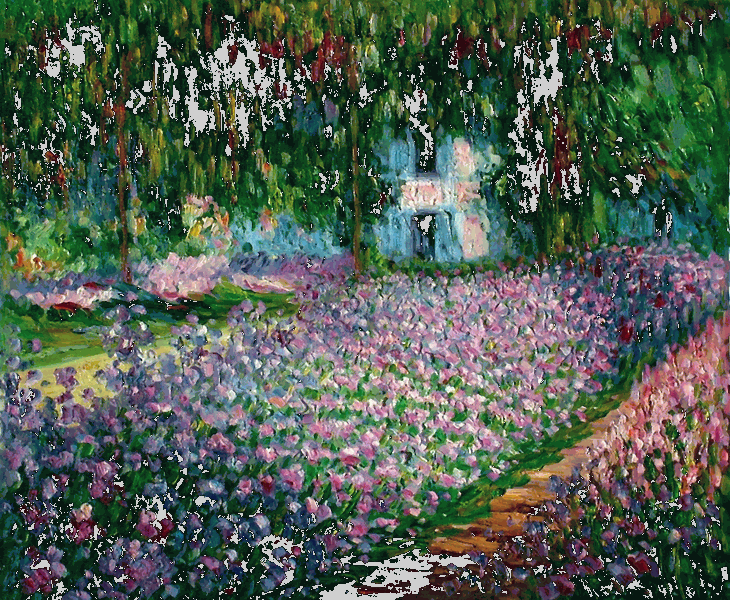
Giverny povestit de catre Jean

Claude Monet, Giverny

In fapt, Giverny este un satuc langa Vernon, in Normandie, la vreo 30 de kilometri de mine. Acolo Monet si-a facut cuibul, acolo a pictat oameni si gradina pana in ultimele lui clipe.
Locul a fost intamaiat de admiratorii artistului care au salvat cu inspiratie si transpiratie aceasta bucata de patrimoniu. A devenit loc de pelerinaj iar americanii si-au infiintat alaturi o colonie de artisti activa, infloritoare.
O prima dilema: cand sa vizitezi casa lui Monet? Raspunsul in epoca in care toate gradinile sunt mai frumose se va tempera prin idiosincrazia de a merge intru impartasire, comunicare cu Arta impreuna - puhoi cu puzderia de mici japonezi fotografianti, de mari americani galagiosi, de docti germani in grupuri compacte si alte numeroase neamuri vorbarete, transpirante, ocupatoare de spatiu si invadatoare de peisaj.
Am vazut coltisorul lui Monet in toate sezoanele. Si cel mai drag mi-a fost in afara lor, ca sa zic asa, primavara devreme.

Acum, ca am decis vizita, uite ce descoperim:

Satucul mic, curatel si verde te conduce prin strazile lungi spre locul magic. O casa mare, destul de oarecare din strada. Cand ii calci pragul insa (dupa mereu existenta coada la bilete) dinspre curte te ia cu piele de gaina. Replonjat inainte cu un secol, te surprinde inca din afara nonconformismul: casa tzipa roz visina-putreda si verde frunza. Fauve avant la lettre. Inauntru, camerele inghetate in timp: mobile simple dar originale, obiecte adevarate, si poze... Si, surprinzatoare iar si de neuitat, bucataria galbena (galben crom) scuturand tipicul si vizitatorul, o camera cu soare din pereti, atat de curajoasa pentru epoca incat te amuza in context vechile, desuetele obiecte centenare...

Clou-ul ramane insa gradina.

In spatele casei, o gradina patratoasa, destul de clasica. Ceea ce azi s-ar numi in Franta un jardin de curé, o gradina din dosul casei parohiale a unui preot de tzara. O gradina structurata pe alei drepte, intre parteruri de flori dintre cele pe care le stim din gradinile bunicilor noastre: trandafiri, petunii, zinii... Deasupra aleilor se incoarda arcuri de trandafiri cataratori. Ici si colo cate un bujor arborescent, o albizzia... O dulce desuetitudine.
E departe, ca sa fiu sincer de imaginea gradinii mele ideale. Daca gradina s-ar opri aici ar fi prea putina materie pentru mine ca sa va relatez de ce iubesc eu locul.

Dar Monet si-a mai cumparat un picior de plai. Devenit, da, a urmat ceea ce presupuneti ! Din fundul gradinii popesti, trecand strada (azi un tunel subterana sigura continuitatea = purgatoriul) ajungi direct in rai!

O gradina fara egal in amintirea celui care sunt, vanator de gradini si vizitator asiduu. O gradina impadurita, cu alei intortocheate, crescuta in jurul unei salbe de lacuri...Gradina cu irisi, cu nuferi (nympheas), cu salcii plangatoare care isi limpezesc coama in ape, tufe inflorate si bambus.
Nu poti simti gradina aceea decat dupa ce ai cunoscut sala Monet la Jeu de Paume la Paris, dupa ce te-ai impregnat de tablourile naturii maestrului. Atunci ai cheia raiului si nu iti ramane decat sa faci preumblarea scaldandu-te in atmosfera care a constituit pretextul creatiei de geniu si gustand nemurirea.

Jean


(Monet)

Labels: