Updates, Live

Thursday, September 21, 2006

Rothko Chapel and the Menil Collection

Rothko Chapel and the Broken Obelisk of Barnett Newman, Houston, Texas
Houston, Texas: the Rothko Chapel, and in front of it the Broken Obelisk created by Barnett Newman to honor the memory of Dr. Martin Luther King.


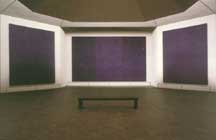
Rothko Chapel, Interior, Houston, Texas
I saw the works of Rothko and Newman at the Washington National Gallery of Art - and there is a small Rothko Room at the Phillips Collection.
Hopefully I will have the possibility to see the Rothko Chapel during my brief staying in Houston.
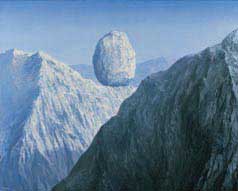
And here three paintings from the Menil Collection, nearby the chapel. Picasso, a Still Life with Skull, then an astoundingly beautiful Magritte, La Clef de Verre, and a delicate Black Leaf on Green Background, painted by Matisse.
I leave you with them, I will be back at the end of next week.

Picasso, Nature Morte au Crâne, 1945, Menil Collection, Houston, Texas
Magritte, La Clef de Verre, 1959, Menil Collection, Houston, Texas
Matisse, Black Leaf on Green Background, Menil Collection, Houston, Texas


(René Magritte)

Labels: , , , ,

Sunday, November 25, 2007

The Rothko Room


Phillips Collection gathered Mark Rothko's works in a special space: the Rothko Room. People come here to meditate for a few moments.

Last year I had the opportunity to be for a day in Houston, Texas, and I went there to the Rothko Chapel. It was an unforgettable experience.

This Rothko Room at Phillips Collection is much smaller: there is the same atmosphere.


(Phillips Collection)

Friday, April 13, 2007

Un băiat pe care îl chema Gogol

imagine din film
Afisul filmuluiUn băiat pe care îl chema Gogol - o însemnare făcută de o adolescentă pe un blocnotes - aşa a început, cu ani buni în urmă, povestea unui roman şi a unui film.
Un băiat pe care îl chema Gogol, una din acele fraze care se nasc odată la o sută de ani. Câţi scriitori nu şi-ar da ani buni din viaţă ca să aibă geniul unei asemenea frânturi de frază? Adolescenta de atunci este azi autoarea a două cărţi uluitoare.
Jhumpa Lahiri, născută în Londra, fiica unor imigranţi veniţi din Calcutta - băiatul pe care îl chema Gogol era de fapt un alter-ego al ei, copil de imigranţi veniti din India - şi a simţit că trebuie să scrie o carte despre căutarea identităţii proprii, despre universurile paralele în care trăim - părinţii ei din Calcutta, ea avea să păstreze oraşul în sufletul ei - pretutindeni va fi în noul loc, dar şi în Calcutta.
Aşa a început romanul, cu o frază notată pe blocnotes, un băiat pe care îl chema Gogol - peste ani fraza va fi înveşmântată într-un roman, The Namesake. Va fi a doua ei carte, după o culegere de povestiri, Interpreter of Maladies.
Şi într-o seară va primi un telefon de la regizoarea Mira Nair, care o va ruga să accepte o ecranizare a romanului.
Mira Nair, născută în India, trăind acum în America. Experienţă asemănătoare.
Ce putea să aducă Mira Nair peste bogăţia romanului?
Filmul, The Namesake (Tizul), este o poveste spusă de imagini - iar Mira Nair este o gurmandă a imaginii - în faţa unei fotografii cu un T-shirt atârnat la uscat pe o sârmă în faţa unei case din Calcutta gândul o duce la pictorul Mark Rothko, la acele color fields ale lui.
Dacă pentru Jhumpa Lahiri romanul a început cu obsesia unor cuvinte, un băiat pe care îl chema Gogol, pentru Mira Nair, filmul a început, în capul ei, cu obsesia unei imagini, iată cum o povesteşte, de altfel (într-un articol din revista FLM):
As I prepared to make The Namesake, I had an idea for a frame: an image of a dusky Bengali beauty against a Mark Rothko painting in a sleek Madison Avenue space. Then, looking through a book of photographs by Raghubir Singh from the 1980s, I came across a startling image of a red T-shirt drying on a flaking Calcutta ironwork railing, decaying Edwardian columns looming in the background. In its rich swath of color amid the layering of centuries, I realized that Rothko was alive and well in modern-day Calcutta. Raghubir’s photograph was among the first signs for me that The Namesake could be made in an austere photographic style. With the great cinematographer Fred Elmes by my side, we conceived each scene as a series of wide-angle shots, “democratic frames” within which the actors, not the camera, would move in a choreographed swirl.
Un T-shirt atârnat la uscat, în spate o casă cu coloane edwardiene delabrate, intuiţia fulgerătoare că Rothko continuă să trăiască în Calcutta de azi - intuitie care apare tot la o sută de ani odată.
A rezultat un film care este o superbă meditaţie în imagini - universul american în care se ţese obsesiv universul de acasă - imaginea New Yorkului recreându-se în imagine a Calcuttei, şi apoi revenind. Ca norii plutind pe cer şi schimbându-şi neîncetat forma.
Am pornit să văd filmul având în cap o idee despre el. Insă era o idee greşită. Filmul nu este centrat pe băiatul numit Gogol - este centrat pe mama băiatului - în jurul ei se întâmplă toate - ea suportă cel mai greu condiţia de imigrantă - pentru că ea îi înţelege pe toţi cei din jurul ei şi suferă pentru fiecare. Iar universurile cele multe se oglindesc în ea, şi arată aşa cum le vede ea.
Şi filmul îl decantezi după aceea în tine, zile întregi, te urmăreşte şi te pătrunde tot mai adânc.
O poveste în imagini care, ele, meditează povestea - o poveste despre imigranţi şi copii de imigranţi, despre identitate, despre căutări şi iluzii, despre înţelepciunea de a-ţi aminti atunci când eşti mai nefericit despre clipele când ai fost fericit - pentru că ele sunt hrana binecuvântată, hrana de suflet pentru totdeauna. Şi despre înţelepciunea de a le lua pe toate aşa cum sunt şi de a socoti fiecare zi ca un dar de la viaţă.
Ce se întâmplă în film? Se întâmplă multe, fără o logică anume - pentru că povestea este lăsată să curgă în voia ei - pentru că viaţa îşi are o bogăţie care este de capul ei - nici o poveste nu trebuie să încorseteze viaţa - o poveste trebuie să urmărească cu empatie viaţa, atât.
Este un lucru pe care l-a inţeles cândva de mult un mare scriitor - şi toţi scriitorii de după aceea au ieşit din mantaua lui.
Iar băiatul pe care îl chema Gogol, născut in America, având o mama al cărei accent o va trăda toată viaţa, acest băiat care va îmbătrâni şi el odată cu povestea, căutându-şi identitatea şi rostul, va înţelege aşa cum tuturor ne vine rândul să înţelegem, va întţelege că viata nu este uşor de înţeles - va înţelege însă dece tatăl său ţinuse să îi dea numele de Gogol - şi va înţelege dece toţi am ieşit din Mantaua lui Gogol.


(Jhumpa Lahiri)

(Filmofilia)

(Gogol)

Labels: , ,

Sunday, July 09, 2006

Andre Kertesz, Mondrian's Glasses and Pipe

Andre Kertesz, Mondrian's Glasses and Pipe

Through its simple means, pure abstract art can attain the objectivity of ornament, the purity of geometric construction, the spontaneity of the child. But to be art, the subjective must be manifested through the objective, the apparently mathematical must be free, spontaneity must be consciously expressed.
Piet Mondrian, 1929

I was today at the Phillips Collection to see again the two compositions by Piet Mondrian they have there. Geometrical abstractionism? Minimalism? His compositions consist of rectangular forms of red, yellow, blue, or black, separated by thick, black, rectilinear lines. What is there, beyond this extreme simplicity?

Piet Mondrian, Composition No. III, 1921-25, Phillips Collection, Washington DC I believe, said Mondrian, it is possible that, through horizontal and vertical lines constructed with awareness, but not with calculation, led by high intuition, and brought to harmony and rhythm, these basic forms of beauty, supplemented if necessary by other direct lines or curves, can become a work of art, as strong as it is true.

Mondrian's art is intimately related to his spiritual preoccupations - he was extremely interested in theosophy. Helena Blavatsky (her work had a profound influence over Mondrian) believed that it was possible to attain a knowledge of nature more profound than that provided by empirical means. How?

If we look for the reality, then we should free ourselves from the tyranny of objects - and while the literature language is one of words, the language of music is one of sounds - so, the language of paintings should be one of shapes and colors - to see through them the reality beyond the objects - is that the lesson taught by Mondrian?

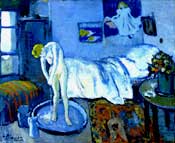
The two compositions by Mondrian are to be found usually in the same room with a couple of works by Paul Klee, and a splendid Blue Room, by Picasso.


Picasso, The Blue Room, 1901, Pillips Gallery, Washington DC
Only today the arrangement was changed. The Blue Room of Picasso was in another place - and the works of Klee were also moved - there was a Paul Klee exhibition, with works gathered from different American museums and collections.

Stuart Davis, Still Life with Saw, Phillips Collection, Washington DC Today I found Mondrian in the company of Stuart Davis (Still Life with Saw). Two other works of Stuart Davis (Blue Cafe and Corner Cafe) were in another place, near a room devoted entirely to Soutine.

Phillips - the collection of masterpieces in downtown DC - Giacometti, de Kooning, Pollock, Gottlieb, Noland, Modigliani, Matisse, Cezanne (Mont Sainte Victoire, reminding me by some curios association the Mount Fuji of Hokusai), Braque, Rouault (with a portrait of Verlaine), Degas, Vuillard, Bonnard, Redon, Van Gogh ...Siskind, Kline ... a Repentant Saint peter by El Greco, and a replica by Goya ...

And I like John Sloan with his Staten Island ferry-boat.

And the Rothko room ... they had in mind the Mark Rothko - Barnett Newman Chapel from Houston, Texas, that I saw only in albums.

At the entrance of the Collection, a bronze by Arp, a Helmeted Head, with strong influence of Brancusi.

As for Paul Klee, let's talk about him in another post ...


(Phillips Collection)

Labels: ,

Sunday, August 21, 2011

Wong Kar-Wai: Fallen Angels (1995)


It's kind of exhausting and kind of exhilarating. It will appeal to the kinds of people you see in the Japanese animation section of the video store, with their sleeves cut off so you can see their tattoos. And to those who subscribe to more than three film magazines. And to members of garage bands. And to art students. It's not for your average moviegoers—unless of course, they want to see something new.

Almost manga-like in camera style and story telling (I mean manga as in Akira and Ghost in The Shell). Very colorful yet dark, explicit yet tender, soft and violent. You're sucked in by the nostrils, visually shaken about and taken for a very exciting trip into hyper-sub-reality. The daylight at the end has the same effect as the dish cleaning and lights on after a very good party. Very sobering. The movie leaves you with the feeling of having had a vigorous massage and wanting more. More Wong Kar-Wai.

And there is the real star, the traum-city itself. Corridors, subways, neon, time lapse, travelators and low flying jets, trains, shopping arcades, Chung King Mansions stuffed to the gullets with sullen, sweating people cooled by antique electric fans, the scheming tattooed triads, outbursts of random violence, warehouses, chopping knives, video cameras, motorbikes speeding through tunnels, the multiracial hand in hand with the super-commercial... Hong Kong insinuates itself into our imaginations as the Űbertraumstadt, the place of ultimate nightmare and ultimate romance, where beauty is all the more poignant for its dark, cheap, pitiless setting and dreams are all the more necessary.

Bringing a manga to the screen leads to a movie that's structured like a manga, which is far different from the structure of a novel. Manga means cartoons with a few explanatory text. Such a structure is by its nature extremely elliptic, leaving the details unexplained and assuming the active participation of the reader (viewer) who should fill the gaps and make the links. More than that, actually a manga offers only the essential elements, you are to imagine the story behind.


Fallen Angels (墮落天使 - Duo luo tian shi): like the companion movie (Chungking Express), it's a pure cinematographic gem born unexpectedly. Wong Kar-Wai and Chris Doyle were working on Ashes of Time, and the project was exhausting. They decided suddenly to put Ashes of Time on hold and to produce quickly something light, unpretentious, just to warm their spirits. There was no script, just a loose idea: some slices of life in today's Hong Kong, kind of romantic comedies with young heroes hanging around Chungking Mansions and Midnight Express. Two vignettes were made this way, with young cops falling in love, drug dealers wearing sun glasses and blond wigs, barmaids becoming flight attendants and flight attendants returning from San Francisco: this was Chungking Express, released in 1994.

As the third vignette was unfolding, it became clear for the director that the mood of the story was different, and it deserved a separate movie: that was Fallen Angels, released in 1995. Two completely distinct plots evolving in parallel, and intertwining only in brief moments and only by hazard. A young hitman getting his assignments through a fax machine and a sympathetic and totally immature mute (played with irresistible charm by Takeshi Kaneshiro, who was also an irresistible cop-in-love in Chungking Express).

Well, a mute cannot talk, everybody knows it, but what happens in Fallen Angels is that actually nobody seems able to communicate through human speech. The agent (Michelle Reis - I saw her also in Flowers of Shanghai) who gives the assignments to the hitman (and even visits his narrow apartment when he is out) is a gorgeous girl, unconditionally in love for his subordinate. However she never meets him and prefers to masturbate instead. It is a terrifying impression of loneliness in a frenetic city, everybody is alone there, on her or his own, deepened in her or his own thoughts and dreams, and everybody's dreams seem crazy while only dreams keep you there to not get crazy.

I remember the cabs in a region I used to live for many years: the driver had a small computer on board and all communication with the dispatcher was through the screen, no room for bargaining of any kind, no space for any human feeling, of joy or sorrow, of sympathy or sarcasm. Here in Fallen Angels it's the fax machine, the same sensation of alienation, of loss of humanity. Humans transformed in robots, keeping their human condition for themselves only, through masturbating dreams of impossible love.

And it remains the city itself. Mark Rothko (Jacob Baal-Teshuva: Mark Rothko, 1903-1970, Pictures as Drama, Taschen, 2003, p.27) has a great observation about the relation between foreground and background in an art work: sometimes the personages (or the objects) have only the function to glorify the background (... may limit space arbitrarily and thus heroify his objects. Or he makes infinite space, dwarfing the importance of objects, causing them to merge and become part of the space world). The same observation is somehow made by Malevich when analyzing the way Monet had rendered the Cathedral of Rouen: ...when the artist paints, and he plants the paint, and the object is his flower-bed, he must sow the paint in such a way that the object disappears, because it is merely a ground for the visible paint with which it is painted (Gilles Néret: Kazimir Malevich, 1878-1935, and Suprematism, Taschen, 2003, p.13).

Is this movie about people alienated by Hong Kong, or is it here a meditative poem about the city itself? One of the personages in the movie has an unexpected sentence, Buddha said, If I don't descend into hell, who will? The sentence passes quickly and seems at first sight without any meaning in the logic of the story. Maybe it offers the clue: Hong Kong, this space of hyper-sub-reality (as one of the reviewers puts it), this Űbertraumstadt of ultimate nightmare (apud another reviewer), actually offers the image of hell, and the heroes of the story descend there, why? To follow the archetype?

And if we go again to the observation made by Malevich on Monet and Rouen Cathedral, here in Fallen Angels subject and city disappear in the gorgeous cinematic language: a great movie pushing the cinematic language to its ultimate expression. A couple of great creators: Wong Kar-Wai and Chris Doyle. Let me add here that another great contemporary cinematographer was also part in the team: Mark Lee Ping-Bin.

And if I were to choose an image from Fallen Angels, this one would be: the city in the night with its endless traffic and movement and changing lights, near the narrow apartment where the hitman inspects quietly the fax machine.


墮落天使 (Fallen Angels): Part 1/10
(video by tooomat)


墮落天使 (Fallen Angels): Part 2/10
(video by tooomat)


墮落天使 (Fallen Angels): Part 3/10
(video by tooomat)


墮落天使 (Fallen Angels): Part 4/10
(video by tooomat)


墮落天使 (Fallen Angels): Part 5/10
(video by tooomat)


墮落天使 (Fallen Angels): Part 6/10
(video by tooomat)


墮落天使 (Fallen Angels): Part 7/10
(video by tooomat)


墮落天使 (Fallen Angels): Part 8/10
(video by tooomat)


墮落天使 (Fallen Angels): Part 9/10
(video by tooomat)


墮落天使 (Fallen Angels): Part 10/10
(video by tooomat)


-----

Some useful links:


(Wong Kar-Way and Chris Doyle)

Labels: ,

Tuesday, October 23, 2007

Phillips Collection

Phillips Collection


View across the street


(Washington, District of Columbia)

Tuesday, August 12, 2008

Clyfford Still at Hirshhorn


(Musical Background: Schubert, Symphony No. 5 in B flat major, D. 485 II. Andante con moto, Philharmonia Cassovia)

Clyfford Still is often considered on the same page with Mark Rothko and Barnett Newman. Actually he is different. Look a bit closer at his paintings: you'll see there shapes that have a figurative meaning.


1948-C, 1948
oil on canvas


1950-M No. 1, 1950
oil on canvas


1960, 1960
oil on canvas


1960-R, 1960
oil on canvas


1962-D, 1962
oil on canvas


(Hirshhorn Museum)

Wednesday, August 15, 2007

Washington Color School

Kenneth Noland - April, 1960
When I saw firstly this April painted by Kenneth Noland I thought at the Targets of Jasper Jones, only Noland is different, with his delicacy of the blue. While Jones is in search for the place of the objects becoming images and symbols and loosing their concrete reality, Noland is rather preoccupied with understanding the place of the spaces within the universe: spaces of light blue and dark blue, and green, and yellow, spaces fighting with other spaces, each one trying to impose its color over the other .

Here is another painting by Noland, where the spaces gave up their fight - there is a suggestion of a goal here, a goal to be fulfilled by these spaces, arranged in perfect shape, V behind V, behind V, light yellow and bright yellow, and light gray, and black, and red...


Kenneth Noland - Untitled, 1978
In the paintings of Gene Davis spaces became stripes. He was persuaded with finding equivalences between musical and pictorial rhythms. I was looking at his Red Devil, made in 1959: each of the stripes would have no meaning if we were to forget the whole, each stripe had meaning only related to the others: and the relation was the rhythm, the pictorial rhythm.

Gene Davis - Red Devil, 1959
Phillips Collection hosted an exhibition of the artists known as belonging to the Washington Color School. This exhibition was for me an interesting road from Noland and Gene Davis to Paul Reed. I will explain a bit later what I mean.

Anyway, I found on this road Willem de Looper, with Kiri Te and Sur, in which he follows Rothko, only I know that he tried also other directions.


Willem de Looper - Kiri Te, 1972
Willem de Looper - Sur, 1975

There was then Sam Gilliam. Look at his Red Petals. The first association to be made would go to Georgia O'Keeffe: at Phillips you'll find a Pattern of Leaves created by her. She declared once that only by selection, by elimination, by emphasis, we get at the real meaning of things (Phillips).

Only the Red Petals of Gilliam call other name in mind: a filmmaker, Stan Brakhage and his Dante Quartet. A movie of six minutes only, and hand painted, like so many of the works of Brakhage. It is of a painstaking beauty, and it expresses a closed-eye vision; and here is also the secret of the Red Petals of Gilliam: it is a pursuit of his interior states, it is programmatically subjective. Hypnagogic versus anagogic: it was the anagogic, the transcendental what Georgia O'Keeffe was looking for, while Gilliam (and Brakhage) were trying to express their own perception, as close to the total openness as possible.


Dante had been an obsession for Brakhage since high school. And after long years of reading various translations of the Divine Comedy, Brakhage realized that the words were no more necessary: he had the pictorial image of the whole poem. The cercles of Hell, Purgatory and Paradise were now image, color, and rhythm: and Brakhage started to work on his movie. It took a good couple of years to make a movie of six minutes: images hand-painted on the film, in vivid colors, and editing them to make them dance, dilate, contract. Editing like composing tape music: changing speeds, inversing, filtering. There are moments the image implodes, collapses, it remains the empty screen, then it explodes again in a symphony of colors. The Quartet: four progressive stages, Hell Itself, Hell Spit Flexion, Purgation, Existence is Song. The journey starts in Hell


Nel mezzo del cammin
di nostra vita,
mi ritrovai per
una selva oscura...

and you pull up yourself, stage by stage, up to the place where you discover the sense of life: Existence is Song. The movie was finished in 1987.


Sam Gilliam - Red Petals
Alma Thomas, with her Breeze Rustling Through Fall Flowers, made in 1968: the stripes from the works of Gene Davis became here pieces of mosaic. An universe of tiny spaces with random shapes. If you consider these pieces of mosaic as microstructures, the whole is much more than the sum of the components. You should consider each piece also as an event that evolves randomly and change the global behavior: so you will see each time the mosaic differently.

Alma Thomas - Breeze Rustling Through Fall Flowers, 1968
At Howard Mehring the spaces were no more vertical. They were trying to make agreements with each other, compromising on color and position. Each one had to guard the boundaries, to gain the right for a reserved tiny spot in the center. And this organization of spaces was suggesting the beginning of a story: the painting was subtly trying to leave abstractionism.

Howard Mehring - Untitled
As I was approaching the end of the road through the exhibition I found two acrylics of Thomas Downing: Dream Rate and Tsivory. The real objects had been abandoned by abstractionists, and for good reason; circles and stripes had taken their place - now the circles were starting to look for a story of their own, they were becoming objects.

Thomas Downing - Dream Rate, 1962
Thomas Downing - Tsivory, 1972

And at the end of the road I found Paul Reed with his No 22A: now the circles were clear objects and there was a clear plot. Abstractionism was now synthesizing its own objects. Yes, it was the end of the road. For the Washingtonian colorists it was the ultimate stage, as in Brakhage's movie: Existence is Song.

Paul Reed - No 22A, 1963


(By Brakhage)

(Contemporary Art)

Monday, June 01, 2015

René Magritte


(Contemporary Art)

Labels:

Sunday, October 01, 2006

Intalniri neasteptate cu romani - Victor Brauner

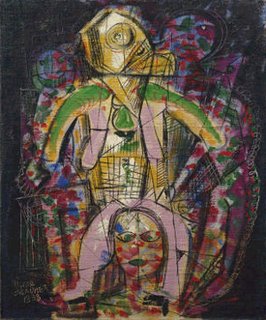
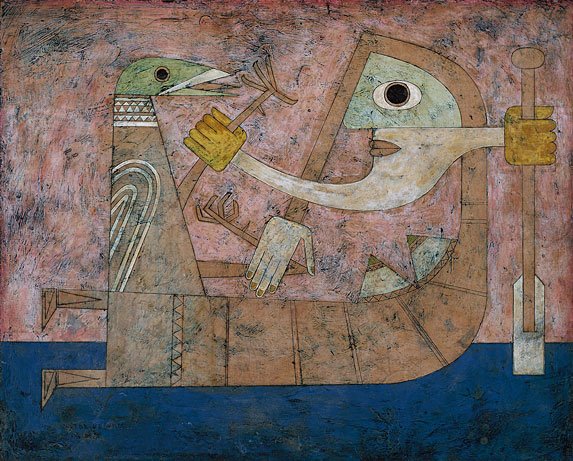
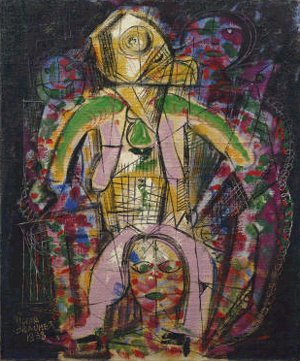
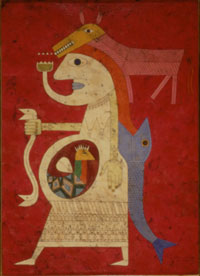
Victor Brauner, La Bas, Menil Collection
Aflat pentru o zi in Houston, am vrut neaparat sa vizitez capela Rothko si colectia de arta John si Dominique de Menil. Era un vechi vis al meu.

Ma aflam acum in cladirea colectiei Menil, stiam de picturile lui Picasso, Magritte si Matisse aflate acolo. Asteptarile mele erau depasite. Erau numai lucrari de mare valoare - si erau multe. Picasso dupa Picasso, Magritte dupa Magritte, Max Ernst, foarte multe lucrari de Max Ernst, cateva lucrari superbe ale lui Noguchi - pe care le stiam de la o expozitie care calatorise prin New York si Washington ... si deodata m-am aflat in fata unei lucrari de Victor Brauner.

Am tresarit de emotie. Am simtit ca eram cumva la capatul unui drum care incepuse cu vreo cinci ani in urma, la Bucuresti. Prin 2001 am vazut prima oara lucrari de Brauner - o expozitie cuprinzatoare organizata in fostul Palat Regal, in aripa dinspre biserica Kretzulescu.

Revenisem de cateva ori la expozitia Brauner - erau lucrari aduse din toata lumea, si cuprindeau intreaga lui creatie.
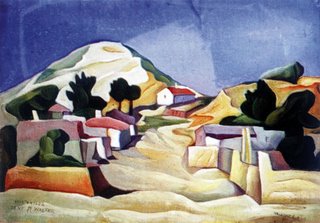
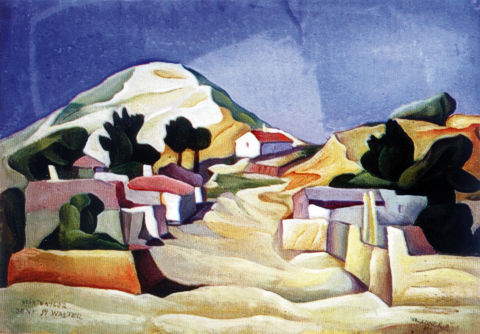
Victor Brauner, Peisaj dobrogean, 1920


Imi amintesc de acest peisaj din Dobrogea, pictat de maestru in 1920, l-am regasit acum cateva zile pe web si mi-am amintit de el - se afla in expozitia de la Bucuresti.


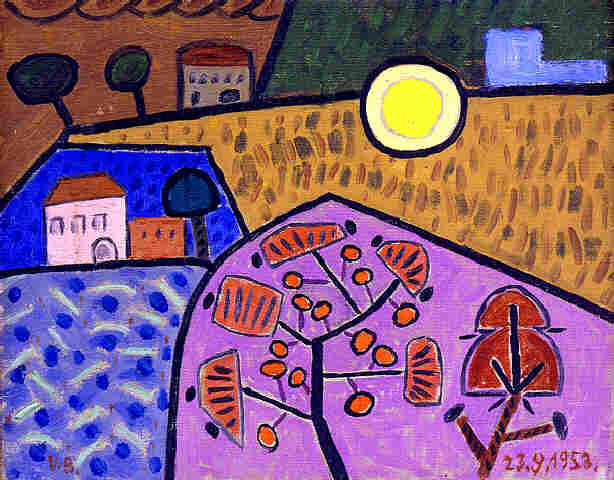
Dupa cum imi amintesc si de peisajul pictat de Brauner in 1953 - aflat si el in expozitia de la Bucuresti.
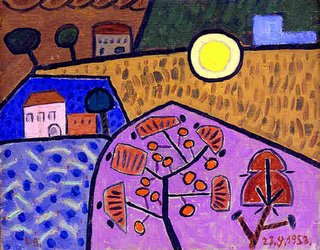
Victor Brauner, Peisaj, 1953

Fusesem vrajit de evolutia artei lui Brauner - cele doua peisaje erau despartite de treizeci si trei de ani de cautari, de subtile deplasari ale accentelor, ale discursului pictural. Picasso spunea undeva, la cinci ani desenam ca Rafael, mi-au trebuit foarte multi ani sa ajung sa desenez ca un copil. Cat de bine se potrivesc vorbele aceste si in cazul lui Victor Brauner! Peisajul din 1953 era o sinteza de mare sinceritate artistica, era arta in starea de gratie - universul lui Brauner era de acum eliberat de orice retinere, de orice zgura pe care o aseaza anii peste puritatea inceputurilor.

Imi amintesc ca una din picturile expuse la Bucuresti cuprindea cateva cuvinte puse acolo de Brauner, la somnambule ouvre l'imagination du poète qui se sent emporté par la puissance du sommeil, sensul lor nu imi era foarte clar, dar cuvintele acestea aveau parca o vraja a lor, o magie, mi le-am notat si mi-am promis ca voi reveni asupra lor.
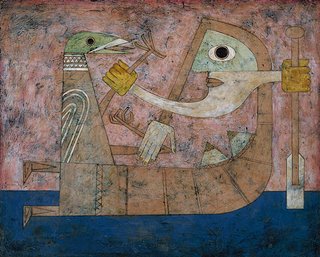


Consciousness of Shock, 1951, New York, Guggenheim Aveam sa ma reintalnesc cu opera lui Victor Brauner la New York, la Museum of Modern Art si la Galeria Guggenheim. Pictura din stanga, aflata in galeria Guggenheim, a fost pictata in 1951 - dimensiuni ale spatiului mitic egiptean devenite dimensiuni ale universului artistic al lui Brauner.
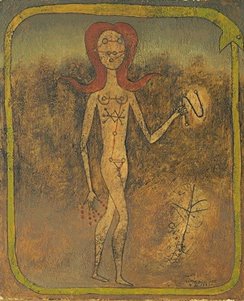


Victor Brauner, La Psylle Miraculeuse, 1943, New York Museum of Modern Art
Pictura din dreapta, creata in 1943, aflata la Muzeul de Arta Moderna din New York, o imblanzitoare de serpi.


Aveam sa incep sa il inteleg mai bine atunci cand am inceput sa vad lucrari de-ale lui Joan Miró si mai ales cand am aflat de lucrarile pictoritei Remedios Varo.
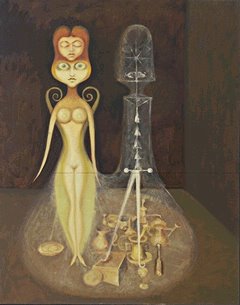


Victor Brauner, La Vie Interieure, 1939,  New York Museum of Modern Art
Universul lui Remedios Varo, spiritul ei, sunt atat de aproape de cautarile si obsesiile artistice ale lui Victor Brauner! Pictura din stanga, aflata la Muzeul de Arta Moderna din New York, a fost pictata de Brauner in 1939. Va fi vazut-o oare Remedios Varo? Aceeasi senzatie ca te afli in laboratorul unui alchimist, acelasi simt teribil al enigmei!


Si acum ma aflam la Houston, in fata unei lucrari a lui Brauner - cuvintele acelea in franceza, notate de mine cand vazusem expozitia la Bucuresti, la somnambule ouvre l'imagination du poète qui se sent emporté par la puissance du sommeil, mi le aminteam acum si intelegeam sensul lor - pentru ca opera lui Brauner este o explorare activa a oniricului, a inconstientului - un drum de eliberare din chingile realului, care ne limiteaza deschiderea spre Univers. Iar acolo, in lumea visului si a inconstientului, cufundarea in ocult si in spatiile spatiile mitice devine fireasca si totodata fertila - Victor Brauner a reusit sa fuzioneze in opera lui elemente de mitologie azteca si egipteana, hindusa si iudaica, si nu numai.

Acum, aflat la Houston, intelegeam ca eram la sfarsitul unui drum spre intelegerea dimensiunilor artei lui Victor Brauner - iar colectia Menil, cuprinzand exclusiv capodopere, il aseza pe Brauner pe locul care este al lui - unul din marii artisti ai secolului douazeci - si aveam sa inteleg ca prin Victor Brauner, (si prin Brancusi, prin Eliade, prin Eugen Ionescu) cultura romaneasca intra in constiinta universala.
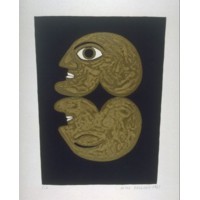


Victor Brauner, Double Head, 1963, Fine Arts Museum of San Francisco
Am gasit apoi pe web alte cateva opere ale lui Brauner si le asez aici - ele inlesnesc intelegerea universului unui artist covarsitor.

(Intalniri neasteptate cu Romani)


Victor Brauner, Fascination, 1939, San Francisco Museum of Modern Art
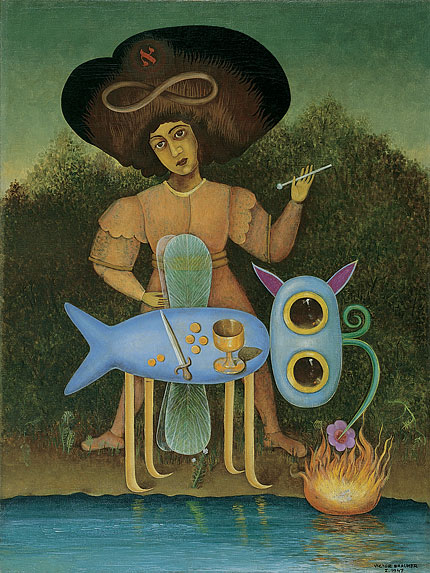
Victor Brauner, Le Surrealiste, 1947, Guggenheim, New York

Victor Brauner, Prelude to a Civilization, 1954, Metropolitan Museum of Art, New York


Victor Brauner, Talisman, 1943, New York Museum of Modern Art

Victor Brauner, Untitled, 1938, New York Museum of Modern Art

Wednesday, September 20, 2006

San Antonio

San Antonio River Walk
A new trip in Texas, starting this Friday. We are two, attending next week a training course in Dallas. We will leave early in the morning. The flight will take around three hours. As soon as we are on the Dallas-Fort Worth airport, we will start driving toward San Antonio. They say the river walk there is fabulous, and hopefully there would be the chance of a boat ride.

I'm just reading the history of the place. River Walk, Paseo del Rio, the first document about is from 1536 - written by Alvar Nuñez Cabeza de Vaca, a shipwrecked captive of Indians.
June 13, 1691, Padre Damian Massanet celebrated here a mass and renamed the stream San Antonio, because it was Saint Antony's day.
And the history went on, in 1821 Mexico gained its independence from Spain, in 1825 US immigrants reached the settlement fo San Antonio and began purchasing land, in 1830 Mexico declared US immigration illegal, in 1836, after fierce battles, Texas gained its independence from Mexico, the border was on Nueces River, in 1845 Texas became a component of the US. The Mexican War followed, the peace treaty would set the things: besides Texas, US took California, Arizona and New Mexico. The Texas border would be from now on Rio Grande.

I've just passed on another web site - here is the history of the siege of Alamo:

In December 1835, Ben Milam led Texian and Tejano volunteers against Mexican troops quartered in the city. After five days of house-to-house fighting, they forced General Marín Perfecto de Cós and his soldiers to surrender. The victorious volunteers then occupied the Alamo — already fortified prior to the battle by Cós' men — and strengthened its defenses.
On February 23, 1836, the arrival of General Antonio López de Santa Anna's army outside San Antonio nearly caught them by surprise. Undaunted, the Texians and Tejanos prepared to defend the Alamo together. The defenders held out for 13 days against Santa Anna's army. William B. Travis, the commander of the Alamo sent forth couriers carrying pleas for help to communities in Texas. On the eighth day of the siege, a band of 32 volunteers from Gonzales arrived, bringing the number of defenders to nearly two hundred. Legend holds that with the possibility of additional help fading, Colonel Travis drew a line on the ground and asked any man willing to stay and fight to step over — all except one did. As the defenders saw it, the Alamo was the key to the defense of Texas, and they were ready to give their lives rather than surrender their position to General Santa Anna. Among the Alamo's garrison were Jim Bowie, renowned knife fighter, and David Crockett, famed frontiersman and former congressman from Tennessee.
The final assault came before daybreak on the morning of March 6, 1836, as columns of Mexican soldiers emerged from the predawn darkness and headed for the Alamo's walls. Cannon and small arms fire from inside the Alamo beat back several attacks. Regrouping, the Mexicans scaled the walls and rushed into the compound. Once inside, they turned a captured cannon on the Long Barrack and church, blasting open the barricaded doors. The desperate struggle continued until the defenders were overwhelmed. By sunrise, the battle had ended and Santa Anna entered the Alamo compound to survey the scene of his victory.


And then we will visit Houston, with its Rothko Chapel - on Sunday evening we will be in Dallas, as our training starts on Monday. It will the whole next week.

Tuesday, June 27, 2006

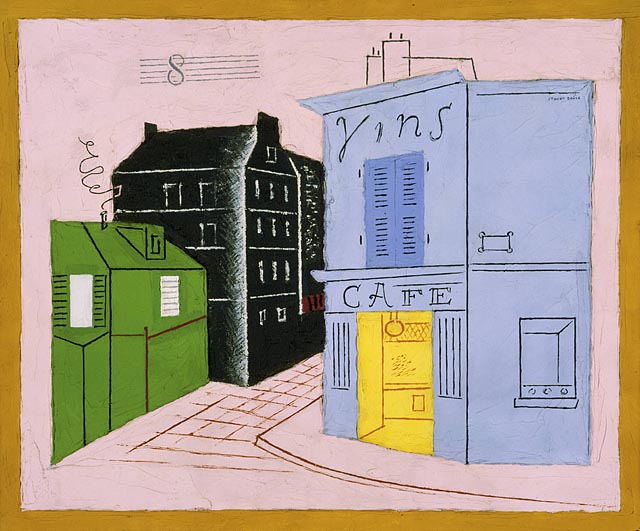
Stuart Davis, Blue Cafe and Corner Cafe

Stuart Davis, Blue Cafe, 1928, Phillips Collection, Washington, DCStuart Davis, Corner Cafe, Phillips Collection, Washington DC


I had the feeling that this was the best place in the world for an artist to live and work ... The prevalence of the sidewalk cafe was an important factor. It gave easy access to one's friends and gave extra pleasure to long walks through various parts of the city ... There was a seeming timelessness about the place that was conducive to the kind of contemplation essential to art.

Stuart Davis, Autobiography


Everyone heard about the Washington National Gallery of Art. Few know about the Phillips Collection. It's a much smaller gallery, close to DuPont Circle. Each artist is represented by few works, each one is a masterpiece. Paul Klee, Piet Mondrian, Stuart Davis, Oskar Kokoschka ... A Picasso from the blue period (The Blue Room), a splendid Pattern of Leaves by Georgia O'Keeffe, a Hopper (an image near Penn Station in New York), a Sloan (the Staten Island ferryboat), an amazing Rothko room, then Renoir, Cezanne, Degas ... A Repentant St. Peter by El Greco, in another room a Repentant St. Peter by Goya ... An exhibition just started, Klee in America, with works gathered from other American museums and collections.

DuPont Circle - with the coffee house, with the Kramer Books, with the Phillips Collection - with the entire bohemian atmosphere around the huge fountain and then on the Connecticut Avenue - you feel a kind of Parisian esprit there.


(Phillips Collection)